

Isometric exercises include strength-training movements in which muscles are stretched to their full length and position at the joints without any change. The exercises are characterised by tension when they are holding a position, making them effective in the strengthening of stability as well as endurance with minimal equipment. Isometric exercises can be performed anywhere; they can be put together with dynamic exercises and done daily, as they can be done on planks, or squat holds, and push-up pauses, among others and can be done anywhere provided they are programmed correctly. They would be best suited to give better muscle control, strength and overall efficiency in the workout.
- What are Isometric Exercises?
- The main Characteristics of Isometric Exercises
- Advantages of Isometric Exercises during training.
- Isometric Exercise Types
- Whole Body isometric exercises
- What is the Maximum Time of Isometric Exercises?
- The Organisation of an Isometric Workout
- Isometric Exercises at Home
- Common Mistakes to Avoid
- Isometric Exercises
- What is the frequency of isometric exercises?
- Isometric Exercises with Progress
- Final Thoughts
- Frequently Asked Questions
What are Isometric Exercises?
Isometric exercises refer to the type of exercise where the muscle contracts, but no joint under its control is seen to move. The term isometric also has Greek roots that simply mean equal length, i.e. the length of the muscle that remains constant throughout the contraction. This is what gives it the name isometric exercise; the muscle is in effect generating a force without either lengthening or shortening.
This, in real-life application, involves standing in a pose like a plank, wall sit, or squatting position. These exercises are also referred to as static strength exercises since there is no movement involved. In strength training, isometric training is widely done to enhance the tension of the muscles, to provide stability in appropriate positions, and to gain strength at individual angles of joints.
The main Characteristics of Isometric Exercises
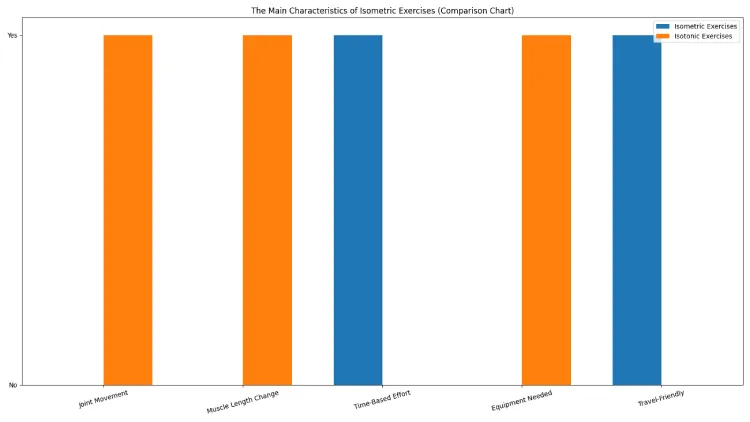
Isometric exercises are characterised by their simplicity and effectiveness. The characteristics that identify them include:
- Without joint movement, muscle contraction occurs.
- During the hold, there is tension.
- Time-based effort as opposed to repetition-based.
- Low equipment or no equipment needed.
- Good at home, at the gym or travelling.
Due to their properties, isometric exercises find numerous applications in yoga, strength training, rehabilitation-like workouts, and athletic conditioning training.
Advantages of Isometric Exercises during training.
These exercises also have various training advantages in their routine. Greater strength at certain points is one of the primary benefits that can literally boost results in dynamic exercises such as squats, presses, and lunges.
There are other advantages, such as Strengthening of muscles.
- Greater muscle strength.
- Better body control and posture.
- Enhanced core stability
- Less stress on the joints than the heavy dynamic lifting.
- Improved mind muscle relationship.
Isometric exercises can be used in strength maintenance, and doing moderate-intensity exercises daily will not overload the muscles. Nonetheless, agility on balance as well as dynamic motion is required to develop muscles completely.
Isometric Exercise Types
Isometric exercises may be categorised by the muscle groups they act on or the method of doing the exercises.
1. Isometric exercises of the upper body.
Isometric exercises of the upper body make the arms, chest and back stronger without the repeated movement.
- Plank Hold (Arm Emphasis): This activity uses the shoulders, chest, and arms, as well as keeping a straight posture. It is among the most effective examples of isometric exercises that may be used to ensure upper-body stability.
- Wall Push Hold: The chest, shoulders and triceps are under constant tension, though the chest, shoulders and triceps are not moving.
- Isometric Bicep Hold: The half curl pose is effective to train the biceps, as well as to enhance grip strength.
2. Isometric Lower Body Strengthening Exercise.
Isometric exercises of the lower body are some of the best exercise types that may be used to develop the endurance of the legs and stability of the joints.
- Wall Sit: Wall sits, which work the quadriceps, glutes, as well as the calves, are one of the most billed isometric exercises. The movement is usually employed to show how squats can be isometric in positioning as opposed to repetitive.
- Isometric Squat Hold: The isotonic movement occurs during squats up and down, whereas the isometric one is maintained at the bottom.
- Calf Raise Hold: The stance of a calf raise with the top on it enhances the strength and balance of the ankle.
3. Core Isometric Exercises
Isometric exercises that are core-oriented form the basis of almost any kind of training.
- Forearm Plank: It is very much regarded as among the best exercises that will activate the core completely, as an isometric exercise.
- Side Plank: Tensioning the laterals and enhancing the stability.
- Hollow Body Hold: This hold is also a common element of gymnastics-style training that works core deep muscles.
Whole Body isometric exercises
Isometric exercises with the rest of the body involve the use of more than one muscle group simultaneously.
- Static Lunge Hold: There is involvement of legs, hips, and core in addition to enhancing balance.
- Isometric Push-Up Hold: Halfway through the push-up will strengthen and make the upper body endurance.
- Farmer’s Carry Hold: It is a pose that helps to strengthen grip, shoulders, and core at the same time.
What is the Maximum Time of Isometric Exercises?
The isometric exercises depend on the level of experience and the targets of training.
- Beginners: 10–20 seconds
- Intermediate: 20–40 seconds
- Advanced: 40–60 seconds or more
The bulk of isometric exercises is carried out in 2-4 sets. Longer holds enhance muscular endurance, whereas stronger contractions in shorter holds enhance strength.
The Organisation of an Isometric Workout
Various forms of isometric exercises can be designed depending on your regimen.
Option 1: No-resistance Workout
An isometric-only exercise is all about holding poses and thus is best on recovery days or when it is not a strenuous workout.
Option 2: Isometric Finisher
Post-dynamic movement addition leads to greater time under tension, which is achieved by adding isometric exercises. As an illustration, the completion of squats by squat hold consolidates the strength at the greatest point of the lift.
This is compatible with organised training regimes like the 5-3-1 rule or 4-8-12 rule, in which isometric holds may be used to supplement conventional sets.

Isometric Exercises at Home
Isometric exercises are highly efficient in-house exercises since they need very minimal space and do not need any equipment. One can do dozens of variations on a wall, floor, or chair. This causes them to be applicable in a hectic schedule and minimal daily workouts.
They are also usually incorporated into yoga classes, with positions that entail extended stillness. Although yoga consists of movements, most of the poses are not dynamic, but they are essentially isometric.
Common Mistakes to Avoid
To do isometric exercises properly, you should not make the following mistakes:
- Breathing in quick bursts as opposed to breathing consistently.
- Irregularities of posture when in the hold.
- Employing a bulky locking of joints.
- Too soon ended without due tension.
- Proper methodology guarantees an enhanced outcome and minimisation of superfluous exhaustion.
Isometric Exercises
- Isometric exercises contrast with the isotonic (dynamic) exercises in which muscles shorten and lengthen during exercise.
- Isometric: stiff poses, no action.
- Isotonic: up and down activities.
Both forms are essential. Squats, bench presses, and deadlifts are isotonic, but the paused forms of these exercises are isometric. This balance enhances strength gain in an imbalanced way.

What is the frequency of isometric exercises?
The isometric exercises may be done regularly. Light holds can be performed on a day-to-day basis, but the vigorous ones should be restricted to 35 times a week at maximum. It is safe to do isometrics daily, provided that the volume and the intensity are moderated.
Bench pressing every day is also a source of fatigue in the case of pressing movement, unless intensity is decreased. Light effort isometric holds will not damage muscle gain, as they can help in recovery and technique.
Isometric Exercises with Progress
The progress of isometric exercises can be maintained by:
- Increasing hold time
- Adding resistance
- Doing single-arm holds.
- Reducing rest periods
These techniques allow sustaining the constant strength gain without the use of greater loads.

Final Thoughts
Isometric exercises are a flexible and powerful type of strength training which develops muscular tension without motion. They enhance strength, stability and endurance with a minimal load put on the joints. Isometric exercises are important in balanced training programs, whether done individually or used in combination with dynamic exercises.
When they are conducted properly and regularly, they prove helpful in building strength in the long term, improving control, and proving to be perfectly compatible with almost every type of workout or program.
Frequently Asked Questions
1. Which would be the most appropriate example of an isometric exercise?
One of the most effective isometric exercises is the plank hold since the exercise involves the simultaneous activation of many muscle groups, and the body is constantly stationary. Squat holds and wall sit can be made very effective in the development of strength and endurance.
2. Is it possible to do the isometric exercises daily?
Isometric exercise is something one can do every day, provided that it is done in moderation and with reduced hold periods. More tense or lengthy holds are supposed to be repeated several times in a week to enable the muscles to rest.
3. What is the best duration of isometric exercises?
The usual isometric exercises take 20-60 seconds per set. The novices can begin with shorter holds and build longer as the muscles get stronger and become more controlled.
4. Is it better to use isometric exercise than dynamic exercise?
There is no difference between isometric and dynamic exercises, but they are used for varying purposes. Isometric holds strengthen at a certain point, whereas the dynamic exercises strengthen with full ranges of motion. The combination of the two is the most effective.