

Dumbbell shoulder exercises are also very flexible, effective and ideal in cases where the individual requires strength, body or tightness in the shoulders. These exercises exercise all three heads of the deltoid, are better at improving posture, developing functional strength, and can be modified to home workouts, gym workouts, beginners, advanced lifters, women, and the senior population. With presses, raises, and isolation movements, every individual can realise the balanced development of the shoulders safely and efficiently.
- Such exercises are highly flexible
- Essential Dumbbell Shoulder Exercises
- How to organise a Full Dumbbell Shoulder Exercises Workout
- Shoulder Exercises at Home with Dumbbells
- The best tips for optimal shoulder growth
- Advanced Techniques
- Frequency, Recovery and Overtraining
- Who Can Benefit from Dumbbell Shoulder Exercises?
- Common Mistakes to Avoid
- Conclusion
- Frequently Asked Questions
Such exercises are highly flexible
- Lighter weights, 5-10 kg, can be used by beginners to achieve controlled form.
- The intermediate lifters will be able to add the loads and add tempo methods of hypertrophy.
- Advanced lifters may use heavier dumbbells, high intensity or complicated training programs such as 7-7- 7 or 4-2- 1 tempo.
- Sculpted and toned shoulders Women can target more reps with medium weight.
- Moderate weights and controlled movements can help older adults (50+) to stay strong and remain mobile.
- A twenty to thirty-minute workout of dumbbell shoulder exercises can prove to be impressive, provided it is done correctly using progressive overload with enough rest.
Essential Dumbbell Shoulder Exercises
Dumbbell Shoulder Press
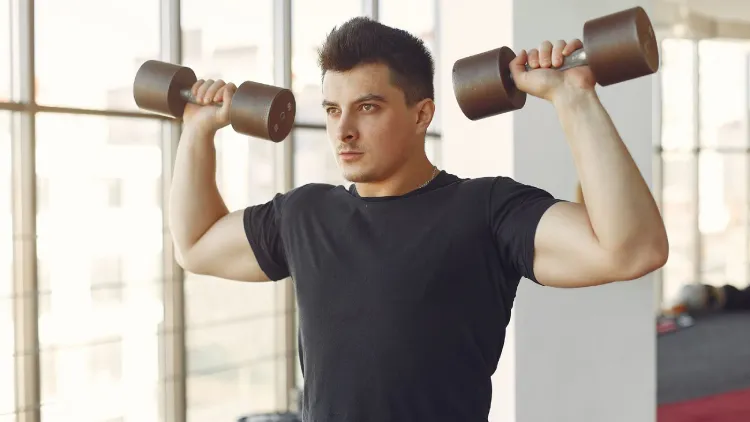
The dumbbell press exercise is sometimes called the king of all the shoulder exercises since it targets all three heads of the deltoid, including the anterior, lateral and posterior and involves triceps as well as the upper chest.
How to perform:
- Seat or stand with a dumbbell in both hands at a shoulder level.
- Punch overhead till the arms are completely stretched.
- Slowly and gradually bring it back to the starting point.
- Repeat for 3–4 sets of 8–12 reps.
Variations:
- Single-arm shoulder press: This involves training one arm of the body at a time, enhancing balance and stability.
- Sit-On press: MMinimisesforce and enables the use of greater weight.
- Standing press on the house: works on core muscles as well as shoulders to lift it.
The given exercise can be adjusted to any fitness level. Even 5kg dumbbells should be sufficient to help beginners gain strength and endurance. In the case of advanced lifters, hypertrophy may be enhanced by the use of 10 20 kg dumbbells.
Arnold Press
The Arnold press is a type of shoulder press that is named after Arnold Schwarzenegger and is performed by rotating the wrists on the lift. It is a workout which activates all three deltoid heads and enhances the shoulder movement.
Execution:
- Grasp dumbbells at the level of the shoulders, with palms turned to each other.
- Turn your palms outwards and squeeze the dumbbells.
- Decrease, then turn upside down to the point of origin.
- Complete 3 sets of 10–12 reps.
The movement is good to make the shoulders balanced, and it may be performed standing or sitting. The single-arm variations can be used to focus more attention on each shoulder, which removes muscle imbalance and enhances coordination.
Lateral Raises
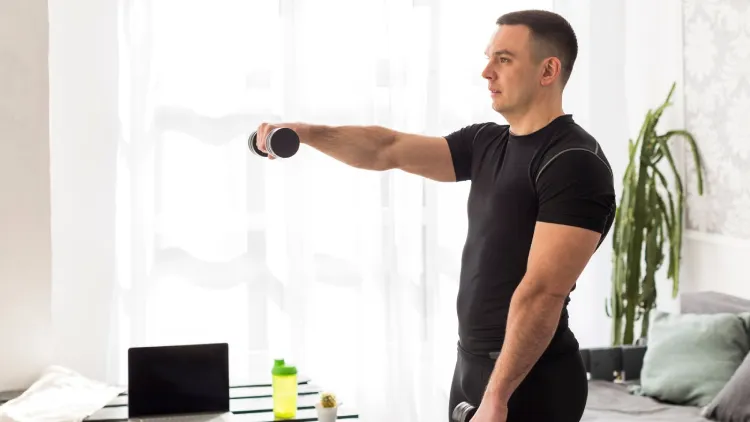
Lateral raises are the only muscles that can be considered to be isolated because they form the shoulder width and appearance of a better upper body.
How to perform:
- Keep dumbbells next to your side with palms facing inwards.
- Lift the dumbbells up to the level of your shoulders, keeping the elbows slightly bent.
- Slowly decrease to the beginning.
- Perform 3–4 sets of 12–15 reps.
Single dumbbell lateral raises can be a good choice in home workouts since they do not need a lot of space and equipment. The exercise also suits women who want to train their shoulders and sculpt them without having to bulk.
Front Raises
The front raises work mostly on the anterior deltoids, and they are crucial in pressing and stabilising the shoulder.
Execution:
- Grasp the dumbbells before your thighs.
- Strauss to the shoulder.
- Bring it down gradually to the beginning.
- Perform 3 sets of 10–12 reps.
The exercise is a complement to presses and lateral raises, making sure that the development of the shoulders will be full. It is also possible to use single-arm variations to pay more attention to weaker sides.
Bent-Over Reverse Fly
The posterior delts are very important in posture, shoulder wellbeing and harmonious aesthetics. The traps and upper back stabilisers are also worked with the bent-over reverse flies.
Execution:
- Stand with bent knees on the dumbbells.
- Bend slightly, and raise the arms to the shoulder.
- Slowly bring it down to the starting position.
- Perform 3–4 sets of 12–15 reps.
This exercise will help avoid front-to-rear delt imbalances that will decrease the likelihood of shoulder injury in case your routine is dominated by pressing exercises.
Front-to-Lateral Combo Raises
The combination of this is to bring the dumbbells forward and to the sides, striking both the anterior and lateral delts. It is also good in time saving exercises or at home, where one is looking at a minimum work out equipment.
How to organise a Full Dumbbell Shoulder Exercises Workout
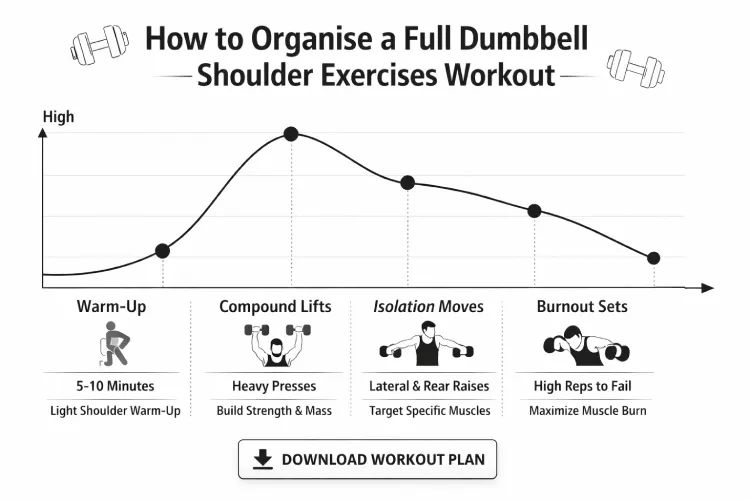
An inclusive routine must include presses, lifts and back delt exercises:
- Dumbbell Shoulder Press 3 sets of 8-12 reps.
- Arnold Press – 3 sets of 10–12 reps
- Lateral Raises – 3 sets of 12–15 reps
- Front Raises – 3 sets of 10–12 reps
- Bent-Over Reverse Fly -3-4 sets of 12-15 reps
The combination will engage all seven large shoulder muscles: the anterior, lateral and posterior deltoids, and the supporting rotator cuff and stabiliser muscles. Tempo exercises such as 4-2-1, 3-3-3, or 7-7-7 are increasingly effective in time under tension, which is crucial to the development of strength and size.
Even brief and sharp exercises of 20 minutes can be effective at stimulating the shoulders if they are done in proper shape and intensity.
Shoulder Exercises at Home with Dumbbells
Home workouts are not any worse than those done in the gym when one uses dumbbells. You will find a lot of exercises that do not need a bench, and just one or two dumbbells:
- Single-arm shoulder press
- Lateral raise variations
- Front raises
- Bent-over reverse fly
These movements have the ability to flex in small areas and give full deltoid activity. Proper forms of GIFs or videos can be added to make beginners perform exercises safely.
With the little equipment, you will be able to adhere to a systematic routine which takes into account every shoulder, head and develops strength effectively.
The best tips for optimal shoulder growth
- Progressive Overload: Add weight or repetitions gradually to trigger hypertrophy.
- Controlled Movements: do not be used with momentum; instead, do slow and controlled lifts, which make maximum muscle involvement.
- Equal Routine: Work all anterior, lateral, and posterior delts.
- Rest: The rest time between sessions is 48 hours (shoulders); otherwise, they may become overtrained.
- Weight Choices: Begin to use light weights, but then move to 10 -20 kg dumbbells to develop hypertrophy.
- Even mini dumbbells (510 kg) may yield some visible outcomes when combined with increased reps or tempo exercises. The factors that impair muscle gains are overtraining, insomnia, and non-consistency.
Advanced Techniques
- 7-7-7 Workout: Pick up, hold and lower dumbbells every seven seconds to lengthen time under tension.
- 30/30/30: 30 seconds of lifting, 30 seconds of holding, 30 seconds of lowering; works well in endurance and hypertrophy.
- Big 4 Exercises: A shoulder routine should consist of four exercises, i.e. shoulder press, lateral raise, front raise and rear delt fly.
Such techniques are very good when being used by more advanced lifters or when one is out to build efficient and effective shoulders.
Frequency, Recovery and Overtraining
Shoulders are smaller muscles than legs or chest are. Growth only requires 2-3 times of training a week.
Overtraining can lead to:
- Persistent soreness
- Reduced performance
- Fatigue and risk of injury
The progress will be optimally maximised by tracking your progress, not lifting heavy materials every day, and engaging in mobility exercises. Growth is also supported by recovery techniques such as stretching and foam rolling, in addition to sufficient sleep.
Who Can Benefit from Dumbbell Shoulder Exercises?
- Women: Build and become lean.
- Noobs: Start with light weights to develop base strength.
- Advanced Lifters: Progress in terms of hypertrophy involving heavier weights and speed exercises.
- Older Adults (50 years of age and above): Be strong, mobile, and stable.
Even brief, properly designed sessions prove very effective, and dumbbells can be considered one of the most useful devices at any level.
Common Mistakes to Avoid
- Doing shoulder overtraining in a day.
- Excessive weight is used, which is detrimental to form.
- Neglecting posterior delts
- Skipping warm-ups
- Movements based on momentum and not controlled.
The symptoms of overtraining are tiredness, chronic soreness, and loss of strength. To be able to monitor recovery is one of the paramount reasons to be able to grow sustainably.
Conclusion
Dumbbell shoulder exercises can be considered as one of the most multifaceted and productive exercises to build strong, defined, and healthy shoulders. With the integration of presses, lateral and front raises, and rear delt movements, it is possible to train all three deltoid heads and supporting muscles.
Having the right form, regulated tempo, gradual overload, and rest, dumbbells enable anyone, be it an amateur or experienced lifter, to develop his/her shoulders in a safe way, with balance. Single-dumbbell exercises, home exercises and gym exercises can deliver identical advantages.
Regular workouts enhance power, stance, and beauty besides reducing the risk of injury. You would like tight, modeled or larger shoulders, dumbbells can give you a feasible, versatile and most efficient option.
Frequently Asked Questions
1. What is the frequency of dumbbell shoulder exercises?
It is best to train the shoulders 2-3 times a week so as to have enough rest and, at the same time, develop strength, definition, and not overtrain them.
2. Do women develop shoulder tone without gaining bulk?
Yes, moderate weights with a greater number of repetitions create and train the shoulders with less bulk, and all deltoid heads are safe.
3. Can you do dumbbell shoulder exercises at home?
Absolutely! Shoulder exercises, such as presses, raises, and rear delt exercises, can be done in their full range using single or paired dumbbells without going to the gym.
4. What are the dumbbells I need to begin with?
Novices may start with 510 kg; intermediate lifters may start with 10-15 kg; advanced lifters may start with 20kg or above in order to build strength and muscle.