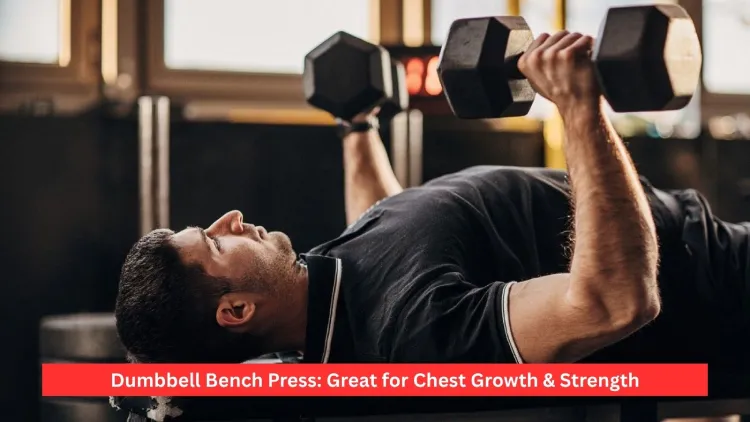

The dumbbell bench press is one of the most effective exercises in creating chest strength, size, symmetry and stability of the muscles. It offers a more natural and expanded variety of movement compared to barbell pressing and allows beginner and experienced lifters to move at their own pace with pinnacle weight training. You can train your chest with dumbbells alone, get the maximum out of them, with a correct form, progressive overload, rest and continuity. The article hypothesises on how to do the exercise properly, the appropriate weight to use, why some lifters fail to gain chest growth and how this type of movement compares to other chest-building methods.
- What Is the Dumbbell Bench Press?
- Muscles Worked
- How to Do a Dumbbell Bench Press
- Advantages of Dumbbell Bench Press
- Dumbbell bench press Variations
- Common Mistakes to Avoid
- Tips for Better Performance
- What is the Right Amount of weight?
- Is it possible to Train Your Chest With Dumbbells Only?
- Why the Dumbbell Bench Press is one of the best chest builders
- Final Thoughts
- Frequently Asked Questions
What Is the Dumbbell Bench Press?
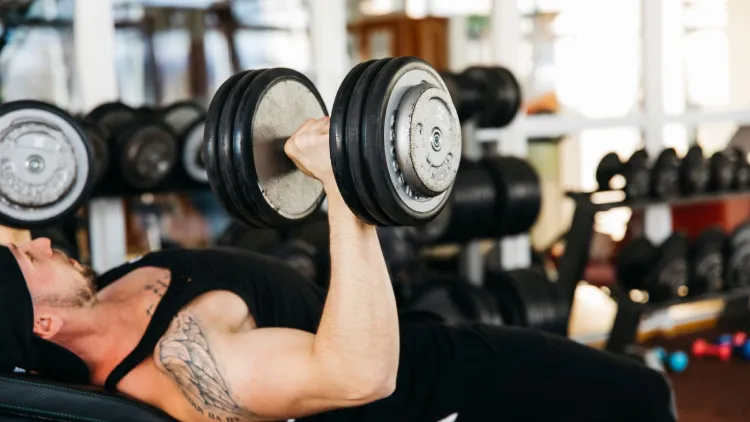
The dumbbell bench press is a strength-training exercise that is performed by lying flat, inclining forward or lying on the back of the bench and pressing the dumbbells upwards, starting at the chest level. This free-weight movement causes a deeper activation of the pectoral muscles and enables a deeper lifting stretch at the bottom. One of the reasons why it is regarded as more joint-friendly and muscle-activating as compared with many of the machine-based versions is this extended range of motion.
Such exercise is known to be very effective as it puts a strain on stabilisation muscles. Although the barbell pressing can be used to load heavier, the dumbbell bench press would promote controlled and stable movement, tension, and specific activation of the chest. That is why it is often suggested, even in the advanced ones, like the 5-3-1 strength method and other progressive overload systems implemented by the athletes.
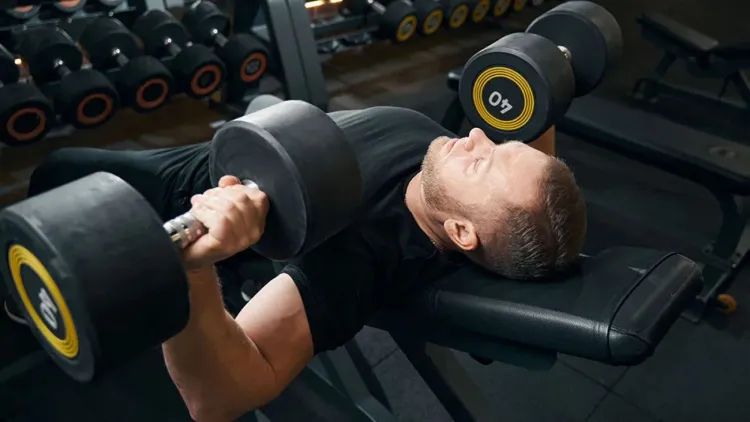
Muscles Worked
The chest is the primary area of the dumbbell bench press, whereas minor muscles are also involved in this exercise:
Pectoralis Major (Chest)
This is the main muscle that is being exercised. The use of dumbbells makes a more complete stretch and contract, leading to improved chest hypertrophy with equal development between upper and lower fibres.
Front Shoulders (Anterior Deltoids)
Dumbbells are raised and supported using the shoulders. Efficient shoulders will increase an efficient press.
Triceps Brachii
The triceps stretch the arms in the press and assist in a firm lockout.
Stabilizer Muscles
The scapular muscles, forearms and core also play an essential role in ensuring that the motion is smooth and controlled. This extra movement also benefits the growth of a better overall upper body.
How to Do a Dumbbell Bench Press
It is important to use the right form of safety and improvement. Poor pressing mechanics result in many chest plateaus.
The following is a stepwise breakdown that is clean:
- Sit on the bench, keeping dumbbells on your thighs.
- Do with the weights at the chest level with a movement on the back.
- You should place your feet on the floor, and your shoulders should be pulled back.
- Lift the dumbbells off the ground in the even arc, noting to never get in touch with one another.
- Bend them down gradually to produce tension in the muscles on the bottom.
- Repetition with a steady rhythm that should be controlled.
The appropriate form of the dumbbell bench press ensures the prevention of shoulder problems and also helps to maximise the involvement of the chest. That is why this is a basic chest lift in the opinion of experienced bodybuilders.
Advantages of Dumbbell Bench Press
1. Greater Range of Motion
This pressing allows one to move more deeply at the bottom, allowing this exercise to have an edge over machine and barbell pressing.
2. Remediates Strength Imbalances
The movement of the arms is independent, and all the sides are forced to develop symmetrically.
3. More Joint-Friendly
Dumbbells will help your wrists and elbows to take a natural course that will cause less strain.
4. Establishes Balance and Management
The muscles to be stabilised will be made tougher in that there is no well-developed bar route.
5. Efficient in All Fitness Levels
Weak trainees may start with light weights, and those who have become advanced can use heavy dumbbells to do difficult sets.
Dumbbell bench press Variations
- Incline Dumbbell Bench Press: Stresses the upper chest and can be used to enhance high-pressure strength and form.
- Decline Dumbbell bench press: Targets the lower chest muscles, and might be more relaxed on the shoulders.
- Neutral-Grip Press: Favourable for persons with shoulder pain and enhances triceps activity.
- Single-Arm Press: Enhances the essential involvement and detects areas with weaknesses.
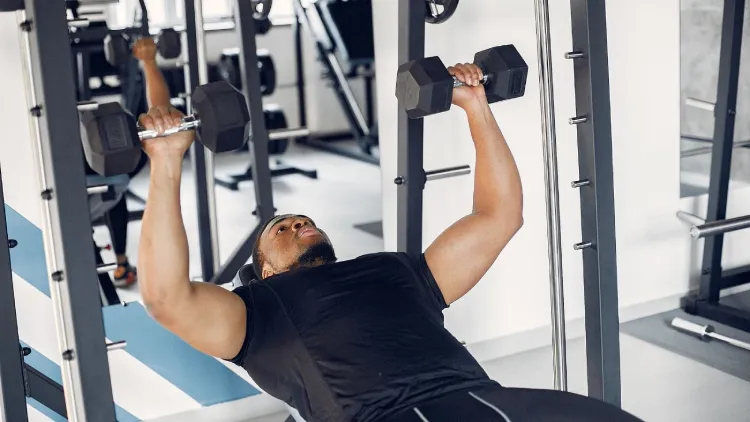
Such variations are also advantageous to the lifters who might be feeling their chest is not growing, and enable them to train at different angles and eliminate training gaps.
Common Mistakes to Avoid
Lots of lifters have inadequate chest development since they make preventable mistakes:
- Heavy weights are used.
- Flaring elbows excessively
- Poor shoulder positioning
- Running through exercises without straining.
- Poor rest between the chest sessions.
The rest is important – a majority of the population trainings always respond better with 4872 hours of rest before retraining the chest. The body cannot grow without having proper rest.
Tips for Better Performance
- Above all, warm up your shoulders and chest.
- Draw the shoulder blades firmly into position.
- Keep your feet well to the ground.
- Home in on the reduction of the dumbbells gradually.
- Use progressive overload
- Permit your chest to stretch all the way to the bottom.
Regularity is greater than employing the gravest dumbbells. Nevertheless, it is important to make the right weight choice to move forward.
What is the Right Amount of weight?
The type of dumbbell weight selected should be determined by experience, body weight and objectives.
A good starting point of 20kg dumbbell bench press can be regarded as good for beginners, provided that form is correct. Light loads will be used by some of these beginners, and others- particularly people of the athletic type- can comfortably use 20 kg.
Depending on their strength, intermediate lifters usually use 2635 kg dumbbells. Elite athletes can press 40kg and above in one hand, and this needs good control and shoulder stability. A 30 kg dumbbell with most people is sufficient to achieve significant chest development. Even 20 kg dumbbells might have the ability to gain new muscle, particularly using progressive overload, slower setup repetitions or increased training volume.
The realistic target of the dumbbell press will be 50-70 per cent of their bodyweight sum (both dumbbells), as an individual weighs around 70 kg. Nevertheless, the advancement depends on the experience during training, genes, and the method.
Is it possible to Train Your Chest With Dumbbells Only?
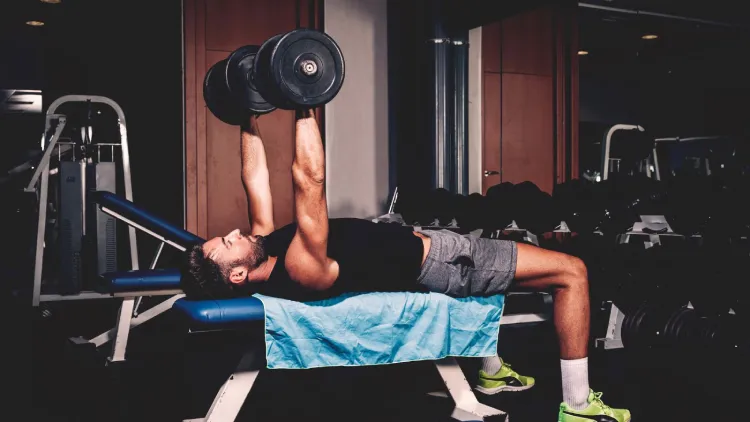
Yes–some weight lifters work out the predominant summons of the chest with dumbbells alone. It has been established that dumbbells can successfully trigger muscle growth when applied properly, since they help to enhance stretch, tension, and stabilisation. They also reduce the imbalance in barbell pressing.
Some athletes and celebrities train on the dumbbells almost solely in the chest, and there are those who engage in using them together with a barbell or a machine. Progressive overload and not equipment is the key determinant.
Why the Dumbbell Bench Press is one of the best chest builders
The dumbbell bench press is regarded by many lifters as the king of the chest workouts since it gives them the optimum balance of building the muscle, increasing the muscle mass, as well as securing the safety of the joint. It promotes the symmetric growth and diminishes the chances of shoulder discomfort that is typical when performing heavy barbell pressing.
Although machine pressing is convenient, free-weight pressing usually provokes a greater amount of muscle activity. It is on this ground that many trainers tend to consider the dumbbell bench press as the best option as far as chest hypertrophy is concerned.
Final Thoughts
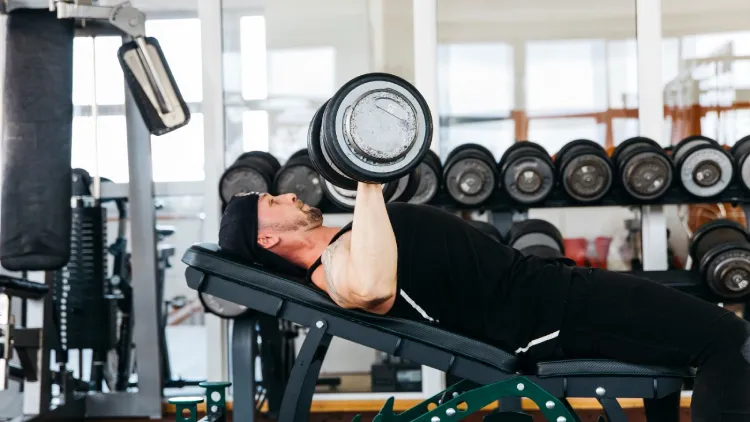
One of the best and most effective activities for developing a strong muscular chest is the dumbbell bench press. It gives an unequalled extent of movement, provides a better isolating factor of the chest than most variations of the barbell, and makes the movement as comfortable as is suitable, and at the level of experience.
This exercise helps you to continue gaining power in the long term, whether you are a beginner with dumbbells and weighing 20 kg or working with heavy weights as an advanced athlete. When properly structured, the right exercise and focused rest, you can develop the strength of your chest, your shoulders, your triceps, and your upper-body strength and stability, all by means of a single highly versatile movement.
Frequently Asked Questions
1. Does the dumbbell bench press suit beginners?
Of course, it is suitable for beginners as it provides them with an appropriate pressing form and establishes stability. It is possible to begin with light weights and advance slowly.
2. Will I be able to create a large chest out of dumbbells?
Yes, the dumbbell bench press will provide a deep stretch and powerful activation to allow one to develop a complete chest with the help of nothing but dumbbells.
3. What is the number of training sessions (weekly) I should have on my chest?
The most effective way to keep your chest growing and recovering is to train your chest 1-2 times/week, taking 48-72 hours of rest.
4. What is a good weight to reach with the dumbbell bench press?
Amateurs can start with 10-20 kg, while heavy-lifting makes use of heavier weights. Pay attention to form and gradual development.