
Some of the best exercises that one can adopt to build lower-body strength, become more mobile, and have more endurance include air squats. They are focused on the legs, glutes, and the core, as well as reinforcing joint well-being and mobility. However, when done properly, the squats might help to improve posture, enhance cardiovascular fitness, and even maintain bone density. This guide includes all the aspects of a proper technique and variations, as well as the frequently made mistakes, safety, and the role of air squats in a complete workout.
- What are Air Squats?
- Advantages of Air Squats
- Correct Air Squats position
- Common Mistakes to Avoid
- Air Squat Variations
- Workout Routines: Air Squats
- 5 sets of 20–25 repetitions
- Air Squats + Other Exercises.
- Progression Tips
- Frequency and Recovery
- Should Air Squats be done by whom?
- Science of Exercise, Safety, and General Concerns
- Hip Flexors, Mobility, and Strength
- Activities of Eternal Averageness Limitations Daily Training
- Practicality in relation to other exercises
- Final Thoughts
- Frequently Asked Questions
What are Air Squats?
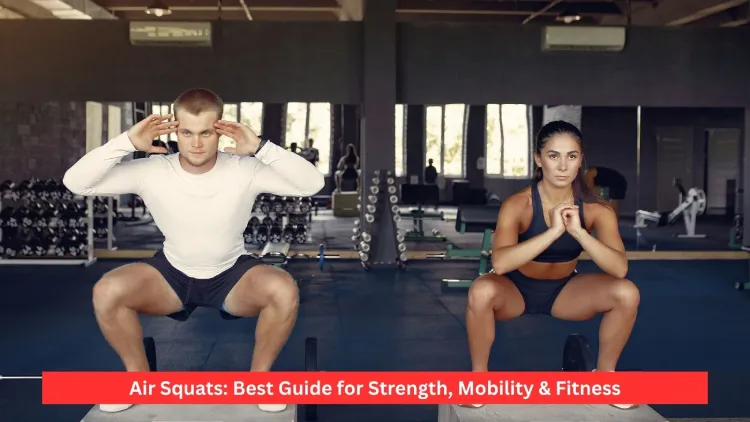
Air squats are a basic bodyweight exercise that involves lowering your body by bending your joints, the knees and hips, and getting back to the feet all without supplementary support. Air squat,s in comparison to weighted squats, are utilitarian; that is, they are based on your body weight; they are available to a wide range of fitness levels.
Air squats majorly target:
- Quadriceps
- Hamstrings
- Glutes
- Core stabilizers
They also utilize auxiliary muscles like the lower back and calves to aid in enhancing balance and stability. Since air squat closely resemble actions people perform in daily life, such as sitting and standing, they can be identified as a functional exercise, which improves movement efficiency in real-life.
Air squats are most helpful for flexibility. They may be used by beginners to get to know the proper movement mechanics, and by advanced individuals to train their endurance, warm-ups, and high-intensity circuits.
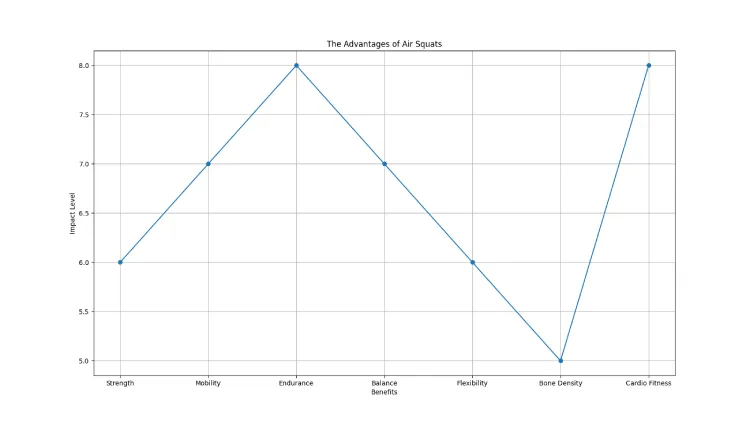
Advantages of Air Squats
Air squats offer numerous physical advantages, which make them among the most valuable workouts in any regimen.
Develops Lower Body Strength
Air squat are a good exercise to build leg and butt strength. With time, endurance and better muscle tone come with ongoing training. They also aid in preparing your body for the higher degrees of resistance training.
Enhances Movement and agility
Full-range air squats will improve hip, knee, and ankle flexibility. This mobility will be able to decrease rigidity and make other methods of exercise less difficult.
Improves Balance and Stability
Air squats involve coordinating various muscle groups. This contributes to the stabilizing muscles and enhances balance, which is essential for the prevention of injuries.
Boosts Cardiovascular Fitness
Air squats increase your heart rate when performed in greater repetitions or during a circuit. This enables them to be an excellent alternative to a combination of strength and cardio in a workout.
Supports Bone Density
Heavy exercise, such as air squat,s can also be used to stimulate bone growth and enhance bone density in the long run. This especially helps in averting bone weakness-related conditions.
Assists in Posture and Core Strength
Air squats make use of core muscles and thus aid in keeping the body straight. This tightens muscles that hold the spine and decreases the possibility of having back pain.
Correct Air Squats position
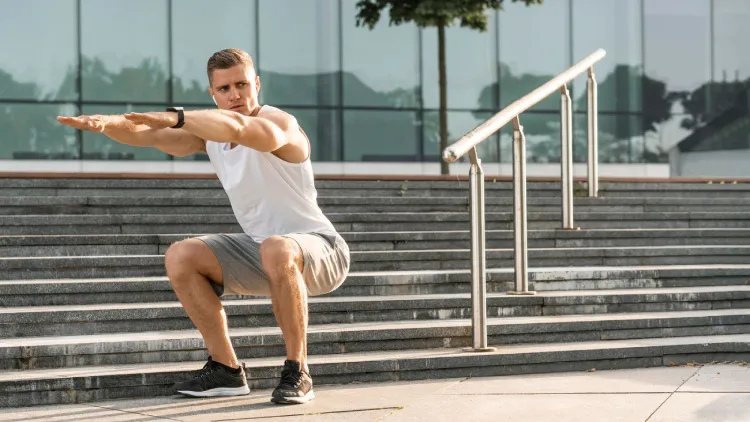
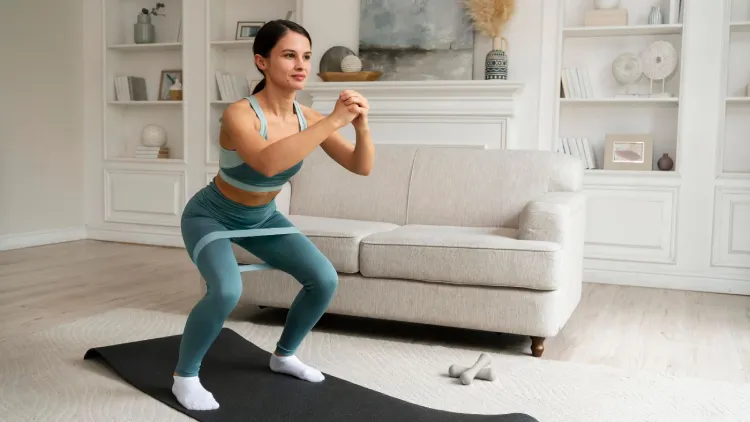
When doing air squats, it is important to maintain correct form to ensure maximum results and prevent injury.
Step-by-Step Technique
1. Starting Position
Feet: Have your feet at shoulder-width. To maintain your chest high, with shoulders loosely attached and core tight.
2. Lowering Phase
Sit backwards with your hips. Keep them together with your toes, bend your knees. Bend down till your thighs are at right angles or as low as you can comfortably.
3. Bottom Position
Your heels must be flat on the floor. Avoid rounding your back and maintain a neutral posture.
4. Rising Phase
Bend your knees with your heels back to a standing position. Maximize muscle activity by squeezing your glutes at the top.
It is important to breathe well, too–breathe in when you get down, breathe out when you get up.
Common Mistakes to Avoid
Although air squats are easy to perform, incorrect performance can decrease performance and pose more risks of injury.
Knees Collapsing Inward
This causes undue stress in the joints. Keep your knees in the same direction as your toes.
Floating Heels off the Ground.
This means the balance is poor or there is a lack of mobility of the ankle. Attention should be on the even distribution of weight.
Rounding the Back
Strain and discomfort can arise because of a rounded spine. Have chest up and core tight.
Shallow Squats
Failure to go deep cuts down on muscle activation. Strive to achieve complete movements.
Moving Too Fast
Form can be sacrificed to speed. The controlled movement is safer and more successful in engaging the muscle.
Overtraining
Excessively practicing the air squat without rest may result in fatigue or stress on the joints. Balance is key.
Air Squat Variations
Alternate variations of the air squat will help make your workouts interesting and effective.
Basic Air Squat
Best with beginners who are concerned with the proper technique.
Pulse Squats
Small bottom pulses enhance tension time and burn in muscles.
Jump Squats
Include a body bang to enhance strength and cardiovascular conditioning.
Single-Leg Squats (Pistol Squats)
A difficult modification that creates power, equilibrium, and coordination.
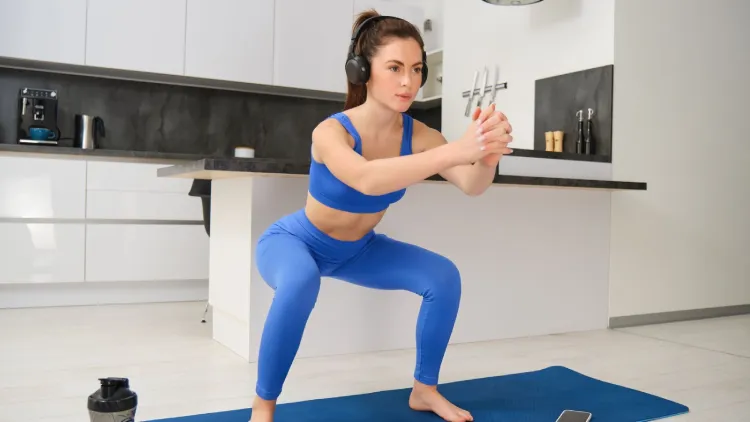
Wide-Stance Squats
Embolden Target inner thighs and glutes.
Tempo Squats
Reducing velocity with movement slows down and enhances muscular activity.
All variations have their own advantages and are able to work through the workout plateaus.
Workout Routines: Air Squats
Beginner Routine
- 3 sets of 10–15 repetitions
- Rest: 60 seconds
Emphasize learning from and creating consistency.
Intermediate Routine
- 4 sets of 15–20 repetitions
- Simple tempo or pulse squats.
- Rest: 45–60 seconds
This stage enhances stamina and body coordination.
Advanced Routine
5 sets of 20–25 repetitions
- Include jump squats or single-leg squats
- Rest: 30–45 seconds
Developed to achieve maximum strength, power, and stamina.
Air Squats + Other Exercises.
The air squats are most effective in strengthening a balanced workout.
Lower Body Circuit
- Air squats – 15 reps
- Lunges -12 rep. each leg.
- Glute bridges – 15 reps
- Calf raises – 20 reps
- Repeat 3–4 times.
Full Body Workout
- Air squats – 15 reps
- Push-ups – 10–15 reps
- Plank – 30–60 seconds
- Jumping jacks – 30 seconds
This union enhances both whole-body fitness and stamina.
Progression Tips
To keep on improving with the air squat, progressively make it more challenging.
- Repeat more sets.
- Reduce rest time
- Add explosive movements
- When justified, switch to weight squats.
The so-called long-term results require consistency and progression.
Frequency and Recovery
Air squats are also allowed to be done many times; however, one ought to take some rest.
- Ride 2 4 times a week.
- Give rest days between vigorous workouts.
- Warm up after exercises to enhance flexibility.
An air squat can be done daily, although the balance must be maintained to prevent overuse injuries.
Should Air Squats be done by whom?
Air squats can be used by a great variety of people; however, some conditions necessitate precautions.
They are ideal for:
- Intermediate students studying movement patterns.
- Athletes improving performance
- Individuals who want home workouts.
Nevertheless, people who have severe joint problems, spinal problems, or acute injuries are not recommended to do air squats without consulting a professional.
Science of Exercise, Safety, and General Concerns
Air squats are often compared to traditional squats. The only major distinction is that resistance air squats involve body weight, and regular squats can involve the use of external weights. This is because air squats are also safer for beginners and those who are concerned with mobility and endurance.
Spinal Compression and Squats
Squats may cause pressure to the backbone, and squats,s like heavy lifting, especially when done with wrong form or heavy weight, may lead to pressure. Air squats, though, greatly reduce this risk as there is no added weight.
Impingement and Hip Health
Air squats may be helpful to people with a hip impingement or with arthritis, provided the person can comfortably stay within the pain-free tolerance. But squatting too deeply or in an unsuitable position can intensify pain.
Back and L5 Issue
Some of these activities, like poor form heavy lifting, may worsen the problem of the lower spine. Air squats are mostly safer, but should also be performed well in order to prevent strains.
Sleeping positions that allow the spine to position itself in alignment, like lying on your back and placing a pillow under your knee,s would assist in alleviating pressure in the lower back.
Sciatica and Air squats
Air squats can contribute to increasing mobility and reducing stiffness, which can be beneficial to people with mild sciatica. Nonetheless, it should be in good shape to prevent worsening of symptoms.
Hip Flexors, Mobility, and Strength
Air squats indirectly tighten and stretch hip flexors, which are necessary in movement and stability.
Weak Hip Flexors.
- Pain when raising knees.
- Poor balance
- Lower back discomfort
Strengthening Hip Flexors
Leg raises, lunges, and controlled squats are some of the exercises that can enhance the strength of the hip flexor.
Hips Mobility and Position
Tight hips may be caused by prolonged sitting and inactivity. All stretching and mobility exercises can be done to help relieve tension, such as air squats.
Activities of Eternal Averageness Limitations Daily Training
What is the number of air squats that you should do per day?
The number (50–150 air squats a day) may seem like a sensible range to most people based on the level of fitness. Novices are not to begin too high and make it up slowly.
Dreams of the Cons
Although effective, resting daily and performing air squats daily can result in:
- Muscle fatigue
- Joint stress
- Reduced recovery
It is essential to balance between intensity and recovery.
Practicality in relation to other exercises
Air squats can be regarded as one of the best lower-body exercises. Some call squats the king of exercises because of their engagement of the entire body, but air squats are more approachable and versatile.
A moderate schedule could have:
The combination of these movements can make up a fitness program.
Final Thoughts
Air squats are not complicated but a potent exercise with amazing results when done routinely and properly. They develop strength, increase mobility, and fitness in general without the use of equipment. Concentrating on good technique, preventing typical errors, and training slowly, you will be able to safely use air squats in your routine activity and get a long-term impact. Air squats are among the most effective exercises and the most viable exercises to add variety to your workout, whether you are working out at home or in addition to the workouts that you are already doing to develop your entire lower body as well as achieve functional fitness.
Frequently Asked Questions
1. Can air squats be done by beginners and in workouts?
Yes, air squats will be good with beginners, as they will use no weight, but they will learn to form the correct shape. They may be taken daily in moderate portions, though it is best to pay attention to your body and take a break in case you experience pain or weariness.
2. Does air squat relieve sciatica or back pain?
Air squats have the potential to enhance mobility and reinforcement of the supporting muscles that can alleviate those minor levels of back discomfort or sciatica. Nevertheless, correct form is paramount, and those who are in intense pain would need to consult an expert prior to executing air squats.
3. What is the number of air squats that I will do per day?
This will depend on how fit you are. Novices can join with 20-50 air squats daily, whereas those who are more experienced can do 100 or more. It’s best to increase gradually and maintain good technique.
4. What are the most commonly used air squat errors?
Most of the mistakes that may be made are allowing the knees to sink in, raising the heels, arching the back, and failing to squat low. By avoiding these mistakes, they would achieve improved outcomes, and the danger of getting hurt could be decreased.