


The incline push-up is an easy workout for beginners that will build up muscles in your chest, triceps, shoulders, and core. It reduces resistance, making push-ups easier when you put your hands on an elevated surface. It’s perfect for the novice and the person who is trying to build up to standard push-ups.
- What is an Incline Push Up?
- What does an Incline Push Up Do?
- What Muscles Do Incline Push Ups Work?
- Which part of the chest should an incline push-up target?
- How to Do an Incline Push Up
- Incline Push Up Form: How to Do It Correctly
- Incline Push Up Benefits
- Are Incline Push Ups Easier than Push Ups?
- Incline Push Up vs. Regular Push Up vs. Decline Push Up
- How to Do an Incline Tricep Push Up
- Incline Push Up Variations
- Incline Push Up at Home
- How Many Incline Push Ups Should You Do?
- Common Push-Up Mistakes
- Incline Push Up Progression: From Beginner to Standard Push Up
- Incline Push Up Workout
- Coclusion
What is an Incline Push Up?
An incline push-up is a variation of a push-up done with hands on an elevated, stable surface and feet on the floor. As you lower your chest toward the water and push yourself back up, your body remains in a straight line.
The higher your hands are, the easier the movement will be, generally speaking, because you are now pushing a smaller amount of body weight. As the slope of the surface is reduced, so is the difficulty.
Common incline pushup surfaces are:
- Exercise benches
- Sturdy tables
- Countertops
- Boxes
- Step platforms
- A stable desk
- Other secure elevated surfaces
This allows you to work the incline push-up exercise at home or at a gym with little or no equipment.
What does an Incline Push Up Do?
The incline push-up is a compound movement that engages the chest and triceps, along with the front shoulders and core to aid in the performance and stability of the exercise.
What Muscles Do Incline Push Ups Work?
The main muscles involved include:
| Muscle | Role |
| Pectoralis major | Main chest muscle responsible for pressing |
| Triceps brachii | Helps extend the elbows |
| Anterior deltoids | Assists with the pressing movement |
| Serratus anterior | Helps stabilize the shoulder blades |
| Core muscles | Keep the body rigid during the exercise |
The exact emphasis can change with hand position, body angle, range of motion, and technique. Keeping your body rigid and using controlled repetitions helps you get more from every rep.
Which part of the chest should an incline push-up target?
So, if you have the question “incline push up targets which part of chest?” the answer is your chest, but it really depends on your body angle and the way you do the push up.
An incline push up may be helpful when building the chest and also to help the pressing motion, which is less difficult than the floor push up. It doesn’t have to be an exercise for one part of the chest since the pectoralis major is engaged as a unit in this movement.
Do Incline Push Ups Target the Lower Chest?
If you’re looking to work the lower chest, then incline push ups are not a great option. The elevated-hand position alters the pressing angle and helps to make this exercise easier to do for beginners. Other push-up variations can be included with the incline push-up to provide a different chest emphasis if desired.
The height of your hands, body angle, and the technique all have an impact on the way the movement feels.
How to Do an Incline Push Up
It is far more important to learn how to do an incline push up properly than to do a lot of them.
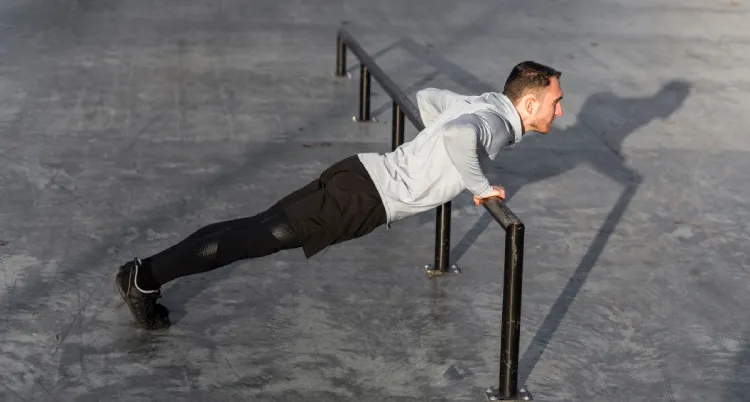
Step 1: Choose a Stable Surface
Face a secure bench, box, table, countertop, or any other raised surface. Ensure that it won’t slide, tip, or collapse during the exercise.
Step 2: Place Your Hands
Place your hands on the edge of the surface, shoulder width or slightly wider. Maintain comfortable wrists and forward- or slightly outward-pointing fingers.
Step 3: Walk Your Feet Back
Step back with your feet until your body is in a straight line from your head to your heels.
Step 4: Brace your core
Squeeze your abdominal and buttock muscles. Do not drop or pull your hips too far down or up.
Step 5: Lower Your Chest
Slowly lower your chest toward the raised surface, keeping elbows bent. Make sure that elbows do not extend beyond a controlled angle.
Step 6: Backpedal Up
Put hands into the surface and straighten elbows back to the starting position.
Step 7: Repeat
Execute controlled movements, keeping the body position constant during the set.
NASM suggests keeping the head in a straight head-to-heel position, maintaining the spine in a neutral position, lowering the chest toward the bench, and controlling the movement of the elbow.
Incline Push Up Form: How to Do It Correctly
Proper form with an incline push-up will allow you to work the desired muscles and control the movement.

Here are a few tips to remember:
- Ensure that your head is kept aligned with your spine.
- Keep your head to feet in a straight line.
- Tighten abdominal muscles before each repetition.
- Do not shrug your shoulder blades.
- Watch your chest descend, rather than your head moving forward.
- Elbows should not be spread too far.
- Avoid using a limited, uncomfortable range of motion.
- Take your repetitions slowly to have good form.
One of the most common technical problems is allowing the hips to sag. Typically, this indicates that the trunk is no longer being properly supported. Too much elbow flare and a jerky or erratic motion can also decrease control.
Incline Push Up Benefits
Incline push ups can offer a number of advantages, particularly if you’re finding standard push ups tough.
1. Builds Upper-Body Strength
Push up Rows To Chest strengthens the chest, triceps, and shoulders with a pressing motion. They can aid in building up the strength for harder push up variations.
2. Beginner-Friendly
The elevated hand position allows beginners to get used to the movement pattern but doesn’t provide the same level of resistance as a floor push-up.
3. Strengthens the Chest
Incline push-ups are a useful bodyweight chest workout, as the pectoral muscles play a key role in the movement.
4. Works the Triceps and Shoulders
The triceps extend the elbows, and the anterior deltoids press the elbows.
5. Supports Push-Up Progression
The position of the hands can be lowered as strength increases. This is a great stepping stone from using a wall or high surface to going into a regularpush-upp on the floor.
6. It’s simple to do at home.
There is no need to have a gym or special equipment. A firm table, countertop, or other raised surface will do.
7. Supports the practice of Full Body Tension.
It is an upper body pushing exercise, but your core and other muscles are engaged to maintain stability of your body throughout each repetition.
Are Incline Push Ups Easier than Push Ups?
Yes, I would say that incline push-ups are easier than regular push ups. You will change your body angle and lower the amount of body weight you need to press if you elevate your hands.
A good sequence to follow is:
Wall push-up / High incline push-up / Table/counter push-up / Bench push-up / Standard Push up / Decline Push up
Generally, the higher the hand above the body, the easier the exercise is. Use a lower surface as you get stronger to gradually increase the challenge.
Incline Push Up vs. Regular Push Up vs. Decline Push Up
| Exercise | Difficulty | Best Use |
| Wall Push-Up | Very easy | Learning the movement |
| Incline Push-Up | Easy–moderate | Beginner strength |
| Regular Push-Up | Moderate | General upper-body strength |
| Decline Push-Up | Harder | Advanced progression |
How to Do an Incline Tricep Push Up
In the incline tricep push up the hands are positioned closer together and the body is elevated, thus adding more triceps contribution.

To perform it:
- Place your hands on a stable elevated surface.
- Hands are spaced less than normal for the incline push-up.
- Place your feet further behind you.
- Keep your back straight; tighten your abdominal muscles.
- Slowly bend your chest down under control.
- Elbows should be somewhat close to the body.
- Extend elbows and push back up.
Do not make the hand position unnecessarily narrow if this results in wrist, elbow, or shoulder discomfort.
Incline Push Up Variations
The surface or hand position offers a number of options to make the exercise more specific.
Bench Incline Push Ups
A bench is a raised area of workable surface in a gym. As your strength improves, lower the height of the bench.
Table Push Ups
A good table will make a convenient home setup. Before starting, always make sure that the table is stable.
Diamond Push Ups Inclined
With hands closer together, the triceps are used more. This variation is a more challenging push-up than the regular push up.
Balance Trainer Incline Push Up
An instability challenge can be added by a balance trainer. Grip the proper stable part of the machine and do controlled reps.
Instructions for beginners
It’s a more challenging exercise due to instability, so they should start practicing on a more stable surface first.
Incline Push Up at Home
At home, incline push ups can be performed using:
- Kitchen countertop
- Strong table
- Stable desk
- Exercise bench
- Secure step platform
Select a surface according to your strength, and safety should be the first priority.
Beginner Incline Push Ups
If you are new to push-ups, begin with a surface that is high enough for you to do repetitions without changing body position.
A starting point is:
2–3 sets × 8–12 repetitions
Don’t neglect technique and don’t go to failure on every set. The focus of the ACE push-up training is to develop proper technique and build the ability to perform controlled repetitions.
If you can do your desired number of reps comfortably with proper form, then move your hands down just a bit to a lower surface.
How Many Incline Push Ups Should You Do?
There is no single number that works for everyone. Your ideal repetition range depends on your current strength, training goal, and the height of your elevated surface.
A practical starting guide is:
| Fitness Level | Sets | Reps |
| Beginner | 2–3 | 6–10 |
| Intermediate | 3–4 | 8–15 |
| Advanced | 3–4 | 12–20+ |
Quality matters more than simply increasing your repetition count. If your hips begin to sag, your range of motion becomes very short, or you lose control, consider ending the set.
Common Push-Up Mistakes
Be sure to avoid these common mistakes:
- Sagging Hips: Engage core and glutes to move from head to toe as one.
- Raising Your Hips Too High: Never make the exercise an angled plank. Keep body line even.
- Flaring Your Elbows: Broad elbows may decrease control and can put too much pressure on the shoulders.
- Using an Unstable Surface: If the surface is moving or tipping, then the exercise may be dangerous. Use a solid and stable object.
- Moving Too Quickly: Ongoing repetitions may decrease control. Slowly lower down and slowly push up.
- Using Too Much Incline: A very high surface can move smoothly, but have less strength challenge. Slowly decrease the surface as strength increases.
These errors are similar to common exercise errors that have been mentioned in professional exercise advice, such as hip sagging, unwanted motion, poor range of motion, a nd excessive elbow flare.
Incline Push Up Progression: From Beginner to Standard Push Up
The most significant benefit of incline push-ups is that they can be used as a progression exercise.
Try this sequence:
1. Wall Push-Up: If it’s easiest, begin off almost straight.
2. High Incline Push-Up: Sit at a tall table or counter.
3. Medium Incline Push-Up: Sit on a smaller bench or sturdy platform.
4. Low Incline Push-Up: As you get stronger, keep your hands closer and closer to the bar.
5. Standard Push-Up: When you believe you can do controlled incline repetitions at a low surface, begin to practice floor push-ups.
NASM recommends advancing to full pushups when you can do about 12-15 good repetitions with your incline bench, and then gradually reducing the height of your bench as you become stronger.
Incline Push Up Workout
To do a simple beginner’s chest workout, do:
- Incline push-ups: 3 × 8–12
- Incline diamond push-ups: 2 × 6–10
- Rest: 60-90 sec. between sets
Use a surface that will give you good technique. Once you’re comfortable with the exercise, add more reps in the target range or switch to a slightly lower surface.
Coclusion
Incline Push Up is a basic, yet effective bodyweight workout for building pushing strength in the upper body. It works mostly the chest with some involvement of the triceps, shoulders, and core. Elevated hands make it easier to perform than a standard push up, and are great for beginners and those aiming to perform full floor push-ups.
The most important points to consider are stability of the surface, smoothness of movement, body alignment, and progressions. Begin on an incline to ensure good form, and work your way down the incline as you become stronger. Incline pushups can be a helpful exercise for building confidence and strength in a standard pushup if practiced regularly.
Frequently Asked Questions
What Is an Incline Push Up?
Incline push up is done by placing your hands on an elevated surface, making it easier than a normal push-up.
What Muscles Do Incline Push Ups Work?
They primarily target the chest, triceps, shoulders, and core muscles.
Are Incline Push Ups Easier?
Yes, they’re beginner-friendly because of the lift they provide.
How Do You Do an Incline Push Up?
Set your hands on a stable surface, hold your body straight, lower your chest, and push back up.