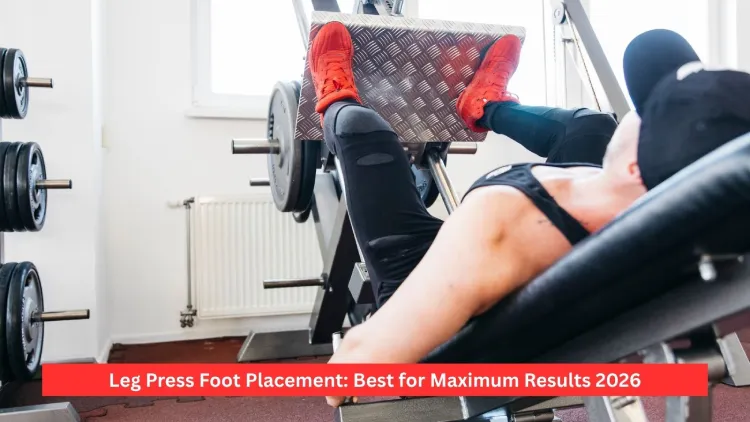

One of the most critical aspects of lower-body training for legs is foot positioning. You can shift focus between quads, glutes, hamstrings, and inner thighs by slightly positioning your feet on the platform. The higher the placing the more glutes you get and the less stress you put on your knees; the lower the placing the more quads you get and the more stress you put on your knees. A wide, or narrow, stance further activates muscles. Proper leg press foot position promotes gains in size, strength, joint safety, and even bone health and metabolic fitness when performed properly.
- What About Leg Press Foot Placement?
- Basic Leg Press Setup (Foundation First)
- High foot placement (Glute & Hamstring focus)
- Low Foot Placement (Quad Dominant)
- Wide Foot Placement (Inner Thigh Focus)
- Narrow Foot Placement (Outer Quad Focus)
- Toes Pointed Out (Inner Leg & Glute Activation)
- Toes Pointed Forward (Balanced Activation):
- Common Mistakes in Leg Press Foot Placement
- How to Choose the Right Foot Placement
- How to Use Leg Press Variations in Your Exercise Routine
- Safety Tips for Effective Training
- Final Thoughts
- Frequently Asked Questions
What About Leg Press Foot Placement?
The Leg Press is an underrated machine exercise and, with proper execution, can be one of the most beneficial for lower-body development. It’s all about positioning the feet on the leg press for getting the right results.
Your feet are your link between your body and resistance. Minor shimmy and changes of position can have a huge impact on the way a force is transmitted across the legs. This means that you don’t have to perform one single repetitive move; you can use the leg press as a versatile trainer, focusing on different muscles and, as a result, on better performances.
For instance, if your feet are higher, they’re not working as much in the knees, so your hips are activated at a higher level; if your feet are lower, their participation in the knees will be increased, and demand on the hip will be reduced. Because of this muscle programming effect, leg press foot placement is an absolute necessity to do it for beginners and advanced lifters alike.
In addition to targeting muscles, foot position also influences:
- Joint stress distribution
- Range of motion
- Stability and balance
- Symmetrical and coordinated movement of muscles
Whether you’re aiming for larger legs, increased athletic performance, or better joint health, leg press foot placement is a vital technique you should master.
Basic Leg Press Setup (Foundation First)
You need the basics. You need to have some foundation before you start playing around. Setting up safely, efficiently, and consistently=proper setup.
First, sit down well in the machine, back supported. The hips should stay stable throughout the movement; no lower back should come off the pad. Start by positioning your feet shoulder-width apart in the center of the leg press machine (your neutral leg press start position).
From here:
- Do not turn your feet away from each other.
- Slowly lower the platform so that the knees are approximately 90°.
- Push back without crossing your legs.
- The overall idea is a balanced activation of the quads, glutes, and hamstrings. It also provides a benchmark for all variations.
The foundation is crucial, as you can work on your foot placement on the leg press while making sure they’re in a good position and that you don’t incur any injury.

High foot placement (Glute & Hamstring focus)
A good variant is the “high foot” position. The feet are raised off the platform, thus removing the emphasis from the knees and moving it to the hips.
The leg press foot position is best for working on the posterior chain. You now use your glutes and hamstrings as your go-to muscles for the exercise, and your quads are supporting you.
This variation is especially beneficial for those who:
- Want to build stronger glutes
- Feel pain in the knees at lower-level placements
- Looking for more hip power to perform athletically!Increased hip power for athletics!
From a functional point of view, this exercise mimics the motion of deadlifting and hip thrusting. It imparts the ability to make power from the hips instead of just the knees.
Receiving the opposite benefit is decreased joint stress. The knees move less forward, which helps to reduce pressure loads on the knees, making it safer for many people.
This large leg press foot position, paired with manageable reps and being through the movement, can really help increase the size of your lower body when weight training.
Low Foot Placement (Quad Dominant)
Slowly lowering the feet on the platform lengthens the quadriceps muscle and puts a lot of stress on it.
This foot position on the leg press is great for developing strong and defined quadriceps. It puts your knees in a more anterior position, thereby adding tension to the front of your thighs.
This modification may be advantageous for athletes as it adds strength to the quadriceps and allows for:
- Sprinting power
- Jump performance
- Knee stability
But this is a role that has to be played wisely. A waist too deep and/or poor posture can lead to an excessive amount of stress being placed on knee joints. This is why controlled movement and good positioning are so important.
If performed properly, this position of the legs on a leg press can be as effective as other leg squat variations at building and shaping the quads. It’s also excellent for people who have balance troubles when performing free-weight training.

Wide Foot Placement (Inner Thigh Focus)
A wider stance will give you more adductor involvement (inner thigh).
This position of your feet on the leg press during this exercise is particularly beneficial for the stability and strengthening of hip muscles that are often overlooked. Putting your feet further apart and angling your toes slightly to the outside of your boot results in a different pattern of movement, which will recruit more muscle fibres.
This variation supports:
- Improved balance and coordination skills.
- Improved hip mobility
- Improved leg power.
This also has a role in injury prevention. Well-developed adductors ensure pelvic and knee stability, and this helps to minimize any imbalances.
If you are seeking to create full legs, and not just the quads or glutes, this leg press foot position is crucial.
Narrow Foot Placement (Outer Quad Focus)
A very narrow stance will emphasize the lateral or outside part of the quadriceps.
It’s best for developing leg definition and a balanced look with this leg footwork position for the leg press. Bringing feet closer together will make the outer quad muscles more active.
This variation is something which is regularly employed by the body builders that wish to create the type of character in their legs. It will help to break out the muscles and add to the aesthetic aspect.
It may not be able to carry the heaviest weight, but it makes for greater control and accuracy. This results in improved muscle activation in long-term use and improved muscle symmetry.

Toes Pointed Out (Inner Leg & Glute Activation)
Rotating the feet can also affect the muscles working. Point toes out engages more of the inner thighs & buttock muscles.
This leg press foot positioning variation decreases the angle of hip position and helps with a more natural movement pattern for some people. It is also important to maintain the correct alignment of the knee, particularly within the deeper range of motion.
It doesn’t cost any more than $10 and could have a tremendous impact on the look and feel of the exercise.
Toes Pointed Forward (Balanced Activation):
Balancing out the effort between the big leg muscles is important: keep toes straight.
Neutral leg press foot position is the preferred leg position for beginners, or if you are trying to work on your overall development. It helps to align and minimize excessive strain. This is the best starting point if you’re not sure where to begin.
Common Mistakes in Leg Press Foot Placement
- With a machine, errors can stifle success. Placing the foot of the leg press is often not proper and results in decreased effectiveness or discomfort.
- Foot positioning too far forward is a common problem, as it compounds knee stresses. The other is to lift off the heels, which is not a place where most of our weight should be.
- The same can be said about having the knees locked on top—it can cause unnecessary stress in the joints. If unequal pressure between the legs develops, imbalances will also develop over time.
- By steering clear of these pitfalls, you can have an effective and safe foot placement during the leg press.

How to Choose the Right Foot Placement
Place your legs on the foot of the leg press machine in whichever position is most suitable for your training objective.
A lower position would be ideal for the quads. A HIGH position is better for glutes and hamstrings. A broad approach focuses on the inner quadriceps, and a narrow approach works out the outer quadriceps.
Rather than present a single style, he is going to change from one variation to another, which assures complete development. This will also avoid “plateaus” and ensure a more interesting training session.
How to Use Leg Press Variations in Your Exercise Routine
If you want to get the best result, try using several different variations of leg press foot placement in the same workout.
Warm up in neutral position (neutral start). Then take your position to shoulder-weighted to a quad station, then a glute station. Work from a wide or narrow stance.
This approach enables you to target the major leg muscles effectively without having to use a variety of different machines or exercises.
Safety Tips for Effective Training
When working with heavy resistance, safety is paramount! The position of your feet when you keep your legs in the leg press aligns your tongue and helps to prevent your joints from being damaged.
Warm up before the activity. Take slow movements, no bouncing of weight. Squeeze firmly against the pad and pick a level weight intensity.
If performed correctly, the leg press may be more beneficial than free weights for people with problems with their spine, such as back pain. Supported position helps to wrap up the back in a way that doesn’t stress it.
Also, resistance activities such as the leg press can help the bones through resistance training. In addition to good nutrition, it can help ensure that bones become more robust with experience.
Squats and leg presses are commonly equivalent exercises. The leg press can be performed with a defined movement and specific activation of muscles compared to squats. They both have worth, and neither one of them can take the place of the other.

Final Thoughts
Leg press foot placement is a great technique that makes a leg press a full lower-body workout. By realizing the different positions, you can create bigger legs, greater strength, and help to achieve long-term health.
Success is achieved with regular training, proper technique, and the intelligent use of variation. Regardless of your primary muscle-building, sports, or fitness objective, knowing how to position your legs on the leg press machine will assist you in reaching your desired outcomes at an all-out pace.
Frequently Asked Questions
1. Where should your feet be on a leg press?
A standard leg press foot placement is shoulder-width apart in the middle of the platform, which provides balanced muscle activation. You’ll want to increase the intensity on the glutes and hamstrings and decrease the intensity on the quads based on your training objective.
3. How to target the front of the legs with the leg press?
Yes, the leg press can really help to grow larger legs. Using proper leg press foot placement, controlled reps, and progressive overload helps target different muscles and promotes overall leg growth.
3. Is the leg press better than squats?
The two exercises are good. Squats are more functional and work more stabilizing muscles; the leg press can be trained safely with controlled movements, and leg press foot placement can be adjusted to work specific areas.
4. Do leg presses benefit bone health?
Absolutely, leg press workouts can help build bones! Proper leg press foot placement will lower joint strain while still forcing them in a direction that can help build bone over time.