
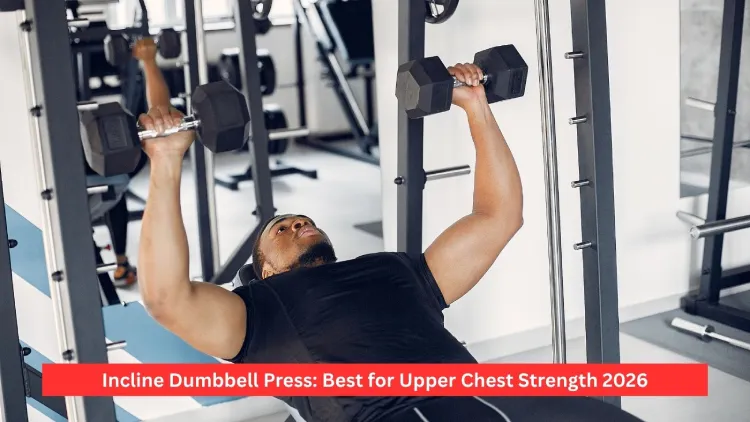

One of the most effective exercises to develop a strong and well-defined upper chest, as well as enhance shoulder stability and overall pressing strength, would be the incline dumbbell press. It is better applied to the upper part of the chest than flat-pressing movements are, for the reason that it is done on a 30 to 45 degree incline. It assists in the growth of muscles, the correction of imbalances, and the enhancement of the aesthetics of the upper body. Their correct form, active movement, and regular training are the key to their maximum results.
- What Is the Incline Dumbbell Press?
- Advantages of Incline Dumbbell Press
- How to Perform Incline Dumbbell Press
- Proper Form Tips
- Common Mistakes to Avoid
- Incline Dumbbell Press Variations
- Muscles Worked
- Best Rep Range and Training Style
- Incline Dumbbell Press vs Flat Bench Press
- How to Add It to Your Workout Routine
- Safety Tips
- Who Should Do the Incline Dumbbell Press?
- Conclusion
- Frequently Asked Questions
What Is the Incline Dumbbell Press?
Incline dumbbell press is a compound resistance exercise that is done on an adjustable bench inclined at a specific angle. As a substitute for the barbell, two dumbbells are used with each arm, respectively, enabling the arms to move independently. This freedom enhances muscle contractions and also facilitates coordination.
The angle of the bench is the characteristic feature of the incline dumbbell press. Generally, the bench is placed at a 30-45-degree angle. A 30-degree incline is more direct on the upper chest, and the 45-degree incline begins to engage the shoulders more. In the vast majority of cases, lifters are able to stay within the range of between 30 degrees and 60 degrees to achieve the most optimal balance between the chest and the shoulders.
This is a movement unlike flat pressing movements because the movement shifts the weight of the work downwards towards the chest’s clavicles. This is significant as the upper chest is often a poorly developed part of the body in comparison to the middle and lower parts. To overcome this imbalance and to enhance the overall shape of the chest, regular incorporation of the dumbbell press can be used effectively.
The other benefit is that it brings out a wider range of motion. Due to the free movement of dumbbells, they can be lowered deeper than a barbell, thus creating a greater range of chest muscles being stretched. This advanced stretch will help to achieve improved muscle growth with time.

Advantages of Incline Dumbbell Press
The incline dumbbell press has a plethora of advantages that extend beyond mere muscle building. It is one of the primary movements that one can turn to to enhance the level of strength, appearance, and overall performance of the upper body.
Builds Upper Chest Development
The biggest benefit of the incline dumbbell press is that the top of the chest is targeted. This is the most difficult to develop, and most lifters have difficulties in developing fullness near the collarbone. The exercise, by focusing on this area, will assist in forming a more complete and well-balanced chest.
Improves Muscle Balance
Due to the independence of both arms, the incline dumbbell press does not allow side dominance in the exercise. In the long run, this serves to correct the imbalance in strength and results in a more symmetrical type of muscle development.
Greater Range of Motion
Dumbbells also enable the bottom of the motion to stretch deeper and the top of the motion to contract stronger. This has been really popularized by the incline using dumbbell press, which is one of the reasons why using the incline dumbbell press is an effective method of muscle growth.
Enhances Shoulder Stability
To stabilize the dumbbells, there should be the participation of smaller muscles that support the shoulders. This enhances joint stability and minimizes the chances of injury during other pressing actions.
Functional Strength
The incline dumbbell press enhances pushing strength, which is transferred to daily life and performance in the field. It also promotes the development of other exercises such as the flat bench press and overhead press.
Helps Build a Bigger Chest
Although the full development of the chest is done by the combination of exercises mentioned above, the incline dumbbell press contributes significantly to forming a fuller and more defined upper chest. In conjunction with the flat and decline movements, it helps in the total size and thickness of the chest.
How to Perform Incline Dumbbell Press
The correct technique in performing the incline dumbbell press is critical in achieving the best outcome and reducing the risk of injury.
Step-by-Step Instructions
- Begin with an adjustable bench on a slope between 30 and 45 degrees. Sitting on the bench with a dumbbell in each hand, place one on your thighs. Lying down carefully with the dumbbells up to the chest level.
- Get the dumbbells on the outside of your upper chest area with your palms forward. Your elbows are slightly lower than your shoulders and not pronounced out too much.
- Hold the dumbbells and do a slow, controlled movement to hardly straighten your arms. Do not bend your elbows at the top. Now, concentrate on your chest muscles, and squeeze them.
Gradually bring the dumbbells back down to their original position. Keep control during the movement and do not allow the forces of gravity to work. Repeat (for repetitions as desired).
Proper Form Tips
Correct shape in the incline dumbbell press guarantees that the muscles are at their highest level of activity and injury is avoided.
- You can keep your feet flat on the ground to gain stability. There is a slight natural curve at the back of your back; however, it should not be overbuilt into excessive curves.
- Your wrists are not to bend. This will eliminate unnecessary strain and will also result in a better force transfer.
- Regulate the speed at which each repetition is done. The gradual reduction of the weights progressively extends the time under tension, and it is good for muscle development.
- Have your shoulder blades a bit retracted. This will help to protect your shoulders and also help you remain focused on the chest.
Do not carry the dumbbells too close to the top. Instead of them coming into contact, keep them just short of contact to ensure that there is tension in the chest.
Common Mistakes to Avoid
Although the incline dumbbell press is too simple, numerous pitfalls can decrease its efficacy.
- One of the biggest mistakes is to use excessive weight. Most heavy weight training tends to result in improper form and strain to the shoulder. It is preferable to work with a manageable weight and move properly.
- Another problem is that the bench is set too high. A sharp Downhill slope moves the centre of interest off the chest to the shoulders. The angle maintained should be between 30 and 45 degrees so that there is proper targeting.
- In a hurry to complete repetitions, muscle involvement decreases. Controlled movements are so much better with slow movements.
- Over-flaring of the elbows may cause undue stress on the shoulder joints. A moderate angle is safe and more efficient in keeping them.
- Not using a full range of motion limits muscle activation. This is done by bringing the dumbbells as low as possible so as to gain maximum advantage of each movement.
Incline Dumbbell Press Variations
The incline dumbbell press could be varied in a number of ways to give variety to it and in order to target other muscles differently.
- One of the variations of a neutral grip is where the dumbbells are held with palms facing one another. It lessens the stress on the shoulder and is applicable to individuals with discomfort in their joints.
- The incline dumbbell press is an exercise that requires pressing of the arms one by one. This enhances core interaction and enhances coordination.
- The incline dumbbell press gives the movement an added stretch and contraction to the chest, making the movement more difficult.
- The single-arm incline dumbbell press is aimed at unilateral force, and the core has to stabilize the body.
Muscles Worked
The incline dumbbell press is a compound type of exercise that stimulates the activity of a number of muscles.
Primary Muscles
The primary muscle of the body targeted is the upper chest. It is a very important area in general chest aesthetics, and is frequently underdeveloped.
Secondary Muscles
The front shoulders (anterior deltoids) help in raising the weights upwards. The triceps also contribute greatly to the extension of the arms.
Stabilizing Muscles
The upper back and core muscles serve to bring stability to the body at the time of the movement. This renders the incline dumbbell press much more than a chest exercise.

Best Rep Range and Training Style
The manner in which you carry out the incline dumbbell press is dependent on your fitness objectives.
- A moderate repetition (8-12) is best in terms of muscle growth. This scale offers the correct degree between intensity and volume.
- To build strength, it is better to have fewer repetitions, but with heavier weights. Normally, each set has between 4 and 6 reps.
- In the case of muscular endurance, more repetitions using smaller weights are preferable. This enhances endurance and management.
A new trainee who weighs 70 kg. Then the trainee may use dumbbells that have relatively low weight and emphasize proper form and technique of the new exercises. With time, the growth in strength will be able to make gradual progress. It does not have a definite number, but beginners should strive to reach the level of weights that they can comfortably control and work out with 8 to 12 repetitions.
Incline Dumbbell Press vs Flat Bench Press
Both exercises are valuable and have different functions.
The upper part of the chest is targeted by the incline dumbbell press, and the middle part of the chest is targeted by the flat bench press. To be balanced in development, as long as you add both of them to regular workouts, then you will have balance in development.
The incline variation is a little more challenging for some people due to the inclination and more involvement of the shoulders. It typically uses lower weights as opposed to flat pressing.

How to Add It to Your Workout Routine
Dumbbell press in an incline should be an important element of any chest exercise.
The typical complete chest routine entails three key movements, including an incline press, a flat press, and a lower chest exercise, like dips or decline press. These can be regarded as the best three workouts to achieve a balanced chest.
The dumbbell press should be done in the first half of the workout when you have maximum energy. This enables you to have a heavier weight and keep the form.
Consistency, progressive overload, and proper nutrition are required of those who wish to build their chest in the shortest amount of time possible. These cannot be obtained using exercises alone without these factors, since they will not yield fast results.
Safety Tips
The incline dumbbell press requires a lot of care in terms of safety.
- It is advisable to warm up before beginning to exercise. This is in preparation for your muscles, and the chances of being injured are minimized.
- Lifting heavy loads is an activity that requires the use of a spotter, particularly when one is challenging his or her limits.
- It is necessary to avoid sudden movements and dropping the weights too quickly. The motion is controlled and hence safer and more effective.
- Should you experience pain in your shoulders or joints, then pause the exercise and re-evaluate your posture.
Who Should Do the Incline Dumbbell Press?
The incline dumbbell press is appropriate for a large variety of people.
- Novices can get some basic strength training and train on the correct mechanics of pressing. When using light weights, it will build technique.
- The intermediate and advanced lifters find it useful to activate the upper chest and achieve muscle balance.
The incline dumbbell press would help the athletes become more powerful and enhance their performance in the upper body.

Conclusion
The incline dumbbell press is a highly effective exercise to strengthen the upper part of the chest, as well as enhance the overall development of the chest. Its ability to target the upper chest, enhance muscle balance, and provide a greater range of motion makes it a must-have in any workout routine.
With proper form and correct choice of weight, along with regular training, you can make big gains in strength and muscle size. The incline dumbbell press can be used to add strength, a more definite and balanced upper body, with other exercises that work on the chest.
Frequently Asked Questions
1. Is the incline dumbbell press better at 30 or 45 degrees?
An angle of 30 degrees is usually preferable to hit the upper chest, though 45 degrees can involve more shoulder action.
2. What is a good starting weight for the incline dumbbell press?
Beginners should start with a weight he/she can manage in 8-12 repetitions without loss of form.
3. Does the incline press make a larger chest?
Yes, it helps greatly in developing the upper chest and the total size of a chest when this particular exercise is combined with other exercises.
4. Which is superior, the incline or the flat bench?
Neither is better overall. They both are significant to achieve a balanced development of the chest and are to be taken into a routine.