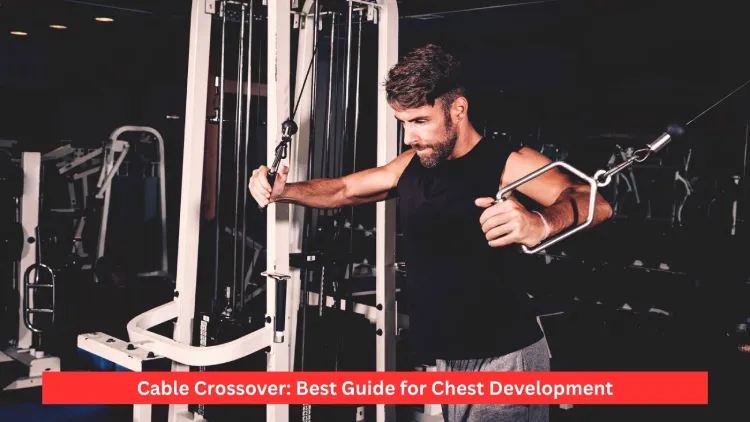

The cable crossover is a very effective exercise to train the chest muscle in isolation, to increase muscle mass, definition, and control through constant tension on the pectoral muscles. This exercise is particularly good for fostering chest symmetry, making the inner or upper chest look bigger or leaner (depending on variation), and helping overall hypertrophy by improving mass when paired with other chest exercises such as dips and the bench press. It will not help “burn fat from the chest” or directly impact medical issues such as gynecomastia, but it will tone and strengthen the chest muscles and will also improve posture, leading to improvements in chest aesthetics.
- What is the Cable Crossover?
- Muscles Worked in Cable Crossover
- Benefits of Cable Crossover Exercise
- How to Do Cable Crossover with Proper Technique
- The Best Form for a Cable Crossover
- Common Mistakes to Avoid
- Variations of Cable Crossover Exercise
- Best Reps and Sets for Growth
- How to Work Cables Crossover into Your Routine
- Who Should Do Cable Crossovers?
- Safety Considerations
- Chest Development, Growth, and Common Fitness Misconceptions
- What are the Top Chest Exercises
- How to Get a Big Chest Quickly
- What is the Hardest Muscle to Grow
- Additional Fitness Insights
- Final Thoughts
- Frequently Asked Questions
What is the Cable Crossover?
The cable crossover exercise is a weightlifting exercise for the chest that works with two cables. The exercise requires the user to hug their arms together in front of their chest. The best benefit of the cable cross is that it provides constant tension, which means that the chest muscles are under tension for the duration of the exercise.
The cable cross enables continuous tension and resistance, unlike free-weight exercises, making it a chest exercise you can count on.
The cable crossover is used by athletes, bodybuilders, and even beginners to enhance the contours of the chest following pressing movements.

Muscles Worked in Cable Crossover
The cable crossover is primarily a chest exercise, but it is also supported by other muscles that help with its movement.
Primary muscles involved:
- Main chest muscle (Pectoralis Major)
- Clavicular head of the chest (upper chest area)
- Sternal head (middle and lower chest muscles)
Secondary muscles:
- Front deltoids (shoulders)
- Biceps (stabilization role)
- Core (stabilisation)
Cable cross is particularly good for targeting the chest muscles because the use of triceps is less than in pressing exercises.
The chest can be one of the most difficult muscles to develop from a bodybuilding standpoint due to individual genetics that determine muscle shape, fiber direction, and overall muscle symmetry. The cable cross enhances the “awareness” of the muscle being worked, which is useful for breaking training plateaus.
Benefits of Cable Crossover Exercise
The cable crossover exercise is beneficial for more than chest growth.
1. Superior Chest Isolation
This exercise is superior to most chest press exercises in isolating the chest muscles, making it perfect for sculpting.
2. Always Maintained Tension
The cable crossover keeps tension on the muscles for greater gain in strength and size, unlike dumbbell or barbell-based pressing.
3. Targets the Upper Chest
The low-to-high cable cross targets the upper chest, which can be hard to reach.
4. Better Muscle Symmetry
The cable crossover includes bilateral work, moving one side of the chest at a time, and can be used to fix uneven muscle development.
5. Joint-Friendly Movement
The cable crossover has less joint pressure on the shoulders than heavy pressing, and can be a safe option for older weight lifters or those recovering from a shoulder or chest injury.
Resistance training in general is beneficial for maintaining muscle and bone mass in the elderly. Since the leg press and walking are more common, the cable cross is safe for the upper body to perform with slow, precise movements and light weight.
How to Do Cable Crossover with Proper Technique
To avoid injury and get the most benefits from the cable crossover, proper form is critical.
Step-by-step execution:
- Adjust pulleys to just above the height of the shoulders (or as needed)
- Take an overhand grip on each handle
- Take a step forward into a staggered stance
- Keep elbows slightly bent
- Keep arms wide spread
- Bend arms together
- Squeeze the chest at the center
- Slowly return to the starting position
The cable cross should be performed as a squeeze of your chest, not a pendulum.
The Best Form for a Cable Crossover
The proper form for the cable crossover includes control, posture, and chest emphasis.
Key points include:
- Keep your chest up and your shoulders back
- Avoid locking elbows
- Use controlled movements
- Concentrate on the mid-way chest squeeze
- Keep the cable crossover tension
Proper technique ensures that the cable crossover works the muscles rather than becomes a shoulder exercise.

Common Mistakes to Avoid
Many people do the cable cross incorrectly, which reduces chest activation and overall results. Since it is an isolation exercise, small form errors can make a big difference.
Mistake 1: Using Too Much Weight
Using heavy weight in the cable cross often leads to poor control and less chest engagement. Instead of squeezing the chest, other muscles start taking over.
Moderate weight works better because it keeps tension on the chest and allows proper movement.
Mistake 2: Turning It Into a Press
The cable crossover is not a pressing exercise. Some people bend their elbows too much and push the weight instead of performing a controlled arc.
It should feel like a chest squeeze, not a push.
Mistake 3: Short Range of Motion
Not stretching fully at the start reduces muscle activation. In the cable cross, the chest should open fully before bringing the handles together.
A full range of motion gives better muscle growth and shape.
Mistake 4: Fast Repetitions
Doing the cable cross too quickly removes tension from the chest. Momentum takes over, and the exercise becomes less effective.
Variations of Cable Crossover Exercise
Different variations of the cable crossover allow you to target specific parts of the chest by simply changing the pulley height and arm direction. This makes it a very flexible exercise for shaping and balancing the chest.
1. High-to-Low Cable Crossover
In this version of the cate, the cables are high, and you pull down to your lower chest.
It primarily targets the lower chest, helping to define the lower edge of the chest. It helps improve your chest shape and three-dimensionality.
2. Low-to-High Cable Crossover
This voltage cable cross is done by starting low and pulling the handles up to your chest.
This exercise targets and develops the upper chest, which is normally more difficult to train as it is not highly activated in ordinary movements and standard benchmark exercises. This exercise results in a wider, higher chest.
3. Mid-Level Cable Crossover
This variation involves lowering the pulleys to chest height and using a straight across motion.
This is the most symmetrical version and engages the whole chest. It is often used to shape the chest and finish off a workout.
4. Single-Arm Cable Crossover
The single-arm cable cross is performed with one arm at a time.
It’s a great exercise that may help to balance muscle development between the two sides of the pectorals and improve control. It also increases core stability to maintain balance.
Why the Upper Chest is Harder to Grow
The upper chest is more difficult to target as it’s not heavily engaged with daily pushing activities and flat chest exercises. This is why incline exercises and low-to-high cable crossovers are needed for a well-rounded chest.

Best Reps and Sets for Growth
Cable cross is best performed with moderate to high reps:
- Muscle growth: 10–15 reps
- Strength endurance: 12–20 reps
- Definition: 15–20 reps
It is performed as a follow-up exercise to big chest exercises such as bench press, incline press,s or dips.
How to Work Cables Crossover into Your Routine
Cable crossovers are used as a finisher.
A well-rounded chest workout could be:
- Barbell Bench Press (strength base)
- Incline Dumbbell Press (upper chest)
- Dips (lower chest and triceps)
- Cable Cross (isolation and shaping)
This will allow you to develop both muscle size and definition.
Dips focus mainly on the lower chest and triceps, and not the upper chest, so they should not be used as the only upper chest exercise.
Who Should Do Cable Crossovers?
Cable crossovers are suitable for:
- Beginners learning chest activation
- Intermediate lifters improving shape
- Experts adding finishing touches
- Ageing athletes: light training to preserve joints
Resistance training increases strength in older adults. But cable crossovers should be done with a light weight and slow movement.
Safety Considerations
Safely perform the cable crossover by:
- Warm up before training
- Use lighter weights
- Avoid overstretching your shoulders
- Maintain a stable posture
- Stop if shoulder pain occurs
Chest Development, Growth, and Common Fitness Misconceptions
There are many factors involved in chest appearance and development:
- Genetics (muscle thickness, shape, and attachments)
- Training intensity and consistency
- Nutrition and recovery
- Hormonal balance
Some individuals may have uneven breasts (shape, size,e and placement), which can be a natural variation and cannot be changed solely through exercise. The cable crossover can promote muscle symmetry but not change body shape.
Claims that exercises “increase breast size” or alter the natural anatomy of breasts are inaccurate. Resistance training, such as the cable crossover,r will increase muscle mass under the breasts but will not directly affect glandular tissue.
For males, chest fullness can be due to excess fat or hormone levels. Weightlifting can enhance overall body fitness, but a medical condition should be assessed by a professional.
In the same vein, there is no such thing as chest exercises “improving your chest by getting rid of fat.” Fat is removed from the entire body with diet and exercise.
Some people report that they strengthen their chest before it grows bigger. This is because your motor skills will improve before you build muscle.

What are the Top Chest Exercises
A good chest workout will include:
- Bench Press (mass builder)
- Incline Dumbbell Press (upper chest)
- Dips (lower chest strength)
- Cable Crossover (detail and definition)
The cable crossover rounds it all out with improved definition and separation.
How to Get a Big Chest Quickly
To build chest size efficiently:
- Train with progressive overload
- Prioritize compound lifts
- Do chest 1-2 times per week
- Consume a high-protein diet
- Include isolation exercise (like the cable crossover)
Cable crossovers will not help build muscle mass, but are heavily used in shaping.
What is the Hardest Muscle to Grow
Some muscles are harder to build due to genetics and how they’re used:
- Calves
- Upper chest
- Rear delts
The upper chest is known for being hard to grow. This is why incline presses and low/high crossover movements with cables are popular.
Additional Fitness Insights
- The cardiac muscle is the hardest-working muscle in the body.
- The masseter (jaw muscle) is relatively the strongest muscle.
- Certain body types (ectomorphs) have a harder time gaining muscle because of their high metabolism.
- Some people have slower rates of chest growth despite increased strength from fibre type distribution.
The cable crossover aids muscle activation but cannot compensate for genetics.

Final Thoughts
The cable crossover is the best chest isolation exercise to improve definition, symmetry, and control. It isn’t a main driver of strength like the bench press, but it is an essential exercise for sculpting and improving the chest’s appearance. Together with compound exercises, adequate nutrition, and training, the cable crossover can pack muscle on your chest. When performed correctly, the cable crossover will enhance your chest workout routine and assist in gaining improved muscle balance and control.
Frequently Asked Questions
1. What muscles does the cable crossover work?
The cable crossover primarily works the chest muscles, particularly the pectoralis major. It also requires the shoulders and abs, so it is a good chest isolation exercise to help improve definition.
2. Does cable crossover make your chest bigger?
The cable crossover is an exercise that works great to enhance chest definition and shape, but is not particularly good for building size. To build a bigger chest quickly, it is best used alongside exercises such as the bench press and dips.
3. Is cable crossover suitable for beginners?
Beginners can do cable crossovers, but must begin with light weights and good form. It will increase chest activation and muscle control.
4. What type of cable crossover is best for the upper chest?
The low-to-high cable crossover is the variation of choice for the upper chest. It’s a good way to develop the top part of the chest muscles, which are often neglected with flat-bench exercises.