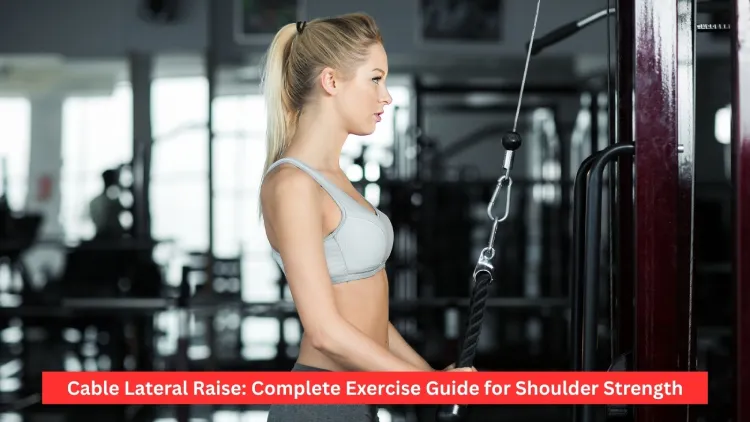

The cable lateral raise is one of the best isolated shoulder exercises to improve shoulder width and balance, as well as to provide constant tension on the middle deltoids (the muscles on the sides of the shoulders). It’s an exercise that targets the lateral shoulders, but also involves the trapezius and rotator cuff muscles. It also provides greater resistance, stability, and decreased joint stress than dumbbells. It can increase the size of your shoulders, enhance posture, and promote shoulder stability when done right. But it is a movement that requires practice, reasonable weight, and an emphasis on protecting your shoulders – particularly if you have shoulder pain or impinging shoulders.
- Cable Lateral Raise Muscles Targeted
- Benefits of Cable Lateral Raise
- How to do Cable Lateral Raise (Video)
- Proper Form Tips
- Common Mistakes to Avoid
- Cable Lateral Raise Variations
- Cable vs Dumbbell Lateral Raise
- Best Rep Range and Sets
- The Best Time to Add Cable Lateral Raise in Your Workout
- Training Tips for Better Results
- Shoulder Health, Safety, and Special Considerations
- Will Cable Lateral Raise Make My Shoulders Bigger?
- Tips for Shoulder Training and Muscle Development
- Building an Aesthetic Physique
- Best Combination of Shoulder Exercises
- Advanced Training Concepts
- Conclusion
- Frequently Asked Questions
Cable Lateral Raise Muscles Targeted
The cable lateral raise is a common exercise to train the lateral deltoid muscle, which is the muscle that gives your shoulders their rounded look. But several accessory muscles assist with stabilisation and movement.
Primary Muscle: Lateral Deltoid
The cable lateral raise primarily works the lateral deltoid. It’s one of the most difficult muscles to develop because it’s a muscle that doesn’t get included in some of the major chest exercises, such as bench presses or push-ups. That’s where isolation exercises play a very important role.
Secondary Muscles
- Anterior Deltoid – Slightly helps to lift
- Posterior Deltoid – Assists in shoulder stability
- Trapezius – Helps to elevate and control your shoulder
- Rotator Cuff Muscles – Stabilise the joint, prevent injury
Deep Stabilizers
Minor muscles like the supraspinatus are important in activating the movement as well as preventing shoulder instability by keeping the joint stable. Proper training can also protect against shoulder impingement.
Where It Works Most
The cable lateral raise primarily hits the outer shoulder, making it a great exercise to get massive shoulders. This is especially useful in getting a balanced body structure and giving you a V-taper or even an hourglass set of shoulders by increasing your shoulder-to-waist ratio.

Benefits of Cable Lateral Raise
1. Constant Muscle Tension
Constant muscle tension is the greatest benefit of using a cable lateral raise. With cables, there is no slackening of weight at the bottom, and you’re in constant contact with the weight.
2. Improved Shoulder Width
By focusing on the lateral deltoids, this exercise helps in widening your shoulders. If you want to have an athletic look or a defined physique, this exercise is a must.
3. Better Muscle Isolation
The cable lateral raise gives you more control of your delts than other exercises. This can be a critical point for people with underdeveloped lateral delts compared to the front delts.
4. Joint-Friendly Movement
The pulley system offers a more uniform resistance, taking strain off the shoulder. It’s therefore safer to perform than heavy free-weight exercises, particularly for those new to exercise.
5. Balanced Development
Unilateral exercises (using only one side at a time) help balance the muscles, which ensures symmetrical strength in both shoulders.
6. Improved Posture
Well-developed shoulders promote good posture, preventing round shoulders and upper back pain.
7. Supports Injury Prevention
This exercise targets stabilizer muscles, which help prevent shoulder injuries, including impingement.
How to do Cable Lateral Raise (Video)
1. Set Up the Machine
Use a single handle on the lowest pulley of a cable machine. Ensure the pin is locked and start with a weight you can handle easily (light to moderate), particularly if you are new to the exercise. There should not be any jerks in the cable. Be close enough to the machine that the cable is under a little tension even when you’re at the beginning of the exercise (this helps keep the muscle engaged at the start of the movement).
2. Position Your Body
Place your feet shoulder-width apart to stand sideways to the machine. Grasp the handle with your hand that’s furthest from the machine (this activates the lateral deltoids more effectively). Make sure to stand up straight, with your chest up and your abs tight. You can also rest your free hand on your hip or hold the machine for support.
3. Starting Position
Have your working arm extended in front of your body with a slight bend in the elbow joint (10-15 degrees). Your hand should be by your outer thigh. Don’t lift or shrug your shoulders. This initial position is important to remember because it should help to align your body and avoid straining your shoulder.
4. Lift the Cable
Lift your arm out in front of you in a wide arc until your arm is approximately at shoulder level. Keep your elbow slightly higher than your hand to activate the lateral deltoid. Don’t twist your hand or arm. Push up with your shoulder, not the traps, and momentum.
5. Pause Briefly
Hold at the top of the lift for 1 second. This enhances muscle contraction and enhances the mind-muscle connection. The side of your shoulder should be active.
6. Lower Slowly
Slowly lower the handle (2-3 seconds). Don’t allow the weight to fall. The downward motion is every bit as important as the lift up (concentric) because it helps strengthen your muscles and reduce the risk of injury. Make sure to keep the tension through your shoulder.
7. Repeat and Switch Sides
Perform your target number of reps, and then move to the other arm. Complete the same number of reps on both sides to ensure you develop evenly in the shoulders.
Key Tip
Emphasise form over weight. This can result in less muscle activity, potential shoulder injury, and swinging. Slow and controlled movements will lead to greater gains with less risk of shoulder pain.

Proper Form Tips
To get all the benefits of the cable lateral raise and avoid shoulder injuries, it’s important to perform the exercise with the right form.
- Don’t fully extend your elbow.
- Don’t use momentum from your body
- Lift only to shoulder height
- Keep your core engaged
- Maintain a neutral spine
- Maintain a smooth lifting and lowering action
Proper form also avoids the onset of shoulder pain,n which may result from poor form.
Common Mistakes to Avoid
Using Too Much Weight
It’s easy to compensate and lift improperly.
Swinging the Body
It draws attention away from the shoulders.
Lifting Too High
Lifting above shoulder level places the burden on the traps.
Ignoring Pain
Pain during the cable lateral raise could be due to poor form, weight, or even shoulder issues such as impingement.
Poor Arm Position
Having your arms too straight or too bent will be inefficient.
Cable Lateral Raise Variations
Single-Arm Cable Lateral Raise
Provides greater concentration and addresses form issues.
Behind-the-Back Variation
Adds stretch and changes lever.
Dual Cable Raise
Engages both arms for time-saving reasons.
Leaning Cable Raise
Provides greater flexibility and tension.
Cross-Body Cable Raise
Works deltoids from a different angle.
Which Variation Is Best?
It depends on what you’re looking to do. If you’re new to the move, the one-arm variation is best. For those with more experience, leaning or behind-the-back raises can be done for more muscle activation.
Cable vs Dumbbell Lateral Raise
| Feature | Cable Lateral Raise | Dumbbell Lateral Raise |
| Tension | Constant | Variable |
| Control | High | Moderate |
| Safety | More joint-friendly | Can strain the shoulders |
| Muscle Activation | Consistent | Drops at bottom |
The cable lateral raise is often a favourite of those looking for better muscle contraction and fluid resistance.

Best Rep Range and Sets
- Beginners: 2–3 sets of 10–12 reps
- Intermediate: 3-4 sets of 12-15 reps
- Advanced: 4–5 sets of 12–20 reps
Modest weight and high repetitions work best for shoulder growth as the deltoids are high-volume and tension-time under-tolerance muscle groups.
The Best Time to Add Cable Lateral Raise in Your Workout
- Post-compound exercises (overhead press)
- During shoulder-focused workouts
- On push or upper body days
The best place for this exercise is at the end of your workout.
Training Tips for Better Results
Mind-Muscle Connection
Try to feel the side delts being used for each repetition.
Slow Tempo
Slow tempo gives more muscle activity.
Progressive Overload
Progressively add weight or volume.
Combine with Compound Exercises
Combine with presses to develop other areas.
Consistency
Train shoulders consistently for optimal results.
Shoulder Health, Safety, and Special Considerations
Cable lateral raises are especially reliant on having healthy shoulders. This exercise is often painful for people due to poor form or underlying issues.
Shoulder Impingement
Shoulder impingement occurs when tendons become compressed with shoulder movement. This presents symptoms such as pain on arm elevation and loss of movement.
Impingement can be divided into structural and functional categories, which can be due to posture, muscle imbalances, or joint structure.
Can You Still Train?
Yes, but in a modified way. Work lighter, don’t lift the arm overhead,d and think of meeting the weight.
The Anti-Impingement Muscles
The rotator cuff and stabilisers keep the shoulder joint in the correct position and can prevent injury.
Safest Shoulder Exercises
- Cable lateral raise (with proper form)
- Face pulls
- External rotations
Exercises to Avoid
Exercises that put more weight on the shoulder joint, particularly if not executed properly, can aggravate problems.

Will Cable Lateral Raise Make My Shoulders Bigger?
The cable lateral raise is a great exercise to build shoulders. The lateral deltoid can be undertrained, ed so the isolation offered by cables can lead to growth.
This exercise adds size and definition to an exercise that uses multiple joints.
Tips for Shoulder Training and Muscle Development
Hardest Muscle to Grow
Laterals may be the hardest muscle to grow as they are not often used.
Most Neglected Muscle
Proper deltoid balance is often overlooked.
Slowest Muscle Growth
Small muscles (delts and calves) grow more slowly than larger muscles.
Muscle That Never Stops
The heart muscle is the hardest-working muscle.
Building an Aesthetic Physique
To build a proportionate, attractive physique:
- Focus on shoulder width
- Keep your waist slender
- Train consistently
The cable lateral raise helps to widen the shoulders to look like you have a smaller waist.
Best Combination of Shoulder Exercises
To build all parts of the shoulder, do:
- Overhead Press
- Cable Lateral Raise
- Rear Delt Fly
Both of these exercises work all the shoulder muscles.
Advanced Training Concepts
777 Workout
This 777 workout is a simple high-volume method suitable for prioritising fatigue and affecting muscle growth. By using the 777 workout on the cable lateral raise, your shoulders will be focused on in various positions.
- 7 reps (bottom half) – from start to middle of the raise
- 7 reps (top half) – from midway to shoulder height
- 7 reps (full range) – all the way up
This equals 21 total reps in 1 set, which will get you a fantastic pump. Lightweight and do it at the end of the exercise.
Benefits: longer time under tension and better shoulder activation.
Progressive Overload
Progressive overload is a way of making your training more difficult to promote muscle growth.
To do this with cable lateral raises, you can:
- Increasing weight slightly
- Adding more reps
- Improving control and slowing reps
- Adding an extra set
Example:
12 reps → 15 reps (progressively increasing weight).
The key to this is to avoid plateaus and keep your shoulders growing.

Conclusion
The cable lateral raise is a powerful exercise for developing strong, muscular shoulders. It’s a great exercise that provides continuous tension, better isolation, and enhances joint integrity. Iff you prioritise proper form, quality movement, and dedication, you can safely incorporate the cable lateral raise to improve your shoulder size, posture,e and overall appearance.
Frequently Asked Questions
1. Target muscles of the cable lateral raise
It primarily works the lateral deltoid (side shoulder) muscle, but also activates the trapezius and rotator cuff for assistance.
2. How far should I raise my arm in a cable lateral raise?
You should raise your arm to the height of your shoulder. Lifting above shoulder height can lead to less focus on the deltoids and an increased strain on the traps.
3. I get painful shoulders when doing cable lateral raises
Shoulder pain is often due to heavy loads, poor technique, or going too high. Again, lift less weight and move slowly.
4. Are cable lateral raises good for bulking up shoulders?
Yes, it’s great for targeting the laterals and putting on width, which can build bigger and more muscular shoulders.