
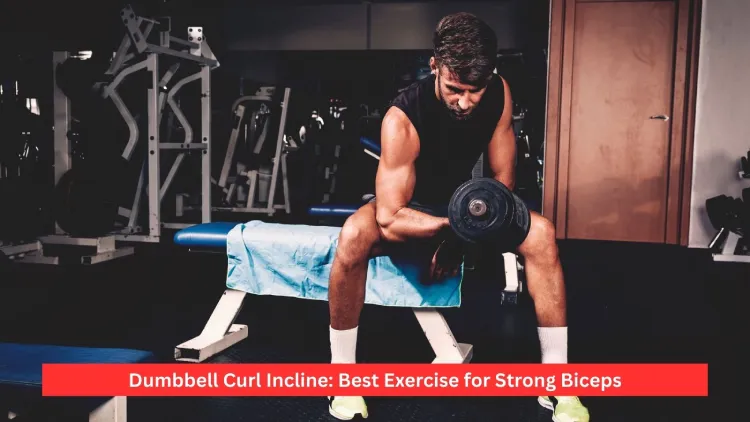

Dumbbell curl incline is a friendly exercise that is one of the best for building the biceps. Regular curls do not involve the muscle as much as the long head of biceps; by performing biceps exercises on an incline bench, the muscle is stretched further, and arm symmetry is enhanced. The change of bench angle, the manipulation of weights, and the correct form are crucial in assuring the enhancement of the activation, the elevation of the muscles, and the enduring growth.
- What is the Dumbbell Curl Incline?
- Muscles Used in Dumbbell Curl Incline
- Advantages of the Dumbbell Curl Incline
- The Dumbbell Curl Incline: How to do it right
- Recommended Sets and Reps
- Common Mistakes to Avoid
- Variations of the Dumbbell Curl Incline
- Tips for Better Results
- Sample Biceps Workout With Dumbbell Curl Incline
- Other Interventions with Incline Curls
- Safety and Performance Tips
- Some Advanced Advice on the Experienced Lifters
- Conclusion
- Frequently Asked Questions
What is the Dumbbell Curl Incline?
Dumbbell curl incline entails biceps isolation, which is carried out on an incline bench, which is usually placed between 30 and 60 degrees. This pose is different to standing curls, positioning your arms behind the torso at the beginning of the movement, which establishes a more profound stretch of the biceps.
This greater extension makes more muscle fibres stretch, particularly the long head of the bicep, which makes up the head of your arm. Although these conventional curls focus on the biceps, the incline difference is tilted towards the outer part and focuses on building larger and more pronounced peaks.
Since you have the bench at your back, you also minimise the chances of utilising momentum or other body parts, such as the shoulders, hence making it a good isolation option. This is because it is perfect for those who are learning to form their curls correctly and those who are otherwise advanced lifters who want to achieve specific growth.
The incline curls are also flexible enough as they may be executed with some variations, such as alternating arms, hammer grip or twisting the wrists, which may focus on the next or a little bit different part of the biceps and forearms.
Muscles Used in Dumbbell Curl Incline
Although the biceps brachii is the main object of attention, the movement is supported and fixed by several other muscles:
- Biceps Brachii: This is the primary target muscle. It flexes and supinates the elbow, and provides the arm with its traditional apogee. Incline curls focus on the long head, making the biceps appear taller.
- Brachialis: The brachialis, which is found under the biceps, helps to make the arm thick. Making it stronger makes the arms appear fuller, even at the side.
- Brachioradialis: This is a muscle in the forearm that aids the flexion of the elbow as well as stabilises the wrist during the curl. With better brachioradialis, the grip strength is increased in the other lifts.
- Forearm Muscles: Biceps flexors and extensors act to hold and control the dumbbells and strengthen and improve the endurance of the forearms.
The dumbbell curl incline enhances the looks and working abilities of the upper arms through coordinated actions of all these muscles.

Advantages of the Dumbbell Curl Incline
The following benefits of including incline curls in your program are as follows:
- Greater Biceps Stretch: The incline bench also places the arms behind your body, which creates a stretch at the bottom of the motion, otherwise not felt in the typical curls. This contraction engages additional muscle fibers and this is essential in hypertrophy.
- Improved Muscle Isolation: The biceps will do the bulk of the task, as the shoulders and the torso are not able to help with your back being supported. This renders incline curls as one of the most suitable isolation exercises to gain long-head development.
- Enhanced Biceps Peak: When the centre of attention is directed to the long head, the biceps peak will increase to a larger height. It is specifically significant to the people who want to enhance the appearance of their limbs.
- Balanced Development: Dumbbells will make sure that every arm is used separately. This assists in mitigating the strength imbalances by distributing growth equally in the long-term.
- Full Range of Motion: The incline position will give a larger range of motion, which will extend time under tension and will enhance the best outcomes.
- Joint-Friendly: Incline curls create less stress on the elbows than standing curls. The regulated movement is less dangerous to those lifters who have pain in the elbow during the conventional curls.
The Dumbbell Curl Incline: How to do it right
Adequate shape is essential in order to achieve maximum advantages and avoid harm.
Step-by-Step Instructions:
- Set the Bench: Vary the slope between 30 and 45 degrees. The decreased angles minimise the stretch, although heavier loads are possible. Increased angles cause stretch without restricting weight. Avoid exceeding 60 degrees.
- Sit Back and Stabilise: Prostrate yourself against the bench. Shoulders, head and back should be supported.
- Grip the Dumbbells: Grab a dumbbell in both hands with the arms extended downwards with the palms forward.
- Keep Elbows Stable: The elbow must also remain close and just a little behind the body. Avoid moving them forward.
- Curl Slowly: Bend the dumbbells upwards to your shoulders, having the biceps tightened at the top. Concentrate on restrained movement as opposed to speed.
- Pause at the Peak: Wait 1-2 seconds to get maximum contraction.
- Lower Under Control: Reduce weights gradually while keeping tension on the biceps. Do not allow the dumbbells to fall.
- Repeat: Do the required number of reps, making sure you maintain the right form throughout.

Recommended Sets and Reps
The basis of your sets and reps will be your training goals:
For Muscle Growth:
- 3–4 sets of 8–12 reps
- Pay attention to medium weight and complete control.
For Strength:
- 4–5 sets of 6–8 reps
- Light weights but very strict form.
For Endurance:
- 3 sets of 12–15 reps
- Lighter weight, higher reps
Hypertrophy Rest 60-90 seconds between sets, a little longer with heavy strength lifts.
Common Mistakes to Avoid
Prevent the following mistakes to achieve the highest results and minimise the risk of injury:
- Lifting Too Heavy: Too much weight brings in momentum, which diminishes the ability of the biceps. Focus on moderate weights.
- Moving the Elbows: Elbows should stay stable. Pulling forward puts tension on the biceps dislocation tof the shoulders.
- Curling Too Fast: Repetitive exercises in a shorter time span decrease tension. Monitor the rising and the dropping stages.
- Incomplete Range of Motion: Partial reps are restricting the stretch and contraction. Stretch out to the lowest and twist up to the top.
- Arching the Back: Use your back to prevent lower-back strain.
- Losing the Mind-Muscle Connection: Engage actively in drawing up the biceps to maximise action.
Variations of the Dumbbell Curl Incline
- Alternating Incline Curl: Curl one arm at a time. This enables one to pay more attention to each bicep and correct strength imbalances.
- Incline Hammer Curl: Grasp dumbbells with palms towards one another. Massages the brachial plexus and forearms, and includes arm fat.
- Incline Concentration Curl: Do curls with one arm each, stopping at the highest point of contraction. Maximises isolation.
- Incline Twist Curl: Curl with the rotation of the wrist to involve a variety of biceps heads and forearms.

Tips for Better Results
- Mind-Muscle Connection: Biceps contraction.
- Controlled Negatives: Lower the dumbbells slowly to gain the best tension.
- The Middleweight: Control, rather than excessive weight, brings about better results.
- Warm-Up: Light curls or stretching armstoo decrease risks of injury.
- Repeat: Use incline curls 12 once a week.
Such minor changes are very effective.
Sample Biceps Workout With Dumbbell Curl Incline
- Barbell Curl – 4×8
- Dumbbell Curl Incline – 3×10
- Hammer Curl – 3×12
- Concentration Curl – 3×10
This exercise attacks the biceps in various positions, which facilitates an equal development and maximum growth.
Other Interventions with Incline Curls
- Optimal Angle: The most effective angles are 30-45. A smaller stretch is permissible in lower angles, and heavier loads are possible. Greater angles (almost 60 degrees) add stretch, which is ideal in hypertrophy, but can reduce the weight capacity.
- Stretch vs Load: Novices should use 30-45 degrees to have an equilibrium between tension and gravity. The high-level lifters can go up to 45-60 degrees to achieve maximum long-head involvement.
- Strength vs Aesthetics: Middle weight, with non-rapid movement, enhances beauty. Heavy weight increases strength but may reduce time under tension if form breaks.
- Incline for Bigger Biceps: Incline curls, when done regularly, can go a long way in increasing the size of the arm. Combined with compound exercises such as a chin-up or a barbell curl, they will give full development of the biceps.
Safety and Performance Tips
- Start light to perfect form.
- Elbows should be stable and should not move forward.
- Do not jerk dumbbells movet.
- Halt in case of joint pains.
- Weigh up with other exercises of the biceps to grow in a balanced way.
Minor modifications, such as the incline or grip position, can be improved to increase muscle involvement and outcome.
Some Advanced Advice on the Experienced Lifters
- Drop Sets: You build up weight, thenmidway cut the set to exhaust the biceps.
- Pause Reps: To raise the tension ofthe stretch, hold at the bottom of the curl between 2-3 seconds.
- Supersets: Combine hammer curls or barbell curls with incline curls to have a vigorous workout of the arms.
- Tempo Fluctuations: The slow 3-second eccentric phase enhances the hypertrophy potential.
- Progressive Overload: Add more weight or reps to the body as time moves on to cause it to grow.

Conclusion
Dumbbell curl incline is a vital exercise one must undertake if he or she is serious about building the biceps. It is a combination of stretch, isolation, and control that is aimed at the long head of the biceps, which leads to growth, definition, and peak performance.
The angles of the bench can be adjusted, the form must be strict, and variations should be introduced, which will allow you to achieve maximum results with minimal risk of injury. Add incline curls to your exercise routine as you train, combine with other biceps and compound lifts and be consistent in exercising and nutrition so you have fuller, stronger arms in the long term.
Frequently Asked Questions
Q. What is the difference between the dumbbell curl incline and the regular curls?
The dumbbell curl incline has a more pronounced impact on the long head of the biceps, complete stretching of the muscle and less involvement of the shoulders; thus, it is beneficial for arm symmetry and optimal development.
Q. What is the optimal dumbbell curl incline benching angle?
To make this effect the most effective, place the incline bench at a range of 30-45 degrees. The heavier weights are used in lower angles, and higher angles maximise the stretch to activate the long head the most.
Q. Does curl incline on dumbbells build bigger biceps?
Yes, they are longer than the standard curls, better biceps stretchers, isolate the long head, and coupled with regular exercise, they grow bigger, stronger and more defined on the arm.
Q. Is there a variation of dumbbell curl incline to help the most?
Yes, the alternating, hammer, concentration, and twist incline curls are dissimilar and strike the various biceps heads and forearms, enhancing growth, peak and general arm balance.


2 thoughts on “Dumbbell Curl Incline: Best Exercise for Strong Biceps”
Everyone loves what you guys are usually up too.
This sort of clever work and exposure! Keep up the good works guys I’ve incorporated you guys to
blogroll.
Thank you so much for your amazing support! We truly appreciate your kind words and are honored to be added to your blogroll.