
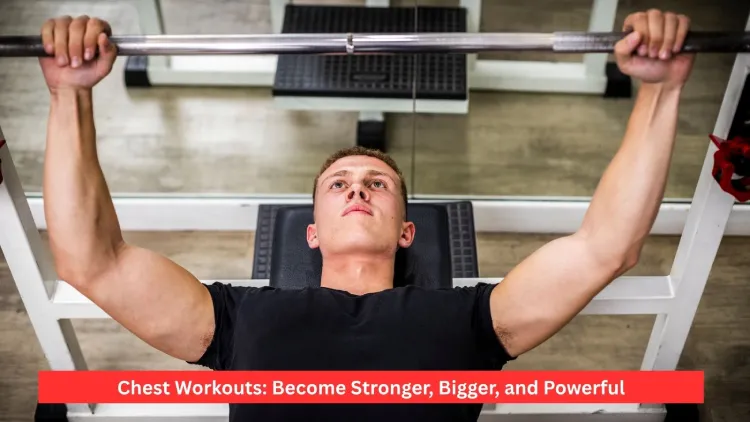

Chest workouts are beneficial for developing strength, size, and upper-body power in the form of the pectoral muscles by undertaking both compound and isolation movements. Proper form, progressive overload, equal training frequency and sufficient rest to develop produce the best results. The mixture of pressing and variety of flies, along with varying angles, combined with different mixes of rep schemes, will guarantee maximum hypertrophy. The key rules of expanding the chest size are consistency, gradual resistance, and intelligent programming.
1. Barbell Bench Press
The barbell bench press can be regarded as the most useful exercise to expand the size and strength of the chest. It makes use of more than one joint, can be loaded heavily and engages all pectoral area. The bench press too is compatible with the long-term strength training exercises like the 5-3-1 rule, which focuses on progressive overload, that i, weight increment in a defined range of reps. Due to its efficiency, the bench press has been incorporated in nearly all of the significant strength or hypertrophy programmes.
To do it in a proper manner, rest on a flat bench, uphold a tight upper back, hold the bar wider than your shoulders, take it back to the middle of the chest, and push it up. This motion involves the greatest number of muscle fibres and plays an important role in the development of the chest. To the lifters who have found it difficult to build their chest, the focus on form and the use of progressive overload in this exercise would usually provide noticeable results.

2. Dumbbell Bench Press
Compared to a barbell, the dumbbell bench press allows the person to widen the scope of the motion and improve the fixed imbalance between the right and left sides of the body. Due to the autonomy of each arm, the stability level rises, and the muscles of the chest work deeper. The difference is especially helpful in the enhancement of muscle symmetry and the stretch in tension, which is vital in hypertrophy.
The movement makes the chest stretch further by reducing the dumbbells downwards and deeper, which facilitates growth. In some situations, where the chest is not developing because of a lack of motion when using a barbell, an alternative to the barbell can be used in dumbbells. The exercise is also efficient in short-duration training sessions, e.g. a 30-minute chest exercise due to its effective nature.
3. Incline Bench Press
The incline bench press targets the upper chest, which is a section which most lifters find difficult to gain. The upper part of the chest has a slower growth rate when compared to the other parts, since it is not targeted by daily activities and thus is among the muscle groups that are difficult to engage in raising. The enhancement of tension on the clavicle head of the pectorals rather than the lower chest is created with an incline bench set at 30 -45 degrees.
This workout aids in building an equalizable chest with the augmentation of high-body pushing force. In the event of attempting to develop a massive chest, which is the aim of incline pressing is imperative since it provides width and height to the chest. The incline bench press also reacts to a variety of training techniques like the 6-12-25 rule, which involves heavy, moderate and high-rep sets to encourage maximum recruitment of muscle fibres.

4. Decline Bench Press
In the decline chest press, a greater percentage of the chest is focused on, and the shoulders do not strain much during a strong press. Lower chest would be easier to build, and pressing results in balanced growth and prevents a flat chest appearance in the lifters. Due to the fact that the bench is tilted towards the ground, lifters can on many occasions lift heavier masses, and this assists in overloading the chest.
This roll could be employed either in low reps, medium reps or in high reps. Other athletes like high-rep sets to promote more blood flow and volume, whereas others sport decline pressing in strength training, such as the 5-4-3-2-1 structure, which includes a reduction in reps as weight increases.
5. Chest Dips
Dips are a perfect form of body weight exercise to use in making the chest bigger and stronger. Bending forward on dips emphasises even more on the chest even more, without excluding the use of the triceps and shoulders. This renders dips an effective supplement in the workout of the chest, particularly when there is a paucity of equipment.
Dip also benefits those who lift more than once a week since body weight exercises cause less stress on the joints. The frequency of training is important, and three times a week may be a good tool with advanced athletes, but too heavy on beginners since it can result in the overtraining effect. Symptoms of overtraining are constant fatigue, decline in performance, pain in the joints, and muscles not growing. Dips and all exercises on the chest require proper recovery.

6. Push-Ups
Push-ups are universal, effective and all-purpose fitness. They can be varied to become more challenging, like the use of decline positions or insertion of pauses, or even slowing the pace. Due to the possibility of doing push-ups anywhere, they can easily be used in brief or time-restricted workouts, like a 30-minute chest workout.
High-rep sets of push-ups would assist in enhancing endurance and induce another form of muscular development. High reps enhance better blood circulation and metabolic stress, whereas heavy lifting builds thick muscle fibres, all of which contribute to the growth of the chest. Chest workouts that include low and high reps will make the workouts balanced.
7. Cable Chest Fly
The chest muscle is isolated as the cable fly exercises maintain tension during the movement. Such isolation enhances definition and makes the width of the chest better. With the assistance of cables, one can do many angles: low-to-high, high-to-low, as well as centre-to-centre, which can build the chest in all directions.
Since cable flyes are independent of heavy weight, the sets can be used in combination with training systems like in the 3-3-3 rule, which splits sets into three levels of tempo or resistance. This type of isolated training plays an essential role in solving the weak areas and enhancing the mind-muscle coordination.
8. Pec Deck Machine
The pec deck machine offers a combination of guided path that allows beginners to master the right patterns of movement that an experienced lifter can concentrate fully on contracting the chest. This machine is specifically useful for squeezing to the maximum without stabilisation.
This exercise is performed by a lot of lifters at the culmination of the chest training when the muscles are tired. It works quite fine with the 70/30 rule, 70 per cent of the workout is dedicated to heavy, compound exercises, and 30 per cent to isolation ones. This ratio guarantees the formation of strength as well as body muscles.

9. Incline Dumbbell Fly
Incline dumbbell flyes are aimed at the deepest part of the chest with a sharp squeeze. They increase the muscle stimulation on parts of the body that may otherwise take a long time to mature. This motion is good because the upper chest is usually the hardest to develop, and therefore every individual who wishes to enhance his/her overall shape and fullness may adopt this.
Fly variations are also suitable for lifters who are doing minimalist lifestyles that are guided by the use of the five major exercises- squat, deadlift, bench press, overhead press, and row. As these routines do not involve direct isolation of the chest, it can be valuable to add flyes and make sure the upper part of the body is balanced.
10. Landmine Chest Press
At a low risk to the shoulders, the landmine chest press is a pressing exercise that is recommended for a lifter who has some form of discomfort when using barbell exercises. It aims at the inner and upper chest, combined with the development of controlled pressing strength.
This press fits very well into the training of high intensity as well as the 2-2-2 rule, in which the sets are separated into periods of controlled tempo. It is also applicable during short routines, thus ideal for lifters who require good working cheats without taking much time in their training period.

Final Thoughts
The chest workouts on the chest have to be trained, balanced and properly programmed to achieve maximum output. It is possible to achieve growth only when the intensity of training, the range of repetitions, and the frequency of exercises are controlled appropriately. Although there are lifters who gain more by training the chest more than once a week, others need to take a break, one or two days between training sessions to give the body time to rest. Some of the signs of overtraining are persistent soreness, loss of strength, and lack of progress.
No matter the kind of heavy heavy-compound lifts or high-rep isolated exercise one follows, the basis of gaining a bigger chest is based on progressive overload. Growth rate is thus dependent on age, genetics and experience, and although certain muscles are more difficult to build, anyone can manage to end up with a strong and impressive chest, and this is through patient individual chest workouts.
Frequently Asked Questions
1. What makes the best builders of the chest?
The barbell bench press due to the possibility to work with heavy weights and engage the chest completely.
2. What is the frequency of training chest?
1-2 times a week in the majority of individuals; high-level lifters can have three sessions.
3. Which is better, dumbbells or barbells?
Both are good; however, dumbbells provide more movement and correct asymmetries.
4. How do I grow my upper chest?
Insert incline presses, incline flyes with an angle of 30-45.