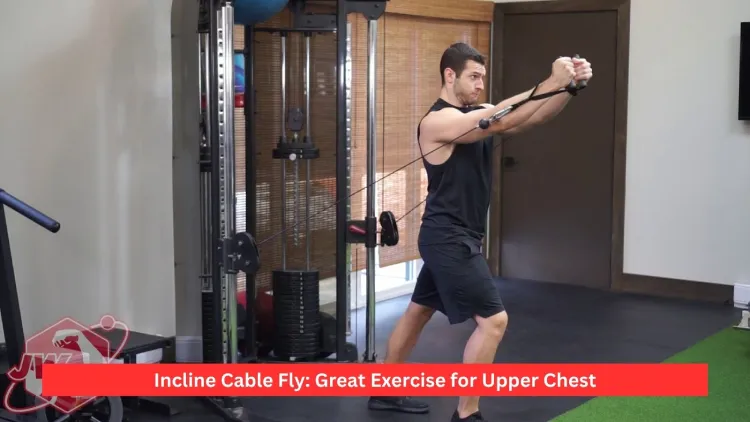

The incline cable fly is an upper pectoralis major isolation exercise. This exercise uses cable pulleys on a bench to offer controlled resistance throughout the exercise. You can incorporate it into upper chest exercises, such as your chest workout, and use it to balance out pressing movements to highlight the upper chest.
- What Is an Incline Cable Fly?
- Incline Cable Fly Muscles Worked
- How to Do an Incline Cable Fly
- Muscles Engaged in the Incline Cable Fly.
- Incline Cable Fly Benefits
- Incline Cable Fly Mistakes to Avoid
- Variations of Incline Cable Fly
- Incline Cable Fly vs Incline Dumbbell Fly
- How to Make Incline Cable Fly A Part of Your Workout.
- Tips for Maximum Results
- Who Should Do Incline Cable Fly?
- Incline Cable Fly Safety Precautions
- Incline Cable Fly vs Other Chest Exercises
- Final Thoughts
- Frequently Asked Questions
What Is an Incline Cable Fly?
An incline Cable Fly is an isolation exercise for the chest muscles that is performed on a bench that is tilted forward. Its main action is on the clavicular head of the pectoralis major muscle (upper chest), with other muscles helping to hold the shoulder blade in place.
Typically, a bench angle in the range of 30 to 45 degrees is utilized. The cable arrangement offers resistance during a large portion of the range of motion, which can help with the upper chest portion of training.

Incline Cable Fly Muscles Worked
The incline cable fly primarily emphasizes the upper chest, especially the clavicular portion of the pectoralis major.
Primary muscle:
- Pectoralis major (upper/clavicular portion)
Secondary muscles:
- Anterior deltoids
- Serratus anterior
- Biceps and forearms as stabilizers
- Core muscles for stability
The exercise emphasizes the upper chest but does not work it in complete isolation.
How to Do an Incline Cable Fly
Follow these steps to perform the incline cable fly with controlled form.
Step 1: Set the Bench
Set the bench to around 30–45 degrees and position it between the cable pulleys. Attach a handle to each pulley.
Step 2: Choose a Manageable Weight
Use a weight that allows you to control every repetition without swinging or losing your shoulder position.
Step 3: Get Into Position
Sit on the bench and hold the handles. Bring your hands above your chest while keeping a slight bend in your elbows.
Step 4: Lower the Handles
Slowly open your arms in a controlled arc until you feel a comfortable stretch across your chest. Avoid forcing the stretch.
Step 5: Bring the Handles Together
Reverse the movement and bring your hands together over your upper chest while keeping your elbows slightly bent.
Step 6: Repeat
Continue for your desired number of repetitions. Keep the movement controlled and avoid using momentum.
Breathing
Breathe in as you lower the handles and breathe out as you bring them together.
Muscles Engaged in the Incline Cable Fly.
The major muscle that is engaged is the upper part of the pectoralis major, which is the part that gives the upper chest its lift and shape.
There are, however, a few secondary muscles involved:
- Anterior deltoids (front shoulders): Aid in the lifting of the arm.
- Biceps brachii: Stabilise when flying.
- Serratus anterior: Assists in shoulder movement.
- Core muscles: Keep the body stable at the incline bench.
The combination of the two makes the incline cable fly the best choice for making a rounded chest and defining the upper body.

Incline Cable Fly Benefits
1. Emphasizes the Upper Chest
The incline variation can focus more on the upper chest (clavicular) end of the pec major.
2. Provides Cable Resistance
Throughout the majority of the cable workout, there is resistance, which helps to keep tension on each rep.
3. Uses a Fly Movement
This exercise works the chest in a fly motion, not the pressing motion typically performed on the bench press.
4. Complements Pressing Exercises
The incline cable fly may be performed with or without pressing exercises to diversify a chest workout.
5. Offers Adjustable Resistance
Cable machines allow you to easily change the difficulty for your level of training and your exercises.
Incline Cable Fly Mistakes to Avoid
Avoid these common mistakes to keep the movement controlled and maintain proper form.
1. Using Too Much Weight
Heavy resistance can make it difficult to control the movement. Choose a weight that allows you to complete each repetition with proper form.
2. Excessive Elbow Movement
Keep a slight bend in your elbows throughout the exercise. Avoid repeatedly bending and straightening your arms.
3. Turning the Fly Into a Press
The incline cable fly should use a controlled arc. If you push the handles forward with your elbows, you are turning the movement into a press.
4. Lowering the Handles Too Far
Lower the handles only until you feel a comfortable chest stretch. Avoid forcing your shoulders into an excessive range of motion.
5. Using Momentum
Swinging the handles reduces control. Move slowly and deliberately during both the lowering and lifting phases.
6. Setting the Bench Too Steep
A very steep bench angle can change the movement and place more emphasis on the shoulders. A moderate incline is generally more suitable for this exercise.
7. Losing Shoulder Control
Keep your shoulders supported and controlled throughout each repetition. Avoid letting them roll forward or move excessively.

Variations of Incline Cable Fly
Single arm incline cable fly
Do the fly while using only one arm at a time. This helps you concentrate on each side of the chest and maintain better control.
Low-to-High Cable Fly
In this variation, the handles are pushed upwards towards the upper chest, which can be used to highlight the clavicular part of the pectoralis major muscle.
High-to-Low Cable Fly
The variation shifts the movement of the handles downward and overall favors the bottom or sternal half of the chest.
Incline Dumbbell Fly
This variation is the same fly, but instead of using cables, the dumbbells are used with a different resistance profile.
Incline Cable Presstriceps
The cable press is a pressing motion with a greater emphasis on the chest, shoulders, and triceps than a cable fly.
Incline Cable Fly vs Incline Dumbbell Fly
Both exercises train the chest through a fly movement, but they use different types of resistance.
| Feature | Incline Cable Fly | Incline Dumbbell Fly |
| Resistance | Cable resistance | Free weights |
| Equipment | Cable machine and bench | Dumbbells and bench |
| Resistance profile | Maintains cable resistance through much of the movement | Resistance changes with arm position |
| Stability | Requires cable control | Requires dumbbell control |
| Best use | Controlled chest isolation | Chest isolation with free weights |
Neither exercise is automatically better. Your choice can depend on the equipment available, comfort, technique, and overall training goals. Both can be useful additions to a balanced chest workout.
How to Make Incline Cable Fly A Part of Your Workout.
The incline cable fly may be easily incorporated into different chest exercises.
In the case of hypertrophy (muscle growth):
- 3–4 sets of 10–15 reps
- Firm, contraction- and form-oriented moderate weight.
For toning or endurance:
- 3 sets of 15–20 reps
- Lightweight weight slower tempo.
Sample Chest Workout:
- Barbell Bench Press – 4×8
- Incline Dumbbell Press – 3×10
- Incline Cable Fly – 3×12–15
- Push-Ups – 3 sets to failure
This frame keeps all of your upper, middle, and lower chest fibres stimulated in order to have balanced growth.
Tips for Maximum Results
- Angle: Hold your bench at an angle of 30-45. This is the best range to use for upper chest targeting.
- Control: Keep under consistent tension- no trembling.
- Squeeze at top: Squeeze your chest upwards; if you can, squeeze for 1-2 seconds and get the maximum work.
- Warm Up: Before heavy sets of arms and shoulders, always take a warm-up of light movements.
- Mind-muscle connection: Visualise the mind on the contraction of the chest as repeated.
A combination of consistency and technique will guarantee that results are visible in a few weeks.

Who Should Do Incline Cable Fly?
The incline cable fly can be useful for beginners, intermediate lifters, and experienced trainees who want to include an upper-chest isolation exercise in their workout.
- Beginners: Start with light resistance to learn proper form and control.
- Intermediate lifters: Use it to complement pressing exercises in a chest workout.
- Experienced lifters: Include it as an isolation movement based on their training goals.
The appropriate weight and range of motion should be adjusted to your experience, comfort, and equipment.
Incline Cable Fly Safety Precautions
- Check the cable attachments and handles before starting.
- Keep your back supported by the bench.
- Use a manageable weight and controlled movement.
- Avoid forcing an excessive stretch at the bottom.
- Stop if you experience sharp or unusual shoulder pain.
- Keep both the lowering and lifting phases controlled.
Incline Cable Fly vs Other Chest Exercises
It is a question for many lifters as to whether incline cable flies are more advantageous compared to the flat and decline movements. Although both are good, the incline version is the only version that focuses on the upper chest, which is usually overlooked in a pressing routine.
The incline fly applies less shoulder stress, and the resistance feels less bumpy than the crossovers; in some cases of crossovers, it can result in overextension or imbalance. Pec deck machines are also not as safe and effective as cable fly when it comes to gaining natural strength and stability.
Compared to the fly, the chest press develops bulk and power, and the fly develops and isolates. Only with an ideal requirement of the two being in the whole workout.

Final Thoughts
The incline cable fly can also be considered one of the best and most diverse activities that can twist and tighten the upper chest. It prevents muscle imbalances, encourages muscle balancing, and helps to support the movement under control, making it improve performance and appearance. You want to develop a larger chest, better posture, or definition, or you just want to ensure that your training outcomes are top-notch; the incline cable fly will allow you to do it.
The keys to success are a uniform routine, right form, and an intelligent choice of an angle (ideally, 30-45 degrees). Together with other forms of lifts involving the use of a cable, the incline cable fly can assist in shaping a strong, balanced, and built body in the upper part of the body.
Frequently Asked Questions
1. What are the muscles used in the incline cable fly?
It appeals to the upper chest, as well as to the front shoulders and arms.
2. Which angle to use on the incline cable fly is the best?
The perfect inclination of the chest to be active is between 30 and 45 degrees.
3. Is it a better idea to use incline cable flies and not use flat flies?
Yes, they give much attention to the upper chest, whereas flat flies are on the top, middle chest.
4. Are flies with an incline cable going to build muscle?
Yes, when they are controlled and formulated, they construct and shape the chest.