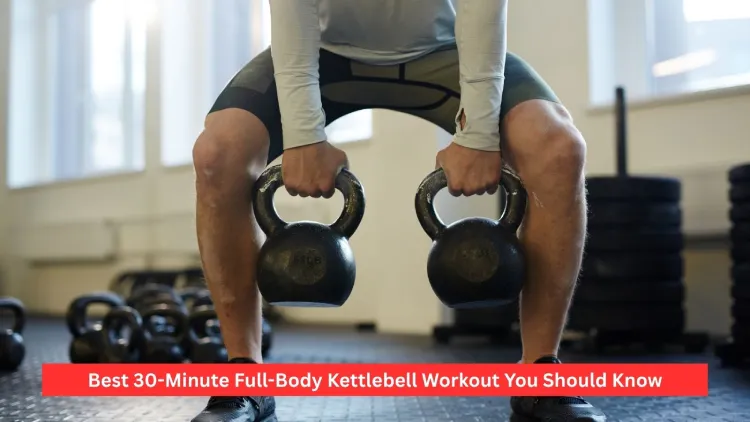

It is a 30-minute full-body kettlebell workout that focuses on gaining explosive strength, endurance, and muscle size with only one kettlebell. Warm up, then do 10 overheads (depending on weight) and then proceed with a minute-by-minute circuit where each minute you change exercises and rest the rest of the minute. There is a full rest every six minutes. Do the circuit 5 rounds of it to work the whole body (quads, hamstrings, shoulders, chest, and back), pushing them as hard as possible to achieve maximum results.

Full-Body Kettlebell Workout
This full-body kettlebell workout is designed to build strength, endurance, and coordination while targeting multiple muscle groups in a short amount of time. Each movement combines power, control, and proper technique to maximise results. Perform the exercises in a circuit format, focusing on quality reps and controlled breathing.
1. Kettlebell Swings – 20 Reps
The kettlebell swing is a powerful hip-hinge movement that targets your glutes, hamstrings, core, and lower back while also improving cardiovascular fitness.
Start by standing with your feet shoulder-width apart and the kettlebell placed slightly in front of you. Hinge at your hips, grab the kettlebell, and hike it back between your legs. From here, drive your hips forward explosively to swing the kettlebell up to chest height. Your arms should stay relaxed—power comes from your hips, not your shoulders.
At the top, squeeze your glutes and brace your core. Allow the kettlebell to naturally fall back between your legs, controlling the descent before repeating the movement. Maintain a steady rhythm and avoid squatting too low—this is a hinge, not a squat.
2. Goblet Squats – 15 Reps
Goblet squats are excellent for building lower-body strength while reinforcing proper squat mechanics. They primarily target your quads, glutes, and core.
Hold the kettlebell close to your chest in a goblet position, with elbows pointing down. Stand with your feet slightly wider than shoulder-width apart. Begin by pushing your hips back and bending your knees to lower into a squat.
Pause at the bottom for 2–3 seconds, ensuring your elbows are positioned inside your knees. Keep your chest upright and your core engaged. From this position, drive through your heels to stand back up explosively.
Focus on controlling the descent slowly and maintaining balance throughout the movement.
3. Three-Point Row – 10 Reps (Each Side)
This exercise targets your upper back, lats, and biceps while also engaging your core for stability.
Hold the kettlebell in one hand and step forward with the opposite leg. Slightly bend your front knee and rest your non-working hand on your thigh for support. Let the kettlebell hang straight down toward your front foot.
From this position, pull the kettlebell up toward your hip in a controlled motion, keeping your elbow close to your body. At the top, squeeze your back muscles, then slowly lower the kettlebell back to the starting position.
Avoid twisting your torso—keep your core tight and movement controlled. Complete all reps on one side before switching.
4. Hang Clean and Push Press – 5 Reps (Each Side)
This is a dynamic, full-body movement that combines power, coordination, and strength. It targets your shoulders, legs, core, and upper back.
Start with the kettlebell hanging between your legs. Perform a clean by driving your hips forward and bringing the kettlebell up to your shoulder, keeping it close to your body. It should rest in the crook of your arm with your wrist neutral.
Once in position, take a deep breath, brace your core, and slightly dip at the knees. Then, explosively drive upward, using your legs to press the kettlebell overhead.
Lock out your arm at the top, then slowly lower the kettlebell back to your shoulder. From there, guide it back down between your legs to begin the next rep.
Maintain control throughout and generate tension by squeezing your free hand.
5. Push-Ups – Max Reps in 60 Seconds
Push-ups are a classic bodyweight exercise that targets your chest, shoulders, triceps, and core.
Start in a strong plank position with your hands directly under your shoulders and your body forming a straight line from head to heels. Engage your core and glutes to prevent sagging.
Lower your chest toward the ground by bending your elbows, keeping them close to your body. Pause briefly at the bottom, then push back up explosively to the starting position.
Perform as many high-quality reps as possible within 60 seconds. If needed, take short pauses to maintain proper form rather than rushing through poor-quality reps.
6. Rest and Recovery
Rest is a crucial part of this workout structure. Take a full rest during minutes 6, 12, 18, and 24.
Use this time to focus on your breathing—inhale deeply through your nose and exhale slowly through your mouth. Try to gradually lengthen your exhales to help bring your heart rate down and prepare your body for the next round.
Active recovery techniques like shaking out your arms or walking lightly can also help you stay loose and ready.

Muscles Worked
A complete kettlebell regime trains several large muscle groups and is so effective at strength and endurance development.
Hip-hinge exercises, such as swings and deadlifts, employ a lot of glutes and hamstrings to develop lower-body power.
When performing squats and lunges, the quadriceps (quads) muscles are used to extend this movement and strengthen the legs.
Primary muscles worked:
- Glutes and hamstrings (strength of the posteriors)
- Quadriceps (lower-body power)
- Shoulders (stability and pressing)
- Back – lats and traps (pulling strength and posture)
In most movements, your core is involved, helping to stabilise your body and enhance balance.
Pushing and pulling also involve the chest and arms, so exercise of the arms as well as the upper body is needed.
Supporting muscles include:
- Core (abs and lower back to hold you stable)
- Chest (push movements)
- Biceps and triceps (strength of an arm)
Advantages of Full-Body Kettlebell Workout
Kettlebells are a diverse workout option that offer a host of benefits due to the nature of the exercises. Kettlebell exercises can also strengthen and develop endurance since they can work several muscle groups at the same time. Activities such as swings, squats, and presses put your cardiovascular system to the test as well as your muscles.
Key benefits include:
- Enhances general power and body strength.
- Increases heart power.
- Increases the amount of calories burned during and after the exercises.
- Helps to lose weight and to build a better body.
The other significant benefit is that it can increase fat burning and metabolism. Resistance training plus intensity makes your body continue burning all those calories long after you have called it quits.
Kettlebell training is also used to improve coordination and balance because most movements need to be controlled and stable.
Additional advantages:
- Enhances body control and balance.
- Improves the functional capacity.
- Grows to have a better posture and stability.
Lastly, it is an exercise that saves time. You are able to train your whole body during one session, and it is ideal for very busy people.

Common Mistakes to Avoid
Even though kettlebell routines prove very successful, they can also lead to decreased performance and injury.
Using an excess of weight is one of the most prevalent mistakes. A massive kettlebell will ruin your posture and cause improper form.
Common mistakes include:
- Having an inappropriate kettlebell weight.
- Lack of proper technique and posture.
- Using arms as opposed to hips in swings.
- Rounding your back on lifts.
Lack of form is another common problem, particularly in dynamic exercises such as swings, squats and cleans. Safety and effectiveness require proper alignment and control.
Another common error made by many individuals is to rush through reps, lowering muscle involvement and predisposing to more injury.
Avoid these habits:
- Performing reps too quickly
- Failure to control the lowering stage.
- Omission of pause where appropriate.
- Sacrificing form for speed
Performing without using the core may place undue stress on your lower back, and performing without warming up or recovery may restrict performance.

Conclusion – 30-Minute Full-Body Kettlebell Workout
It is a 30-minute kettlebell training program that includes high-force full-body exercises that enhance bike fitness and muscle strength. EMOM (Every Minute on the Minute) structure, along with the scheduled rest periods, makes the workout straightforward, efficient and can be modified to fit various levels of fitness. Through training, it is possible to develop endurance, strength, and overall performance in sport. Concentrate on the right form during the process, especially as fatigue sets in, instead of haste in reps. Consistently, these exercises may result in visible gains in strength, body compulsions and fitness in a couple of weeks.
Frequently Asked Questions
1. Are kettlebell exercises suitable in a full-body workout?
Yes, a complete full-body kettlebell workout can be used by beginners because they can start using a lighter weight and concentrate on the right technique. It assists in the development of strength, coordination, and endurance.
2. What is the frequency of this kettlebell workout?
This exercise can be done 3-4 times a week, although one of them should be a day of rest to give the body an opportunity to recover and develop muscles.
3. What is the size of the kettlebell that I should have?
Get a kettlebell that isn’t too difficult, but one that enables good form. Novices can start with 8 -12kg, and better athletes can have heavier weights depending on their strength.
4. Will this exercise aid in reducing fat?
Admittedly, this is a high-intensity, full-body kettlebell exercise that can help her to burn calories, increase metabolism, and aid in the fat-burning process in combination with a healthy diet and regular training.