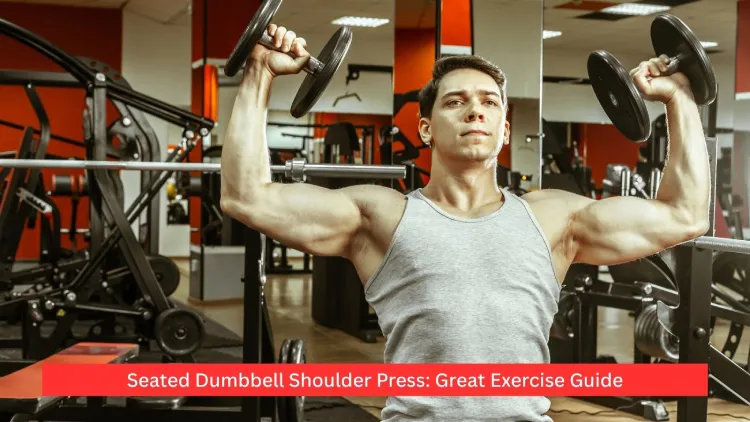

The seated dumbbell shoulder press is one of the best exercises for developing strong, muscular, and well-defined shoulders. It targets deltoids, uses triceps and has a controlled overhead press with minimal strain on the lower back. It is better and more advantageous to the body because it is able to enhance strength, stability, and development of the shoulders with proper use.
- What Is the Seated Dumbbell Shoulder Press?
- Muscles Worked
- The Seated Dumbbell Shoulder Press Technique
- Proper Form Tips
- Common Mistakes to Avoid
- Optimal Pressing Angle
- Reps, Sets and Recommendations of weights
- Standing vs Seated Shoulder Press
- Advanced Considerations
- Seated Dumbbell Shoulder Press variations
- Advantages of the Seated Dumbbell Shoulder Press
- Shoulder Day Programming
- How to correct Weakness in the Shoulder Press
- Breathing and Technique
- Final Thoughts
- Frequently Asked Questions
What Is the Seated Dumbbell Shoulder Press?
The seated dumbbell shoulder press is a compressed exercise that is important during shoulder exercise programs. In contrast to standing presses, with core and lower body stabilisers, the seated one minimises the use of the legs so that you are able to concentrate on the deltoids wholly. On a back-supported bench, your spine is in the correct position, the lower-back stress causes are minimised, and you can lift heavier weights and maintain the correct position to do it.
Dumbbells provide an advantage over barbells as each arm will work separately. This minimises the chances of the development of strength imbalance and promotes balanced muscle growth. The exercise may be used by novices to get acquainted with the correct overhead pressing form and by professional lifters to gain hypertrophy and strength.
Sitting dumbbell shoulder press also enhances the stability of the shoulder joint, and this is useful to athletes who have sports that involve overhead motions like basketball, volleyball and swimming. Additionally, it is versatile, allowing for adjustments to the grip, range of motion, and tempo, which can be modified according to various training goals, such as developing strength, endurance, and muscle size.
Muscles Worked
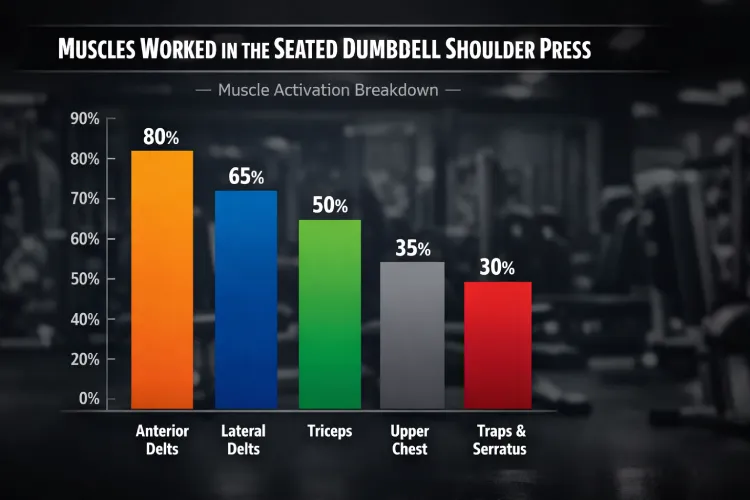
The seizure dumbbell shoulder press works the shoulder muscles, which consist of support muscles which are stabilising and strength-giving.
- Anterior deltoids (front shoulders): These are the prime movers of the lift, and they move the dumbbells overhead.
- Lateral deltoids (side shoulders): Are used to assist the press and make the shoulders wide and shaped.
- Triceps brachii: Strauss the elbows to complete the press movement and provide a lot of overhead strength.
- Upper chest (clavicular part of pectoralis major): Its help is given as a secondary one, particularly when it comes to heavier dumbbells.
- Trapezius and serratus anterior: fix the body on the shoulder girdle, making movement easy.
- Core stabilisers: Although the seated position will lessen the use of the legs, a robust core is essential to achieve the right position and avoid the stress of the lower back.
The whole shoulder press of the seated dumbbell will not only increase the aesthetic growth of the shoulders but also improve the functional strength to perform daily activities and other compound pressing. Effective and safer workouts are guaranteed by the proper application of the supporting muscles.
The Seated Dumbbell Shoulder Press Technique
The proper form of seated dumbbell shoulder press would help avoid injuries and would result in the greatest development of the shoulders. These steps are to be followed in sequential order:
- Position: Use a firm support at the back of the bench. Lay your feet straight on the ground, with your shoulders.
- Grip and positioning: Steadfastness and place a dumbbell on either shoulder at the shoulder level. Palms may either be turned towards the front of the body or a bit towards the inside so as to be comfortable. Make sure that the elbows are slightly ahead of the body.
- Core involvement: Have the abdominal muscles tightened and have a neutral spine. Avoid arching the lower back.
- Press: Lift the dumbbells in an upward controlled movement till your arms are nearly at full extension. Keep your arms gently straightened.
- Lowering stage: Reduce the dumbbells slowly to shoulder height, keeping them in control. You should not drop them so fast.
- Repetition: The number of repetitions should be repeated. Pay attention to the restrained motion and complete usage of the muscles.
- Breathing: Breath out as the dumbbells come under the chest, and breathe in as the dumbbells come over the chest. Closure of the airways allows a person to remain stable, to decrease the surge of blood pressure, and to guarantee a steady stream of oxygen to the muscles under stress.
The art of this skill would make sure that your deltoids, triceps and support muscles are properly addressed and at the same time exercise less pressure on the joints and spine.
Proper Form Tips
Proper technique when performing the seated dumbbell shoulder press is important to the development of muscles and avoiding injury.
Here are detailed tips:
- Elbow position: Anne does not bend her elbows at 90 degrees. This avoids impingement of the shoulders.
- Neutral spine: Do not arch your back; keep your normal head of the spine to avoid hurting the lower part of the back.
- Controlled movement: Anything that is done slowly can be lifted and lowered. Do not use momentum, jerking movements.
- Even pressing: Both arms should be engaged in a symmetric activity to avoid muscular unbalances.
- Neck posture: Your neck must be in its neutral position, and not forward jutting or shrugging.
The tips ensure safety in lifting heavier weights by lifters, even growth of the shoulders, and robustness of stabilising muscles in the long run.
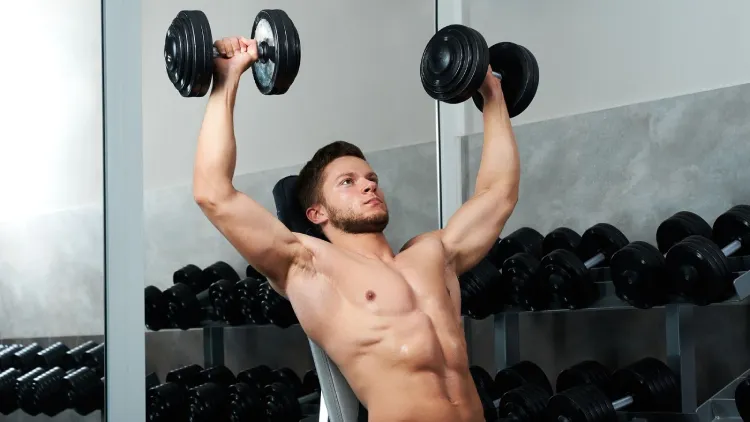
Common Mistakes to Avoid
The seated dumbbell shoulder press is a relatively simple exercise that can be easily mistaken by even experienced lifters, impeding their progress or even injuring them. Common errors include:
- Overloading: Use a weight that you can handle with proper form, and gradually increase it to build strength safely.
- Bending backwards too far: Maintain an upright posture to keep the weight evenly distributed, protecting your lower back while supporting your shoulders.
- Controlled progression: Gradually adjusting dumbbell weight ensures optimal time under tension, promoting safe and effective strength gains.
- Elbow-friendly form: Keeping elbows aligned reduces joint stress and supports smoother, more efficient movements.
- Elbow locking: Although this involves completely locking the elbows on the top, it moves the load off the delts into the joint, and it decreases the equilibrium throughout the muscle.
Making these errors right leads to efficiency, enabling the use of gradual overload, which is safer, and it provides uniform growth of the shoulder.
Optimal Pressing Angle
Shoulder exploration is heavily dependent upon the angle of the backrest. The seated dumbbell shoulder press is best executed at an 85-90 degree bench.
- Upright posture (around 100 degrees or more): Supports shoulder stability while maintaining alignment, though gentle adjustments can enhance comfort.
- Slightly reclined posture (around 80 degrees or less): Encourages chest engagement, helping distribute stress evenly for a balanced upper body.
Identifying the correct angle will guarantee a maximum amount of muscle activation and will not be too harmful or may harm the joint. Minor modifications can additionally help a lot, even for lifters who are highly exposed to shoulder pain.
Reps, Sets and Recommendations of weights
Reps, sets and weights must match your objectives:
- Strength: 4-6 reps with 4-5 sets with heavier dumbbells.
- Hypertrophy: 8-12 reps to achieve maximum muscle growth, which is 3-4 sets.
- Endurance: 12-20 repetitions divided into 2-3 sets with lighter weights.
The intermediate lifters usually press a 20-30kg dumbbell, which is based on the experience and the strength of the individual. In the long run, gradual overload plays a major role. In case three sets of 20 reps are not so hard, change the weight or rep plan.
Standing vs Seated Shoulder Press
It comes in both the seated and standing forms of shoulder press that each has its own advantages:
- Seated dumbbell shoulder press: It isolates deltoids better, less use of lower-back and safer than other types for novices or those with lower-back problems.
- Shoulder press in standing position: Works the core more, gives the ability to lift heavier, and enhances functional strength.
To achieve balanced development of the shoulders, many lifters do both in their programs. Sitting presses enable a high degree of muscle isolation and concentration, whereas standing presses develop whole-body coordination.
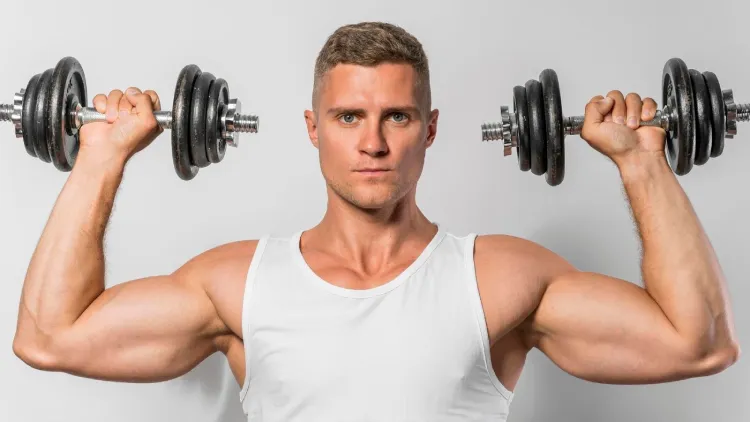
Advanced Considerations
The seated dumbbell shoulder press has the following to increase its gains:
- Avoid full elbow lock: Maintains tension on the delts and cushions joints.
- Rest days: The shoulders require 48 or more hours to rest after strenuous pressing.
- Warm up: Do arm circles, rotator cuff and light presses, then move on to heavy lifting.
- Progress overload guidelines: Training may be organised using such techniques as 2-2-2 (sets/reps/weight progression) and 3-3-3.
Via proper programming and regular implementation, sustainability and expansion will be guaranteed in the long run.
Seated Dumbbell Shoulder Press variations
Variations can also be added and focused on other areas of the deltoid and enhance performance:
- Neutral Grip Press: The palms are facing each other, and there is no stress on the joints.
- Arnold Press: More of the anterior delts are engaged in rotational motion.
- Single-Arm Press: Strength imbalance is corrected, and the core stability is enhanced.
- No-Back Support Press: Engages stabilisers more, enhancing overall strength and control.
- Partial Range Press: It is a weakness-oriented approach that can be applied to overcome the sticking points.
Rotational variations do not allow the adaptation and favour the successful growth of the shoulders.
Advantages of the Seated Dumbbell Shoulder Press
- Enhances the range of the shoulder, size and definition.
- Works with triceps and stabilisers in order to achieve balanced development of the upper body.
- Minimises involvement of the lower back, unlike standing presses.
- Enhances stability and press-ups in the joints.
- Promotes the process of unilateral development, solving imbalances.
This exercise is necessary for everyone serious when it comes to getting upper-body strength or hypertrophy.
Shoulder Day Programming
A good shoulder day includes on many occasions:
- Sitting dumbbell shoulder press (compound lift).
- Lateral delts (isolation) raise.
- Front raises (anterior delts)
- Rear delt fly/ face pulls (posterior delts)
Three to four exercises prove to be sufficient. Optimal volume supports effective recovery and promotes growth. Strive to do equal anterior, lateral and posterior deltoid to develop the shoulder thoroughly.
How to correct Weakness in the Shoulder Press
Weaknesses include shoulder pressing that may be a result of:
- Weak triceps or delts
- Poor shoulder mobility
- Short extension of the thoracic spine.
- Improper warm-up
Specialised accessory exercises, stretching and the ability to raise weights gradually build up weak areas, enhance stability and improve the performance of pressing.
Breathing and Technique
Correct breathing enhances performance and safety:
- Breathing in and downhill motion.
- Breathe in and out, pushing upwards.
- The core stability and blood supply to working muscles are sustained by controlled breathing, enabling you to lift more weight safely.
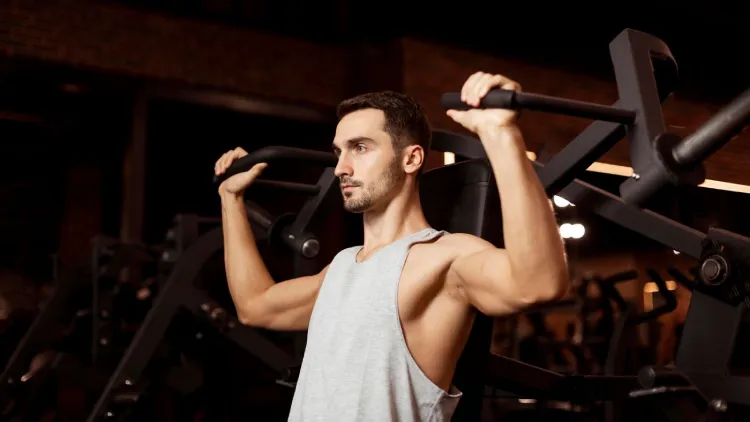
Final Thoughts
Seated dumbbell shoulder press is an essential shoulder-building workout. The fact that it is controlled and seated minimises lower-back strain and helps to achieve maximum deltoid activity. Correct form, overloading, intelligent adaptations, and sufficient rest guarantee good strength and development of the muscles. The more the shoulders are practised, paid attention to technique, and balanced with the shoulder programming, the better they will become stronger and more definite.
Frequently Asked Questions
1: What is the number of reps and sets that I should follow in the seated dumbbell shoulder press?
The number of sets and reps will be based on your objective:
- Intensity: 4-5 sets 4-6 reps with heavier dumbbells.
- Muscle building (hypertrophy): 3-4 sets with 8 to 12 reps.
- Endurance: 12-20 reps 2-3 sets with less weight dumbbells.
The most important factor is progressive overload – to achieve the best results, it is necessary to increase weight or reps gradually.
2: Are seated shoulder presses better or standing shoulder presses?
Both have benefits:
- Seated dumbbell shoulder press: More effective in isolating the deltoids, less risk of involvement of the lower back and safer for beginners or those with a back complication.
- Shoulder press standing: Involves the core more, permits heavier weight lifting and provides functionality.
Both of them are included in the program of many lifters to develop equally.
3: What are the pitfalls of the seated dumbbell shoulder press?
To conduct this exercise safely:
- Do not lean back too much.
- Remain close to but not flared out over the elbow.
- Raise the dumbbells down under controlled movement; do not drop the dumbbells.
- Elbows should not be pushed together with elbows.
- Keep the spine and abdominal muscles balanced during the movement.
4: Does the seated dumbbell shoulder press repair weak shoulders?
Yes, it works the deltoids in all the parts and involves supporting muscles such as triceps and traps. It can be combined with accessory exercises and a good warm-up, and a gradual increase in the amount of weight to be lifted to strengthen weak shoulders and enhance performance in pressing over time.