

Dumbbell back exercises are considered to be among the most fulfilling and effective methods of exercising your back muscles, developing your posture, alleviating pain, and creating a finished muscle building with not too much equipment. With the concentration on such controlled exercises like rows, deadlifts, reverse flys, and pullovers, it becomes possible to train all major back muscles either at home or when in the gym. Regular training, good form, overload, and intelligent recovery are the secrets of long-term success. Despite light versus heavy weight, long versus short workouts, an organised program based on the use of dumbbells back exercises can be an efficient approach in building back strength, muscle size and endurance and general fitness and injury prevention.
- Why does one prefer Dummbell Back Exercises?
- Most effective Dumbbell Back Exercises
- Sample Dumbbell Back Workout Plan
- Tips for Better Results
- Common Mistakes to Avoid
- And What Should The Frequency of Training Back Be?
- The Right Way to Build Back Muscle
- The Back Training and Pain Prevention
- Choosing the Right Weight
- Structuring Your Workout
- Recovery and Muscle Growth
- Successful Home-based training
- Final Thoughts
- Frequently Asked Questions
Why does one prefer Dummbell Back Exercises?
Dumbbell back exercises on the back are also very efficient, as they are both simple and versatile. There is also no limitation with dumbbells compared to machines; they can also allow natural movements, engaging stabilising muscles and enhancing overall muscle balance. As both sides act separately, they assist in rectifying strength imbalances and aid in the creation of enhanced positioning.
The other benefit is convenience. One set of dumbbells back exercises is able to work the whole back, so it is best used at home or in cramped areas. They also permit progressive overloading where the weight, the repetitions, or tempo is increased with time.
Consistently doing dumbbell back exercises would enhance the spine, increase coordination and assist in everyday functions.

Most effective Dumbbell Back Exercises
1. Dumbbell Bent-Over Row
It is general knowledge that the bent-over row is one of the back exercises primarily involving dumbbells, owing to the fact that it has been known to target many muscles at once, in addition to learning proper pulling-type exercises.
How to Perform
Feet position at shoulder height and dumbbells in hand. Flex forward at the hips with your spine in a neutral position with the chest raised slightly. Weight leads this to fall naturally. Bring the dumbbells inwards towards the body and utilise the elbows and not the hands. Stop and stretch a little over ready, and then to the bottom.
Training Benefits
This workout enhances density in the region of the back and makes the muscles important to support strong positions stronger. It also supports good hip-hinging mechanics applied in most strength exercises.
Technique Tips
Be sure to maintain core contact and do not round your lower back. The movement is supposed to be in control as opposed to explosive. It is better to slow down the lowering phase in order to enhance muscle utilisation and performance.
It is one of the most significant dumbbell back exercises that can be performed on the back since it builds strength, as well as coordination.
2. Single-Arm Dumbbell Row
Single-arm rows are more focused on engaging muscles and enhancing better mind-muscle association.
How to Perform
One hand and knee elevated on the bench with the spine in a straight position. And have a dumbbell in the free hand and draw it towards the hip. Reduce the weight gradually till your arm is in full extension.
Why It Works
In unilateral training, there is a decrease in the position of compensations across sides and an enhancement of symmetry of the muscles. This movement activates intensively one of the biggest muscles in the back, which is the latissimus dorsi.
Progression Strategy
Repetitions should be increased first before weight is increased in case form is becoming compromised. Single-arm rows are among the best dumbbell back exercises with dumbbells, where repetitions are controlled by design, thus making the exercise effective for both the beginner and the advanced weight lifter.
3. Dumbbell Deadlift
The dumbbell deadlift is an effective posterior-chain workout which directly improves the lower back.
How to Perform
Get on your feet, gripping some dumbbells close to your thighs. The hip is pushed backwards, and the weights along the legsare lowered. Keep a straight spine with a slight bend on knees. Straussen mit den Ellebeninsassen.
Back Development Role
Yes, the back is a major muscle that is trained during the dumbbell deadlift. Although glutes and hamstrings help, the spinal erectors do the same by stabilising the torso during the motion, which is very important in the development of back strength.
Key Benefits
- Improves lifting mechanics
- Builds lower-back endurance
- The doctor boosts strength in the whole body.
- This is one of the most useful examples of dumbbell back exercises in the eyes of many lifters.
4. Renegade Rows
The combination of strength and stability training is known as renegade rows.
How to Perform
Beginning with a plank, holding dumbbells. The row one weight: works on stabilising the body, but without the weight. Strauss without hip rotation.
Training Impact
The back-to-core is part of this exercise, which enhances coordination and balance. It enhances the endurance of the muscles as well, thus making exercises more effective.
It is also beneficial when in dumbbell back exercises routines, renegade rows are added to make them develop athletically instead of purely building isolated muscles.
5. Dumbbell Reverse Fly
Reverse flies are exercises that help to build the muscles of the upper back that are frequently overlooked.
How to Perform
Hamper forward at the hips with the dumbbells under your shoulders. Extend the weights till they become perpendicular to your torso. Lower slowly.
Why It Matters
Powerful rear delts and upper back override shoulder well-being and positioning. Weak upper-back muscles cause many individuals to develop back discomfort, and thus, this exercise is very beneficial.
Reverse flys form one of the most appropriate corrective dumbbell back exercises in the contemporary lifestyle of office desks.
6. Dumbbell Pullover
The pullover gives deep stretch and contraction to the lats.
How to Perform
Activities: What to Do Lie on a bench with one dumbbell over your chest. Gradually bend it down behind your head and maintain some slight bendinf the arms. Pull the weight up until it goes over your chest.
Unique Advantage
The long scope of movement stretches the muscles of the back, enhancing movement and strength-building.
This movement brings a balance of dumbbell back exercises, flexibility, and strength.
7. Dumbbell Shrugs
Trapezius muscles are targeted in Shrugs.
How to Perform
Hold dumbbells at side on your knees. Raise shoulders towards the ears, taking a moment to stop,p then drop slowly.
Training Benefit
The shoes that have strong traps contribute to the stability of the neck and shoulders and aid heavier pulling exercises.
Sample Dumbbell Back Workout Plan
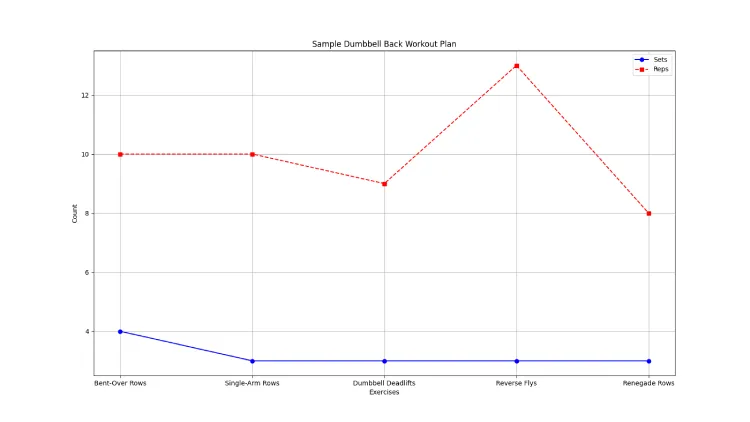
An example of a balanced session with exercises on the back with dumbbells may look like this:
- Bent-Over Rows — 4 sets of 8–12 reps
- Single-Arm Rows — 3 sets per side
- Dumbbell Deadlifts– 3 sets 8-10 reps.
- Reverse Flys — 3 sets of 12–15 reps
- Renegade Rows- 3 sets of 8 reps each side.
This structure is an effective way of covering all the big back regions.
Even a workout that takes about 20 minutes can be effective, provided that intensity and focus are high. Regularity is more important than length, i.e. brief yet balanced sessions would assist with the development of muscle mass and strength.
Tips for Better Results
Dwelling on the Progressive Overload
The progressively complex challenge allows the muscle to grow. You may add weight, repetitions or lower the rhythm.
Choose an appropriate weight
Even a 2 kg or 5 kg dumbbell can grow muscle if one can control and do repetitions near fatigue. Novices are frequently advised to use light weights to get form mastered.
Severe weight is beneficial after mastering the technique, as well as increasing strength, like a 25 kg dumbbell. The aim is to be challenged and not to lose control.
Tempo Methods
Styles of training such as 4-2-1 tempo (four seconds deceleration, two seconds rest, one-second contraction) raise the tension of the muscles. On the same note, the repetitive pattern of structured sets, including the 4-8-12 set, gradually intensifies the endurance and power.
Frequency
Back muscles should be trained two or four times each day. Intersession interval enables muscles to become stronger.
Consistently engaging in dumbbell back exercises ensures that one will make consistent progress and not overtrain.
Common Mistakes to Avoid
Lots of lifters are progressively retarding themselves by bad habits.
Momentum, as opposed to muscle control, is one of the largest issues. Uncontrolled reps are fast, which means their effectiveness is lower, and the probability of injury is high.
The other error is the overconsumption of too heavy items too early. Light dumbbells done correctly would tend to work better than heavy ones used incorrectly.
One more significant problem is the skipping of recovery. The growth of the muscles occurs when resting, and not only in training. The indicators of overtraining are that they were always sore, felt fatigued, their performance declined, and they were unmotivated.
Inappropriate positions during motions can put strain on the lower back. To be safe and productive, dumbbell back exercises must be done with proper alignment.
And What Should The Frequency of Training Back Be?
The frequency of training is based on the level of intensity and the ability to recover. The majority of the people have one to three targeted back sessions each week.
Training can only be done daily in cases where the intensity changes. As an illustration, alternating one strenuous session with exercises that are less strenuous or endurance exercises prevents developing excessive fatigue.
The evidence indicates that a weekly workout of about 240 minutes is beneficial to the whole body and health as a whole, in relation to the numerous sessions.
Back exercises in the form of short workouts per day with the use of dumbbells could be very effective under the conditions of sufficient rest, nutrition and sleep.
The Right Way to Build Back Muscle
The three principles needed to develop back muscle were:
- Resistance training can be used as a mechanical tension.
- Consistent progression
- Adequate recovery
Features Row and deadlifts are regarded as the king exercises in the development of the back, as they engage multiple muscles at the same time. Isolation exercises provide the maximum growth when coupled with compound exercises.
Home-based training is quite possible. Using dumbbells alone, it is possible to do some rows, deadlifts, reverses flys, and pullovers to develop your back completely.
Numerous organised systems can be employed during strength training, including the balanced rules of repetitions or the progressive means of loading. No matter what kind of system to use, the consistency with dumbbell back exercises is the determining factor of success.

The Back Training and Pain Prevention
Combining suitable techniques with mobility work and enhancing the back will alleviate the discomfort. Motions that are gentle strengthening are usually accompaniedbyh postures that encourage the neutrality and relaxation of the spine.
Some rehabilitation methods put stress on controlled breathing, balanced muscle activation and progressive strengthening as opposed to the aggressive loading.
Core stability exercises, as well as using dumbbell back exercises on the spin,e enhance support of the spine and lessen the strain on activities occurring daily.
Choosing the Right Weight
The debate on whether light or heavy dumbbells are good is a common question.
The answer depends on goals:
- Reduced weights enhance stamina and discipline.
- Moderate weights help in hypertrophy.
- The heavier the weight, the stronger it gets.
Growth does not come with heavy weight, but it is only when the muscles are put to the challenge that muscle growth takes place. Most important is legitimate diligence and skill.
Structuring Your Workout
It is possible to train with three to five exercises during a session. Doing excessive movements tends to decrease intensity and focus.
The usual routine of a balanced routine includes:
- One heavy compound movement
- One unilateral row
- A single exercise (isolation) on the upper back.
- A movement that was concerned with stability.
Such a method makes sure it is entirely developed with dumbbell back exercises, and they are not burdened with any complexity.
Recovery and Muscle Growth
Habits of recovery have a great effect. Inadequate sleep, poor nutrition, excessive stress and continuous training at high intensity without rest are the factors that are negative to muscle gains.
An indicator of extreme fatigue is a loss of strength, constant fatigue and lack of motivation. Progress is found in the adjustment of the volume-intensity.
Endurance comes with short rest periods, and heavier lifting is possible when you take long rests. The two strategies are both strategic.
Successful Home-based training
Home exercising can be really useful when it is planned. The minimal training area and the dumbbells that can be adjusted are sufficient to develop the back.
Motion, resistance and the slow change make simple dumbbell back exercises training exercises effective long-term training aids.
Achieving strength can be enhanced by a beginner even with light weights in the effort to concentrate on technique and quality of repetition.

Final Thoughts
The dumbbell back exercises offer a full, available, and very effective way of developing back strength, muscle size and stability. Bent-over rows and deadlifts to reverse flys and pullovers are based on training all major areas of the back with promotion of good posture and functional strength.
It does not matter whether it is light or heavy weight, short or long workouts; consistency, proper technique, and balanced recovery are the keys to success. Having the appropriate composition, dumbbell back exercises have the potential to make any person have a stronger,r healthier back without necessarily complex equipment or training facilities.
Frequently Asked Questions
1. Do the dumbbell back exercises promote muscle growth?
Surely, the idea of building strength and muscle with dumbbell back exercises is that there is a full range of movement, not only and the muscle is uniformly activated with regular exercise.
2. Is it possible to work on my back using dumbbell back exercises only at home?
Yes. Dumbbell back exercises such as rows, deadlifts, reverse flys are sufficient to ensure that one has a complete back workout at home.
3. Which type of dumbbells to use, heavy or light?
Both work well. Those exercises with heavy weights enhance strength, and those with light weights enhance control and stamina in dumbbell back exercises.
4. What is the frequency of dumbbell back exercises?
Training your back – 1-3 times a week- it is always good to have a rest period between sessions.