

The basis of arm development is the bicep exercises. Properly designed exercises that focus on the biceps are beneficial not only in making the arms bigger and more attractive but also in increasing the overall upper-body strength and fitness. A long head and short head, the biceps brachii is important in flexing the elbow and rotating the forearm. They appear with the brachialis and brachioradialis as a result of a defined and powerful arm. Here we will discuss the best exercises for the biceps, methods, and tricks to help build them to the maximum.
- 1. Barbell Bicep Curl
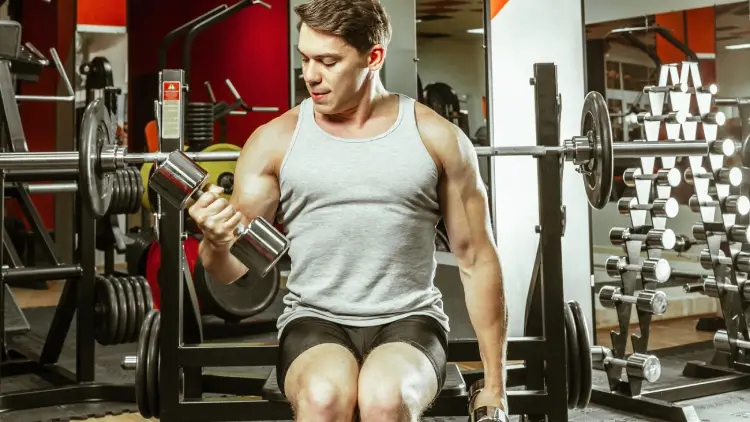
- 2. Dumbbell Bicep Curl
- 3. Hammer Curl
- 4. Incline Dumbbell Curl
- 5. Preacher Curl
- 6. Concentration Curl
- 7. Cable Bicep Curl
- 8. EZ-Bar Curl
- 9. Chin-Ups (Underhand Grip)
- 10. Cable Rope Hammer Curl
- Developed Methods of Bicep Development.
- Structuring a Bicep Workout
- Misconceptions When Training Biceps
- Protein and Nutrition
- How Quickly Do Biceps Grow?
- Biceps Development Tips
- Conclusion
- Frequently Asked Questions
1. Barbell Bicep Curl
Barbell-curl- This is considered to be the best exercise to develop the overall size of the biceps.
It enables heavy loading compared to most isolation activities and is most suitable in cases of strength development.
- Mechanism: A barbell is grasped using the underhand grip, and with the distance between the hands, the width of the shoulders is determined. Bend your elbows inward and bring the barbell up, lifting the biceps. Keep it down gradually to maximum tension.
- Advantages: Strengthens the arms and develops the thickness, as well as strengthens both heads of the biceps. It works particularly well when used in progressive overload, which is a major principle of muscle development.
- Instructions: Do not swing the weight and make sure that there is a full range of motion. Barbell curl gains strength are observed 6-8 weeks after the exercises are done regularly.

2. Dumbbell Bicep Curl
Dumbbell curls enable each of the arms to act as a single unit, hence suitable for repairing an imbalance.
- How it works: You have the option to do simultaneous curls or alternate arms. Turn your wrist a bit to use your upper end.
- Advantages: Benefits: Enhances a more natural motion, increased peak, and symmetry as compared to a barbell curl. The dumbbell exercises will also prove efficient in the case of skinny arms, which require a more focused development.
- Tips: A dumbbell curl of 20 kg is good, depending on the level of experience and strength. It is best always to be in control of weight. Muscle tension and growth are maximised through slow and controlled repetitions.
3. Hammer Curl
Hammer curls use the brachialis and brachioradialis, which are necessary to make arms look wider and fuller.
- How it should be done: Grasp dumbbells in a neutral (palm-to-palm) position and curl the body up, maintaining the position of the elbows.
- Benefits: Strengthens the forearm and makes it wider, helps strengthen the bicep, and makes the grip better. The question that many lifters ask is whether or not the hammer curls increase biceps- it does, and the outer head and the brachialis.
- Tips: Add hammer curls 1-2 times a week to develop the arms evenly. Reverberated and gradual motions provoke development.
4. Incline Dumbbell Curl
The incline dumbbell curl has your shoulders located behind your body, making the long head of the biceps stretch more.
- Technique: Sit on an incline bench, you should have your arms dangling back and draw the weights up.
- Advantages: Optimises maximum growth, strains the biceps when loaded and avoids the takeover by momentum.
- Tips: Perform 3–4 sets of 8–12 reps. It is important to have a complete extension at the bottom and maximum contraction at the top.

5. Preacher Curl
Preacher curls are good for isolating biceps and avoiding cheating.
- Procedure: Sit in a preacher bench and support the arms and roll the barbell or dumbbells towards the shoulder.
- Advantage: Tension is placed on the biceps mostly on the lower part, and the tension on the shoulders is minimised.
- Tips: The eccentric (lowering) phase requires control. Preacher curls are very suitable in the 21s technique, which is advanced in building up bicep endurance and peak contraction.
6. Concentration Curl
This practice focuses on the mind-muscle relationship.
- Instructions: Sit up, place your elbow against your inner thigh and roll the dumbbell slowly up.
- Benefits: Uses up maximum contraction, betterment peaks, and those facing difficulties building the biceps.
- Tips: Perform 3 sets of 12–15 reps. Concentrate on squeezing on movement top. This especially applies to the lifters who have naturally shorter biceps and wish to get maximum definition.
7. Cable Bicep Curl
Cables offer constant tension in all the motions, as opposed to free weights, which are likely to lose tension at some points.
- How to do it: With your back to a cable machine, simply raise the handle upwards without movement of the elbows.
- Advantages: Ease of movement impacts Stress-free on the joints, keeps the biceps tensed and is ideal in building up the muscles.
- Tips: During the last stage of your workout, use cable curls to achieve maximum pump. Moderate weight, slow tempo reps.
8. EZ-Bar Curl
Angled grip on the EZ-Bar means that it causes less strain on the wrist but targets heavier weights than dumbbells.
- How it works: Grip the EZ-Bar and curl towards the chest with the elbows tucked in.
- Advantages: comfortable when placed on wrists, progressive overload ability and great stimulation to both heads.
- Tips: 6 -12- 25 or other kinds of rep schemes can have different intensities. The 6-12-25 rule is a strategy of aiming at the strength, hypertrophy and endurance within a single set.
9. Chin-Ups (Underhand Grip)
Chin-ups. It is a compound movement, but it looks forcefully to the biceps forcefully.
- How to do it: Hang on a bar using an underhand grip and pull your body up.
- Benefits: Strengthens the pulling muscles, builds up bicep size, and creates general upper-body strength. The chin-ups can also be used in order to make skinny arms bulkier as a result of continuous usage.
- Exercises: Keep on adding weight with a dip belt in the process of growth.
10. Cable Rope Hammer Curl
A cable pull-down version of the hammer curl in which tension is maintained on the brachialis and brachioradialis.
- Steps to take: Curl using a neutral grip with a rope handle.
- Benefits: Enhances the width of the arms, the strength of the forearms, and replenishes the ordinary curls.
- Recommendation: It is preferable to have slow and controlled movements as opposed to high reps, which tend to alleviate tension.
Developed Methods of Bicep Development.
21s Method
This entails completing 7 reps each of the bottom half of the curl, the 7 reps of the top half of the curl and then 7 of the full range. This technique aims at enhancing a sense of strength and endurance levels, which compel the biceps to expand.
7-7-7 Principle
Just like in 21s, this technique entails three sets of 7 controlled tension reps. It works well in optimum contraction and hypertrophy.
3-3-3 Rule
Other lifters use a 3-3-3 principle, where they do exercise in three sets of three variations (e.g. standard curl, hammer curl, concentration curl) to work equally in all directions.
Frequency
Biceps Ease of use: 1-2 specific exercises weekly. Overtraining can lead to impaired development because of the lack of rest.
Structuring a Bicep Workout
The best type of exercises to use is heavy, moderate and isolation in order to build size and strength.
Here’s a sample structure:
- Heavy Strength: The Barbell Curl or EZ-Bar Curl (6-8 reps)
- Moderate Hypertrophy Exercise: Dumbbell Curl, Cable Curl or Hammer Curl (8-12 reps)
- Isolation: Concentration Curl, Preacher Curl, or Rope Hammer Curl (12-15 reps)
Hints: Repetition should be slow and gradual to maximise muscle movements. Avoid swinging the weights. Growth requires proper protein consumption (1.6-2.2 g/ kg body weight).
Misconceptions When Training Biceps
- Movement is accomplished by momentum rather than by controlled movement.
- Failure to perform the full range of motion.
- Concentrating on isolated movements instead of on compounds.
- Overtraining and inadequate rest.
- The greatest cause of failure is almost always rushing to lift something too fast or too heavy without proper form, limiting growth, and may lead to injury.
Protein and Nutrition
Biceps, just like other types of muscles, need a proper amount of protein to develop. Goal of 1.6-2.2 grams of protein/kg of body weight/d. This will provide the muscles with building blocks for repair and hypertrophy.
How Quickly Do Biceps Grow?
In novices, visible growth may be achieved in 68 weeks. Efforts of intermediate lifters might yield results in 8-12 weeks under regular training and dietary habits. This is also influenced by genetic factors when it comes to the biceps shape and their high point.
Biceps Development Tips
- Pay attention to the long and short development of the head.
- Mix heavy and moderate loads
- Add on complex and isolated motions.
- Train arms 1–2 times per week
- Apply such higher techniques as 21s, 7-7-7 and 3-3-3 sets.
Conclusion
Bicep exercises demand strength and hypertrophy, coupled with isolation exercises. With curls to hammer curls and cable forms, there can be bicep growth, strength, and beauty that can be maximised by a well-designed program. The secrets of bigger, stronger, and more defined arms are in slow, controlled reps, proper nutrition and a gradual process. Regardless of whether you need peak contraction, overall mass or endurance, these exercises will make you have a whole side of arm development.
Whether he has the proper methods and emphasis on form and progressive overload, anyone can develop strong and attractive biceps.
Frequently Asked Questions
1. How frequently do I attend the gym to train my biceps?
Ideally, 1-2 times a week is the best way to train your biceps. This gives adequate stimulation to hypertrophy and, at the same time, avoids overtraining.
2. What is the best bicep exercise that can be used to build size?
Barbell bicep curl is among the best exercises to increase size in general as it can be loaded heavier and as well plays with both heads of the biceps.
3. What is the time frame one realising bicep growth?
Newcomers will notice visible improvements after 6–8 weeks, whereas average lifters may have to wait 812 weeks with regular training, proper nutrition and progressive overload.
4. Would heavy or light lifting be appropriate to build biceps?
A combination is more effective; however, heavy weights are more effective in terms of strength (6-8 reps) and moderate in terms of hypertrophy (8-12 reps). End with light isolation exercises so that the muscles can be as fatigued as possible and defined.