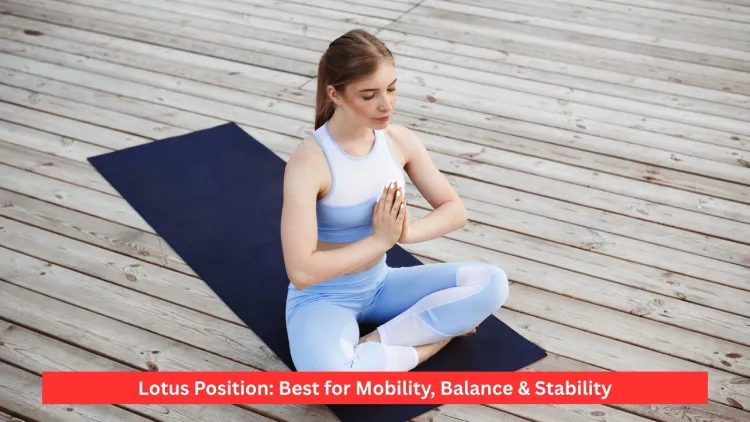

The lotus position is a seated exercise widely practised in yoga and mobility exercises, which improves core stability, spinal posture and strength, and hip flexibility and joint control. It’s not only a meditation pose but a core exercise that isometrically strengthens lower body muscles, enhances posture, and balance. Regularly practicing the lotus position can boost flexibility, reduce pain and stiffness, and improve body awareness. But it needs to be introduced gradually and should not be forced, particularly for novices or when the knees and hips are tight.
- Exercise: Definition of Lotus Position
- Lotus Position Muscles Worked
- How to Practise the Lotus Position as an Exercise
- Working out the Lotus Posture
- Common Mistakes During Lotus Position Exercise
- Beginner Modifications
- Advanced Exercise Variations
- Safety Tips
- Who Should Practice the Lotus Position?
- Further Exercise Explained
- Good or Bad - Lotus Position?
- What is the purpose of the Lotus Position?
- Is Lotus Position Spiritual?
- Conclusion
- Frequently Asked Questions
Exercise: Definition of Lotus Position
The lotus position is a deep external rotation and knee flexion at the hip while in a seated position in yoga and exercise physiology. This is an isometric hold exercise (no muscle movement).
In the lotus position:
- External hip rotation
- Knee flexion and alignment control
- Core stabilization
- Spinal extension endurance
The lotus pose activates several stabilizing mechanisms in the body. As such, it’s a good mobility exercise for athletes, yogis, or those who suffer from stiffness and sedentary living.
The lap or lotus position is one question I am continually asked about – essentially, it’s a slow, controlled posture and alignment exercise that teaches flexibility and posture.
So, the lotus pose is also thought to provide a foundation for some of the more challenging, enhancing yoga poses.

Lotus Position Muscles Worked
Despite appearing to be a simple sitting pose, the lotus position works multiple muscles. Sitting with the body in a still position for a period of time makes this posture a type of fixed isometric exercise that incorporates flexibility, stability, and endurance.
1. Hip External Rotators
The muscles of the hip are involved in the lotus pose as the legs turn out. This aids in control and increases hip rotation with time.
2. Gluteal Muscles
The glutes stabilise the pelvis in lotus pose. They maintain hip balance and keep the body upright and aligned.
3. Inner Thigh Muscles (Adductors)
Sitting in the lotus pose gives the inner thighs a constant, gentle stretch, stretching the muscles and relieving the tension that builds up from sitting too long.
4. Core Muscles
In the lotus position, the abdominal muscles work in a low-key way to maintain an upright posture. This helps strengthen posture and core strength.
5. Lower Back Muscles
The lower back muscles are engaged to keep your back upright during the lotus pose, which improves posture and prevents slouching.
6. Ankles and Knees
Small muscles around the knees and ankles work as stabilisers to maintain joint alignment, which, over time,e helps control and stretch these joints.
In all, the lotus pose is an exercise for lower body and core stability, despite being a static pose.
How to Practise the Lotus Position as an Exercise
It’s important to perform the lotus position with good technique. This should be done gradually, without pushing the knees and the hips.
Step 1: Get Comfortable in a Seated Position
Sit on an even surface with legs out in front. Have a relaxed spine and relax your breathing and hips.
Step 2: Placing the First Leg
Lift your leg and place the bottom of the foot at the top of the opposite thigh. Allow the hip to lead the way for the lotus pose – not the knee.
Step 3: Second Leg Placement
Now bring the other leg up and place the other foot on the opposite thigh, if you can. If you can’t reach, sit with a half lotus pose instead of straining for the full pose.
Step 4: Spine Alignment
Maintain an upright posture. You can contract your shoulders back and the chest up to keep a proper posture in the lotus position.
Step 5: Core Engagement
Gently lift and contract your abdominals to ensure balance and stability in lotus pose.
Step 6: Hold and Breathe
Hold the lotus pose for 30 seconds to several minutes, breathing deeply. Do this for longer as you gradually build up to the pose.
Step 7: Release Slowly
Gently let go and stretch your legs out in front. Take it easy after the lotus pose.

Working out the Lotus Posture
There are many benefits of adopting the lotus pose as an exercise. It may appear to be a seated position, but it has a profound effect on mobility, stability, and posture. Regular practice of the lotus position will eventually improve the efficiency of the interaction between the lower body and spine.
1. Improves Hip Flexibility
The lotus pose helps increase hip flexibility. The position promotes extreme outward rotation of the hips, improving their flexibility.
Over time, the lotus pose reduces tightness in the hips, particularly in individuals who spend a lot of time sitting. This flexibility also helps with other movements such as walking, squatting, and going down, lifting up your bags, and doing other things.
2. Enhances Postural Strength
Sitting in the lotus pose involves holding the back upright for an extended period – something that activates the stabilising muscles of your posture. This engages the muscles of the back and can improve posture.
In the long run, the lotus position helps keep the body upright with less effort. This helps prevent slouching and encourages a longer sitting posture while working or studying.
3. Builds Joint Stability
Stability of the knee and ankle joints is another important function of the lotus pose. The ankle and the knee joints get used to the gentle positioning and weight.
As part of a safe and correct execution, the lotus pose works to improve control of the joints through strengthening of the supporting ligament and muscles. This may improve balance and decrease instability during other movements.
4. Improves Lower Body Flexibility
The lotus position can help relieve stiffness in the hips, thighs, and lower back. It stretches several different muscles at once and holds the body in a static, relaxed position.
The lotus pose reduces tension and strain caused by sitting or a lack of movement. With reduced stiffness, you’re more likely to perform movements with ease throughout the day.
5. Improves Body Awareness
The lotus posture may be one of the most valuable postures for improving body awareness. You have to pay attention to your body position, breathing, and balance.
It promotes mind-body coordination. The lotus pose will give you stability while relaxing, and will improve other exercises and even some sports.
Overall Effect
These are the main effects the lotus position has, but many people who practise it for prolonged periods experience even more significant changes in strength, stability, and control. This position teaches stability in inactivity, which aids physical conditioning as well as overall movement execution.
Traditionally, the lotus pose is regarded as one of the fundamental seated postures. From an exercise perspective, it is considered a basic posture to develop mobility and stability, and is sometimes organised with other major postures used for exercise that broaden flexibility and posture control.
Common Mistakes During Lotus Position Exercise
Practicing the lotus position incorrectly may cause discomfort.
1. Forcing the Knees
Forcing down on the knees is the biggest mistake in the lotus pose.
2. Poor Spine Alignment
A hunched posture decreases the effectiveness of the lotus pose.
3. Uneven Hip Loading
Pressure imbalance can change the symmetry of the lotus position.
4. Holding Breath
Your breathing should be natural in this position.
5. Overstretching
Stretch should not be painful in the lotus position.

Beginner Modifications
It may not be possible to do the full lotus position straight away. Progressions include:
- Cross-legged sitting (basic mobility stage)
- Half lotus pose (one foot rests on the opposite thigh)
- Elevated sitting support
- Dynamic hip opening drills
These variations will prepare the body for a healthy practice of the lotus pose.
Advanced Exercise Variations
For those already familiar with the lotus position, here are some progressions:
1. Lotus Position with Arm Extension
Providing a greater challenge in terms of balance.
2. Forward Lean Variation
Opens the hips more in the lotus position.
3. Moving In and Out
Improves strength and control at the joints.
4. Partner-Assisted Mobility Work
Advanced exercisers or yogis might meditate in the lotus pose with partner-assisted stretching. In traditional yoga, there are forms of partner-assisted meditation, such as the Yab-Yum posture, which is a symbolic rather than physically demanding posture.
Safety Tips
Anyone attempting the lotus position needs to take care.
- Never force knees into position
- Warm up your hips before practice
- Avoid if there is a knee injury
- Use support if the hips are tight
- Progress slowly over weeks
The practice of the lotus position is always controlled.

Who Should Practice the Lotus Position?
The lotus position is good for:
- People are improving their hip mobility
- Beginning exercisers to improve posture
- Athletes enhancing joint control
- People stretching their hips
But others should avoid or alter the lotus pose:
- Those with knee injuries
- Those with limited hip mobility
- People recovering from joint surgery
For those, alternative sitting positions are recommended.
Further Exercise Explained
The lotus position is commonly misinterpreted in online conversations where it’s combined with other (non-exercise) themes. From an exercise point of view, its use is only biomechanical.
- The lotus position is for flexibility,y not sensual pleasure or intimacy.
- It has nothing to do with personal and cultural meanings associated with sex.
- Yoga systems have deeper spiritual meaning in partner postures (such as Yab-Yum), which symbolise awareness and balance, not sporting goals.
- Downward Dog (Adho Mukha Svanasana) is a fundamental yoga asana along with the lotus position.
- The Garland squat (Malasana) is another mobility posture that might be confused with a seated pose, such as the lotus position.
- For women’s health issues such as polycystic ovary syndrome (PCOS), yoga mobility exercises can include seated stretches, but it is important to wait until it’s comfortable before doing the lotus position.
- There are no “seductive” or “pleasurable” positions in exercise science; just mobility, strength, and flexibility gains of the lotus position.
- The physical training view of the lotus position doesn’t include a discussion of cultural or religious positions.
The lotus position is a physical training neutral posture of control and mobility.
Good or Bad – Lotus Position?
The lotus position is good if done correctly, but can be bad if forced. It’s beneficial for flexibility, posture, and joint mobility when done slowly. But it is harmful without sufficient hip mobility.
So, it’s not always good to practise the lotus, nor bad, just depends on how you prepare for it.
What is the purpose of the Lotus Position?
The Lotus position’s main aim is to:
- Improve hip flexibility
- Strengthen postural endurance
- Enhance joint stability
- Train stillness and control
The lotus position is a basic mobility and positioning exercise in the world of exercise.
Is Lotus Position Spiritual?
Historically, the lotus position has a deeper meaning that relates to purity, peace, and concentration in several cultures. But, in exercise science, it is seen as a sitting mobility and stability exercise. Symbolism has no bearing on its function.

Conclusion
The lotus position is a rigorous exercise that promotes lower-body flexibility, strength, and control. If done correctly, it improves hip flexibility, posture, and body awareness. The lotus position is more than a pose, but an all-encompassing mobility exercise that benefits long-term wellness. Through correct progression, patience,e and commitment, the lotus position can be an important component of any exercise routine involving yoga.
Frequently Asked Questions
1. Why would I do the lotus pose during exercise?
The lotus position is usually used to increase the flexibility of the hips, train the postural muscles, and strengthen the joints. It also helps to train balance and proprioception by holding still and sitting in a controlled position.
2. Is the lotus position good or bad for you?
It’s a good posture when done correctly, with no forced posture at the knees or hips. It helps with flexibility and posture, but if it’s not done right or you don’t have flexibility, it can cause injury to the knees.
3. When shouldn’t you practice the lotus position?
The lotus position should not be used by people with knee injuries, stiff hips,s or arthritis. They should perform less demanding lotus variations (such as half lotus) or simply sit cross-legged instead.
4. How long do you hold the lotus pose?
The average time for a beginner is 30 seconds to 1 minute. With time, it can be practised for a few minutes. The trick is to gradually build up and make it comfortable and safe.