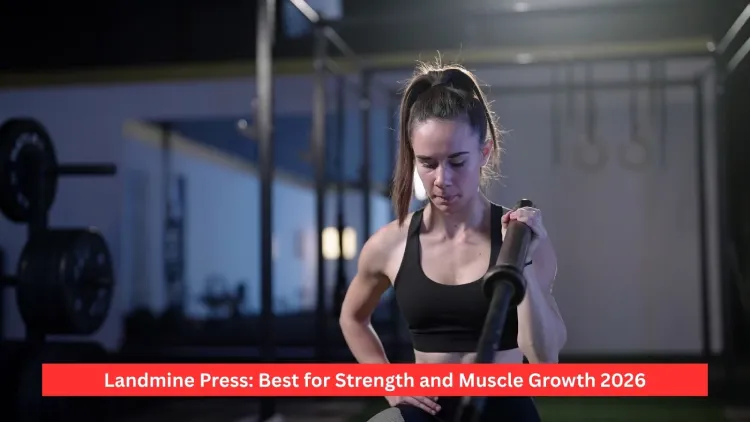

The landmine press is a shoulder-friendly and very effective exercise that develops the shoulder, chest, and core using an oblique press. It puts no pressure on the shoulders like conventional presses; it engages both muscles simultaneously and can be adjusted to a beginner or an experienced lifter. Muscle growth, stability, functional strength: any of the goals mentioned above, the landmine press is a universal movement that can be implemented in almost any workout program.
- What is the Landmine Press?
- Muscles Worked in Landmine Press
- Advantages of the Landmine Press
- How to Do the Landmine Press (Step-by-Step)
- Landmine Press Variations
- Proper Form Tips
- Common Mistakes to Avoid
- Landmine Press vs Overhead Press
- How to Add Landmine Press to Your Workout
- Who Should Do the Landmine Press?
- Safety Tips
- Final Thoughts
- Frequently Asked Questions
What is the Landmine Press?
The landmine press is a barbell resistance training that is done on one end with the anchoring section on the ground. This press utilizes a slanted pressing direction, unlike the traditional vertical pressing motions. This makes the landmine press easier to perform.
This oblique movement puts less pressure on the shoulder joints and yet enables you to produce a considerable amount of force. Due to this fact, landmine press is usually employed as a safer substitution for overhead pressing activities.
The other important feature of the landmine press is its flexibility. It can be done with one arm or both, standing or kneeling, even sitting down. This not only helps young athletes to build muscle but also to gain better balance, coordination, and general movement efficiency.
This exercise has been applied in strength training, rehabilitation, and training of athletes since it fills the gap between rigorous strength training and functional training.
Muscles Worked in Landmine Press
It is a compound movement, i.e., it uses more than one group of muscles. This renders it effective in creating strength and muscle mass.
Primary Muscles
- Anterior deltoids (front shoulders): The muscles that do the pressing.
- Pectoralis major (chest): Particularly the upper.
- Triceps: Muscles that cause the extension of the arms.
Secondary Muscles
- Core muscles: Keep your torso straight and fixate.
- Obliques: These are actively involved, especially in the single-arm forms.
- Muscles of the upper back: Assist in maintaining posture and keep it in check.
This is one of the most commonly asked questions, and it is considered to be effective for pressing the chest. Yes, it does involve the chest (particularly the upper chest), but it is not quite such a flat pressing movement as that is.

Advantages of the Landmine Press
1. Shoulder-Friendly Movement
The press is particularly reputed to be less damaging to the shoulders. The angled pressing track minimises stress to the joint, and this makes it one of the most suitable types of presses to use when individuals feel muscle pains when overhead lifting.
2. Builds Functional Strength
This is an exercise of imitation of real-life pushing patterns. The landmine press, in comparison to machines, needs to be coordinated and stable, which equates to enhanced strength in real-life applications.
3. Strong Core Activation
Although it may seem to be a motion of the upper body, the press involves intense core involvement. Your obliques and abs are also used to stabilize your body during the movement.
4. Supports Muscle Growth
No, a landmine press in no way will build the muscle. Properly done with progressive overload, it helps towards hypertrophy of the shoulders, chest, and triceps.
5. Beginner-Friendly Yet Advanced
The Controlled Movement Pattern of the press makes it safe for beginners. Simultaneously, more advanced weights can be employed by high-level lifters or other variations in order to keep improving.
6. Full-Body Engagement
Although this is not a full-body workout like squats, the landmine press does involve several parts of the body, such as the core and the stabilizers, implying it is more than a simple upper-body workout.
How to Do the Landmine Press (Step-by-Step)
Setup
- Attach one end of a barbell to a landmine attachment or corner.
- Add weight to the end of the free end when necessary.
- Face the barbell with feet at shoulder height.
Execution
- Grab the bar at chest height with either one or both hands.
- Keeping your spine neutral, brace your core.
- Press the bar up and forward in an even curve.
- Stretch your arms towards the top.
- Gradually bring the bar to the original position.
Breathing
- Exhale as you press
- Inhale as you lower
The standard guideline of the landmine press lies in 8-12 reps for muscle growth, but this may also differ according to what you would like to do.

Landmine Press Variations
This press can be easily adjusted to suit your level of strength, training objective, or comfort. These modifications are small and can assist you in training muscles in a different way without making the movement ineffective and harmful to the joint.
1. Single-Arm Landmine Press
The single-arm landmine press is done by hand at a time. This variation enhances core activity as your body will have to resist twisting as you push.
It aids in enhancing the balance on either side of your body as well. When one arm and shoulder are stronger, this difference can work to eliminate the imbalance with time. It is an excellent choice to develop functional strength, coordination, and stability.
2. Double-Arm Landmine Press
During the double-arm landmine press, the hands are gripping the bar together. It allows the movement to be more stable and enables you to work with a heavier weight than with the single-arm variant.
Beginners can use it due to its easy-to-control nature. Meanwhile, it can also be employed in strength training, as it enables one to progressively engage in overload and is not limited to possessing much balance ability.
3. Half-Kneeling Landmine Press
This move is performed when one knee is on the ground and the opposite foot in front. The half-kneeling landmine press lessens involvement of the lower body and concentrates more on the upper body and core.
It is particularly excellent at enhancing posture and stability since your core should remain tight to maintain the upright posture of the body. This stance also contributes to the minimization of your back stress.
4. Standing Landmine Press
The standing landmine press is a more practical one in which you do the movement whilst standing. It demands complete body stability, particularly of the core and lower extremities.
This difference is a close replica of natural pushing motions, and it is therefore helpful in the development of real-life strength and coordination. It also provides a minor balance difficulty as compared to kneeling forms.
5. Rotational Landmine Press
The rotational landmine press is made by rotating the torso a bit as you press the bar up. This involves the obliques more and introduces a dynamic aspect to the workout.
It aids in enhancing core strength, particularly rotational stability, and can be applied in athletic activities where twisting and pressing movements are prevalent.
Proper Form Tips
- Always hold your muscles tight.
- Do not overlean back.
- Keep a straight back.
- Use controlled movements
- Shoulders not to be shrugged.
Good form provides that the landmine press is efficient and decreases any chance of injury.

Common Mistakes to Avoid
Although this press is not very dangerous and is slightly easier than the cable press, a minor mistake in the technique can decrease its advantages and influence the performance. The exercise is effective in keeping the form clean.
1. Using Excessive Weight
Another major problem with the landmine press is over-heavy too early. This normally narrows the scope of motion and urges the body to make up for bad posture. Begin with a low intensity and then move upwards slowly to allow the shoulders and core to get used to it.
2. Lower Back Arching
The core is not braced, and this results in an overarch. This decreases stability in the landmine press and causes additional stress to the lower back. Keep your core tight to hold a safe and strong pressing position.
3. Rushing Through Reps
Increasing the rate of the slide on the landmine decreases muscle control and involvement. Controlled movement is more effective in building strength and stability as compared to fast, uncontrolled movement.
4. Poor Grip Position
An inadequate or unsteady grip may cause a deviation in the pressing course in the landmine press. A stabilized grip is tough, firm, and stable, which means more control and less movement.
5. Ignoring Core Engagement
It depends more on the stability of the core, particularly when it is done in the stance or single-arm setup. When not braced, the balance and overall output of strength drop considerably.
Landmine Press vs Overhead Press
This press is usually related to the conventional overhead movements of pressing.
- It causes less strain on the shoulders.
- It is more beginner-friendly
- It is more natural for motion.
While overhead presses are often considered one of the top shoulder exercises, the landmine press is a strong alternative, especially for those with mobility issues.
How to Add Landmine Press to Your Workout
For Beginners
- 3 sets of 10–12 reps
- Focus on technique
For Muscle Growth
- 3–4 sets of 8–12 reps
- Moderate weight
For Strength
- 4 sets of 5–8 reps
- Heavier weight
Weekly Frequency
- 2–3 times per week
Other individuals adhere to basic training principles such as the 3-3-3 rule, and as a result, this may refer to formal sets, reps, and exercise choice. Such well-organized routines are conducive to such landmines due to their adaptability.

Who Should Do the Landmine Press?
Landmine press is a flexible training regimen that suits most levels and purposes of training. It is also highly suitable for both simple and advanced routines since it has a natural pressing angle and lower joint stress.
The landmine press can be used in:
- Beginners learning pressing techniques
- Athletes need functional strength
- Persons who have had a shoulder discomfort that is healing.
- Anyone wishing to develop upper-body muscle.
The beginner score, as the landmine press can train the aspect of controlled pressing without the challenge of an overhead press. It assists in developing confidence and strength as well as coordination.
The landmine press is a popular tool used by athletes since it enhances functional strength, stability, and power that are transferred into sport movements.
People with shoulder problems (when advised by experts) also use it commonly (although this would be improper usage), as the landmine press puts less stress on the shoulder joint than the vertical press.
In a nutshell, landmine press is a trusted supplement to any training program since it helps to build strength, stability, and muscle growth in a controlled and safe manner.
Safety Tips
The landmine press needs good preparation and technique to be undertaken safely and efficiently.
- It is important to always warm up prior to doing the landmine press.
- Begin with light weights.
- Use the barbell at the secure position.
- Half in case of sharp pains.
The warming up of the shoulders, chest, and core to move and minimize the chances of strain in the landmine press.
Use lighter weights at the beginning to concentrate more on form and control. Progressively, the resistance in the landmine press can be gradually increased as you perfect your technique.
Before beginning, make sure that the barbell is well anchored. Constant position provides efficient and secure mobility during the exercise.
Above all, do not push yourself in case of sharp pains. Although muscle fatigue is not a problem, joint or shoulder pain is an indicator that you should stop and change your position.
The landmine press is considered to be one of the mildest yet effective pressures to build strength and stability of the upper body when it is used properly.

Final Thoughts
One of the most effective exercises that is practical, helpful, and does not strain the joints is the landmine press. It gets strong, gains stability, helps develop muscles, and relieves the shoulders of strain.
The landmine press may not be the best substitute for more basic lifts, such as squats or deadlifts, also known as the big lifts (or even the king of lifts), but it is a worthwhile upper-body movement.
When seeking alternatives, exercises such as dumbbell presses or push-ups may also work. Nevertheless, the landmine press has a special balance between safety and functionality that is difficult to rival.
To develop all-over strength in a balanced workout, you could include the landmine press with some of the most effective exercises, such as the squat, deadlift, and row, also known as the big four exercises.
After all, landmine press is not merely another workout method, but a potent weapon for creating a better, healthier, and more efficient body.
Frequently Asked Questions
1. Does the landmine press make muscles?
Yes, the landmine press is effective in building muscles as long as it is performed regularly with proper form and progressions in overloading it. Primarily, it conditions the shoulders, triceps, and upper chest. Resistance to the landing of the landmines gradually increases with time to enhance their size and strength.
2. Does the broad area of the landmine press reveal the chest?
Yes, the landmine press does utilise chest muscles, particularly the upper chest. Although it is more shoulder-oriented, the pressing action still uses the pecs and, therefore, can be used in the general development of the upper body.
3. Are push-ups worse than the landmine press?
The two work in their own respective ways. The landmine press gives the opportunity to add weight to gain progressive strength, whereas the push-ups make use of body weight and enhance endurance. They are most effective as an exercise that is complementary and not substitutional.
4. What is the number of reps that I must do?
The landmine press is effective in 8-12 reps for most of the objectives. Lower reps are strength building, and higher reps are endurance and control, based on what you focus on in your training.