
Oblique injury involves the abdominal muscles that twist and bend, providing core stability on the side. After injury, the process of recovery requires controlled movement, gradual strengthening, and not straining exercises prematurely. The majority of the cases can be helped within several weeks, and the cases that are severe can last months. The appropriate exercise regimen, breathing, and activation to resistance work aid in regaining strength harmlessly and avoiding re-injury.
- Oblique Injury: Safe Exercises for Recovery and Strength
- Understanding Oblique Injury in Exercise Context
- Phase 1: Gentle Activation Exercises (Early Recovery)
- Phase 2: Light Strengthening Exercises
- Phase 3: Strength Building Exercises
- Phase 4: Full Strength Training
- Eye muscle (superior oblique) observation
- Conclusion
- Frequently Asked Questions
Oblique Injury: Safe Exercises for Recovery and Strength
Chronic core muscle injury is amongst the most frequent occurrences of these both among athletes, gym-goers, and even those with sedentary habits. The obliques are fundamental to rotation, posture, and stability, and when oblique injury occurs alone, even simple movement is painful.
Although there may be an ordinary soreness, an oblique injury may interfere with ordinary and daily activities such as getting in and out of bed, walking, laughing, or turning the body. This is the reason why exercise-based recovery is important. When training is correct, it accelerates the process of healing, and the reverse is also true.
This guide aims to assist you in learning how exercise assists in healing an oblique injury, how to regain strength in a safe way, and how to prevent errors that exacerbate the condition.

Understanding Oblique Injury in Exercise Context
Two layers of muscles cover each side of the abdomen, the obliques:
- Outer (external) obliques are the outermost layers.
- Internal obliques (deeper)
These muscles help with:
- Twisting the torso
- Side bending
- Core stability
- Postural control
An oblique injury usually happens due to:
- Sudden twisting movements
- Lifting heavy items without the involvement of the core muscles.
- Overtraining abdominal muscles
- Incorrect posture in exercising.
- Sports actions such as swinging or throwing.
Experience of an oblique injury.
In the case of an oblique injury, the main symptoms include:
- Acute or non-acute pain on one side.
- Twisting pain or coughing pain.
- Pain on bending the sides.
- Weak core control
- When stretching, pain in the torso.
In more extreme instances, breathing deeply or lying in some positions can also add to the discomfort.
Weak obliques signs
Weak obliques may predispose the risk of an oblique injury and are commonly characterized by:
- Poor standing posture.
- Trouble with torso rotation.
- Strains in the lower part of the back during movement.
- Weaknesses of the core during exercises.
- Straight back (or rounded shoulders or tilted pelvis).
Diagnosis and knowledge of severity.
An oblique injury can typically be diagnosed as:
- Physical examination
- Movement testing
- The response of pain during turning or flexion.
- In extreme situations, imaging such as ultrasound or MRI is used.
In more common cases, strains occur, but in uncommon instances, a severe injury to the oblique may include a muscle tear or even complications of the ribs.
Is it serious?
An injury to the oblique may be mild or severe:
- Mild strain: slight discomfort, heals quickly.
- Moderate strain: pain with movement, must have rest and rehabilitation.
- Severe tear: excruciatingly painful, more time to heal.
An oblique injury may be completely neglected, which will result in its aggravation and delay.
Phase 1: Gentle Activation Exercises (Early Recovery)
The initial step to overcoming an oblique injury is all about calming the pain, reducing muscle guarding, and waking up the core system, very slowly. At this stage, the muscles will all be tender, and therefore, they are not going to be in training mode; they are to be used without strain. When an oblique injury occurs, proper movement may help greatly to enhance the amount of time that it takes to recover and to avoid the accumulation of stiffness. The exercises done during this phase should be easy, slow, and painless.
Diaphragmatic Breathing
This exercise is also one of the most critical beginning exercises once the oblique is injured, as it reminds you that the breathing process is involved in the core control process.
How to do it:
- Knees bent, lie on your back.
- Put one hand over your chest, and the other over your stomach.
- Take slow, deep breaths through your nose with your stomach lifting as you breathe.
- Breathe gradually out of your mouth and slightly bring your core into action.
Why it helps:
Following an injury, the body typically contracts around the area in order to shield the locality. The tension can be relieved by diaphragmatic breathing, which reinforces the proper activity of the core without any physical effort. It also enhances the circulation of oxygen, and this favours recovery.
Pelvic Tilts
Pelvic tilts are mild manner movements that do not involve any body twisting, hence suitable in the initial stages of recovery of oblique injuries.
How to do it:
- Kneeling position.
- Keep your feet on the floor.
- Bend your back, gradually, flat on the ground.
- Hold the position for a few seconds
- Breathe out and then get to rest.
Why it helps:
This exercise enhances the control and management of the lower core and assists in decreasing hardness that commonly occurs following an oblique trauma. It also promotes mild rotation of the spine and conditions the body to more strenuous activities in the future.
Knee Slides
Knee slides are like a sliding movement, with the core maintained stable, which is significant in early practices of knee injury recovery.
How to do it:
- Lying on your back, bending your knees.
- Lightly engage your core.
- Drag one heel out on the floor, slowly.
- Bring it back to the starting position
- Do the same thing on the other leg.
Why it helps:
This activity keeps the hips and lower body area moving without putting pressure on the injured obliques. It counteracts rigidity and the gradual process of recovery following an oblique trauma since drills are kept low-impact and controlled.

Phase 2: Light Strengthening Exercises
When the discomfort of an oblique injury begins to lessen, and the simplest movements are more at ease, then you can progress into light strengthening. The idea behind this phase is not to develop a high degree of muscle strength; rather, it is aimed at bolstering functional recovery, enhancing control, and avoiding stiffness following a barre injury to the oblique. There should be no painful or exaggerated movements.
Standing Side Bend (Controlled)
This is an easy motion that is used to reverse side flexibility that is lost with an oblique injury, and should always be performed with great caution.
How to do it:
- Get on your feet, with a shoulder-wide distance.
- Make your core a little bit active.
- Without forward or backward bending, slowly bend to one side.
- Slowly rejoin the center.
- Duplicate the same on the other side.
Why it helps:
It is a mild movement, which reintroduces lateral motion and stresses the healing tissues less. When properly performed, it enhances the range of motion and even movement following the injury of the oblique without adding to the pain.
Heel Slides with Core Engagement
This exercise is about soft activation of the core with controlled movement.
How to do it:
- Knees bent, lying on your back.
- Slightly strain your stomach muscles.
- Gradually, press one heel aside.
- End it gradually, then flip it and do the same on the other side.
Why it helps:
- It stimulates the core in a very low-impact manner, which aids in regaining strength after an oblique injury without overworking the muscles. It enhances the coordination of the core and lower body, also.
Seated Core Hold
It is an isometric exercise, which is a type of exercise whereby the muscles contract without moving.
How to do it:
- Stand up on a chair.
- Make your back straight.
- Or squeeze your stomach muscles together.
- Traits Hold 10-20 seconds, normal breathing.
Why it helps:
It develops central stamina and steadiness post an oblique injury without exerting strain on the damaged region. It is particularly helpful in meeting the control again before transferring to more strenuous exercises.
Heat or Ice for Oblique Injury
Correct use of heat/ice can greatly aid in healing in an oblique injury, particularly in the initial phases.
At the initial stage, ice is preferable because:
- It reduces inflammation
- It numbs pain
- It limits swelling in the injured area
- Heat in the later phases of recovery is due to:
- It relaxes tight muscles
- It enhances the flow of blood.
- It helps to move and be more flexible.
A combination of the two at the right time aids the body to heal better in case of oblique injury, along with other mild exercises.
By this point, it ought to feel like you are making progress. The aim is to restore the trust in movement and get the body ready to do more vigorous exercises in the future following an oblique injury.

Phase 3: Strength Building Exercises
This stage aims to restore power following an oblique injury without aggravating the healing muscle. When the most basic movements become more comfortable and there is less pain, light strengthening can be commenced. This stage plays a vital role as it helps stabilize the injury and can prevent the relapse of the oblique injury on returning to normal activity. This is all about regulated motion, rather than intensity. All the exercises are supposed to be pain-free.
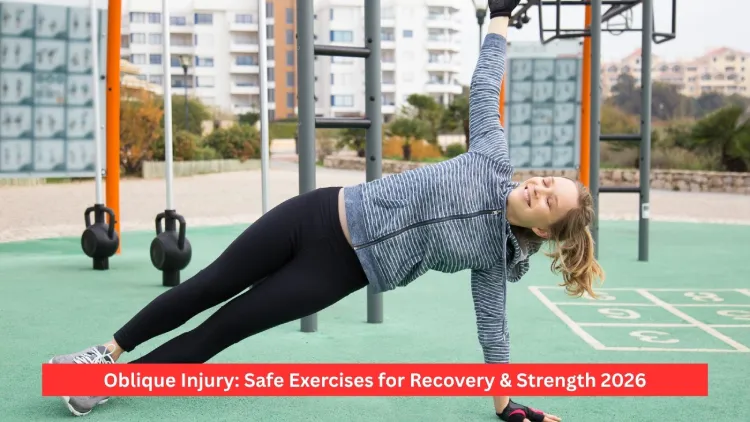
Modified Side Plank
This is one of the safest and most effective exercises that can be done after an oblique injury.
How to do it:
- Lie on your side
- Kneel to help you.
- Bend your elbow below your shoulder.
- Raise hips slightly above ground.
- Wait a moment, then drop gradually.
Why it helps:
It is a non-twisting oblique exercise that causes minimal strain on the oblique during the time of healing after an oblique injury, which is why it is the best. It strengthens the side core and enhances stability.
Bird Dog Exercise
An excellent exercise to enhance balance as well as core stabilization in the event of an oblique injury.
How to do it:
- Start on hands and knees
- Reach with the opposite arm and leg.
- Hold briefly
- Turn around and turn over sides.
Why it helps:
It also ensures the core is kept stable and lessens muscle asymmetry because of an oblique injury. It also enhances the improvisation of upper and lower body coordination.
Anti-Rotation Band Hold
Quite helpful in the reconstruction of the actual core strength of the body that had just sustained an oblique injury.
How to do it:
- Wrap a resistance band around your chest.
- Use both hands to hold.
- Have your body in a forward position.
- Draw not tightly without twisting.
Why it helps:
It works the obliques to act against rotation, which is their primary action. This can be very useful when an oblique injury has taken place, as it will reestablish functional strength safely.
How to Strengthen Oblique Muscles Safely
- Gradual progress is the key after an oblique injury.
- Begin with light, moderate activities.
- Do not twist rapidly at an early age.
- Apply resistance bands before weights.
- Gradually become more difficult.
Regularity is greater in the healing of an oblique injury than intensity. It is aimed at restoring the strength without causing pain once again.
Phase 4: Full Strength Training
The stage is oriented on the progressive movement following the complete healing of an oblique injury.
Controlled Russian Twist
Start light:
- Seat feet on the ground.
- Turn gradually sideways.
This is beneficial in the rebuilding of rotational strength following an oblique injury.
Cable Wood Chop
A functional movement:
- Pull the cable diagonally
- Movement in both directions of control.
This replicates actual movement and makes up obliques following an injury to the oblique.
Big 3 Core Exercises
The best core activities are:
This is believed to be necessary to prevent future oblique injury.

Common mistakes in oblique exercises
Numerous individuals make the situation of an oblique injury worse by:
- Twisting too fast
- Early use of heavy weights.
- Ignoring pain signals
- Skipping warm-ups
- Exercising in a poor position.
Avoiding these injuries accelerates the healing of an oblique injury.
Eye muscle (superior oblique) observation
Occasionally, oblique injury is also used to mean eye muscle complications such as superior oblique dysfunction, which may result in:
- Double vision
- Eye strain
- Head tilt compensation
This has no relation to abdominal oblique injury, but it has the same name.

Conclusion
Oblique injury involves patience, controlled movement, and an incremental process. Exercise itself is one of the most useful aids to recovery, provided that it is performed properly.
The process through breathing and activation, to stability work, and eventually at the end to strengthening training would guarantee the necessary full recuperation without failure. One of the most frequent causes of recurrent pain is the disregard of an oblique injury or its realization back to intense exercising.
By proper treatment, the majority of individuals recover completely after an oblique injury and come out stronger.
Frequently Asked Questions
1. What is the average length of time of an oblique injury?
Curement of an oblique injury is dependent on the severity of the injury. Mild injuries can be healed within 1-2 weeks, moderate injuries will heal within 3 to 6 weeks or even longer, and in severe cases, it may be a full 6 to 12 weeks or even longer. Rest and controlled exercises are also important in accelerating the healing process.
2. Can I work out with an oblique injury?
Of course, but in the proper direction. The light and non-vigorous movements are safe, and in fact, they aid recovery of an oblique injury. Nevertheless, strenuous twisting, swift core exercises, or weight lifting in the immature state should be avoided as they can aggravate the condition further.
3. How do we do the best exercises to help with the oblique injury recovery?
The most comfortable exercises are diaphragmatic breathing exercises, pelvic tilt exercises, bird dog, modified side plank, and anti-rotation band holds. These assist in restoring the core stability with no pressure on the healing muscles following an oblique injury.
4. Is it possible to repair an oblique injury without exercising?
With mild cases of oblique injuries, rest is adequate to recover, but the recovery is slower and less robust. Light exercises support restoring strength, flexibility, and stability that help to decrease the risk of re-injury and contribute to a more effective recovery.