
Bodyweight squats are among the best exercises that can be performed without using equipment to strengthen the lower body, to increase mobility, to burn calories, and to increase general health. They train several muscle groups, aid with the position, strengthen the core, and even assist in metabolic functioning. Bodyweight squats can be very accommodating to any level of fitness, whether you do a few reps on a daily basis or include them as part of a daily routine.
- What Are Bodyweight Squats?
- Advantages of the Bodyweight squats
- How to Do a Bodyweight Squat
- Common Mistakes to Avoid
- Variations of Bodyweight Squats
- The Effect of Bodyweight Squats on Daily Fitness
- Fat Loss and Body Composition
- Strength Development and Muscle Building
- Maximum Result Timing and Frequency
- Common Health and Safety Concerns
- Squats in Combinations with Other Exercises
- Bodyweight Squat Long-term effects
- Conclusion
- Frequently Asked Questions
What Are Bodyweight Squats?
One of the essential exercises that can be identified is bodyweight squats, in which a standing posture is bent by prostrating the hips and standing back upright with no one but your own weight as resistance. The exercise is very versatile and was implemented as one of the most favoured exercises by strength and mobility because it does not need any gym equipment, as opposed to weighted squats.
The main muscles engaged during squats with bodyweight are the quadriceps, hamstrings, glute and calves. Also, you use your core muscles to ensure that you are in balance and in the proper position. This is what makes bodyweight squats a compound exercise in the sense that the exercise is able to work more than one muscle group at a time, making it a higher calorie-burning exercise and functional fitness.
In addition to strengthening the muscles, bodyweight squats increase mobility, flexibility and coordination. This is especially relevant to such simple exercises as walking, stair climbing, and bending. Even after some time, you may also be able to change your posture and limit the probability of lower back pain due to the constant practice.

Advantages of the Bodyweight squats
Bodyweight squats have numerous advantages, both to the novice and to the elite sportspeople.
Trains the Lower Body Muscles
Squats are also effective in training your quadriceps, hamstrings, glutes, and calves. A frequency of practice will contribute to the development of endurance, tone, and power in muscle, which will simplify normal movements and improve sports performance.
Improves Core Stability
In squats, it is important to engage your core to maintain balance. This helps in strengthening the abdominal and lower back muscles, hence helps in posture, maintains the health of the spine, and helps to gain control of the body collectively.
Joint Health and Mobility
Squats involve hip, knee and ankle movements, which are healthy in enhancing functional mobility and flexibility of joints. This can assist in preventing stiffness, minimizing risk of injuries as well as relieving pain related to such conditions as sciatica.
Increases Metabolism and Calories burned
Being a compound exercise, bodyweight squats involve a variety of muscle groups which burns more energy and introduces an efficient burning system. They can help to maintain weight and lose fat when done in increased repetitions, or in conjunction with other cardio exercises.
Anytime, Anywhere
Bodyweight squats need only equipment, and are therefore practical in working out at home, in the office, or outdoors. You can do them on small areas or use them as part of some body circuit training.
Supports Metabolic Health
Frequent squatting can be used to maintain normal blood sugar levels through incorporating muscular glucose uptake and enhancing insulin sensitivity. This causes them to be helpful in general metabolic condition.
Enhances Bone Density
Exercises involving weight such as squats are capable of promoting bone growth and bone density that also aid in strengthening the skeletal system particularly among the elderly.
Improves Body Composition
Bodyweight squats may help in achieving lean muscle in the lower part of the body, aid fat burning and an overall body appearance, by building lean muscle in that lower body as well as the core.
How to Do a Bodyweight Squat
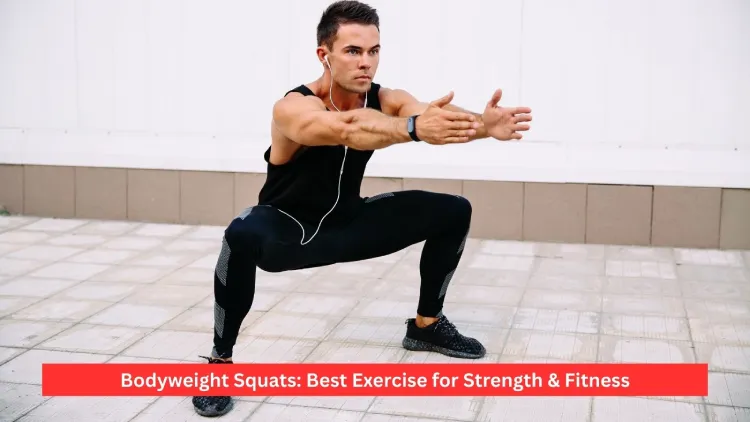
Squatting correctly is important in ensuring the greatest amount of good is gained and the risk of being injured is low. Follow these steps:
Start Position
Stand with feet having a shoulder-width distance with slightly pointed toes. Hold your arms before you in order to balance yourself.
Lowering Phase
Slide back the hips like you are sitting on a chair. Keep your chest erect, core tight and straighten your back whilst bending your knees.
Depth
Bend down till your thighs touch the ground. To be able to do this is always good provided there is flexibility and balance but form should not be compromised.
Return to Standing
Bear in mind to press in your heels to get in the upright position again remembering lifter your chest and tighten in your core.
Repetitions
One can begin with 2-3 sets of 10-15 repetitions and proceed with more experienced users who can work up to 3-4 sets of 20-30 repetitions. Unity is important where results are obtained as time goes by.

Common Mistakes to Avoid
In case of bodyweight squats, even an ordinary exercise can cause injuries in case of improper practice.
Avoid these common mistakes:
- Leaning Forward: with straight back to safeguard the lower back.
- Knees Caving In: Have your knees flexed over your toes in order to avoid stressing your joints.
- Shallow Squats: Squat as low as possible, at least, until your thighs and the floor are parallel to each other in order to maximize muscle benefit.
- Rising Too Quickly: Continuous movements, which would be steady, also enhance the muscle activity.
Variations of Bodyweight Squats
To violate the routine and to make it difficult, add the following variations:
- Sumo Squat: Wide stance and the toes turned outward. Tugs interior thighs harder.
- Jump Squat: Bring in a jump at the top to be more powerful and cardiovascular.
- Pulse Squat: Long wave up and down pulses at the base of the squat ensure constant tension in the muscles.
- Single-Leg Squat (Pistol Squat): Complex postural adjustment and single leg strength.
- Tempo Squat: Delay the descending and increasing phase so that much more time under tension and work are raised.
The Effect of Bodyweight Squats on Daily Fitness
The bodyweight squats are not entirely cosmetic related as they contain practical gain that can be applied in daily living:
- Strengths Performed each day: Squats strengthen the legs to undertake everyday tasks such as stairs, lifting of items or walking.
- Step Equivalence: It is not the same, but again 200 to 250 squats would have a similar cardiovascular and burning-fought benefit as walking 10,000 steps.
- Bone and Joint Health: Consistent squatting of bones enhances joint and bone stability lowering the chances of osteoporosis and knee related issues.
This is because even small daily intervals like 10 squats per hour will be added up over a day to enhance stamina and fat burning. Squatting every day over 30 days will have a significant positive effect on the tone of muscles, strength, and posture.

Fat Loss and Body Composition
Squats on bodyweight are useful in developing muscle tone and in assisting fat loss:
- Belly Fat: Even though it is impossible to reduce fat in a spot, the squats will assist the development of large lower body muscles that enhance metabolism, which will help in losing fat (including the belly).
- Calorie Expenditure: Intense intense squat sessions will help to burn 300-600 calories regardless of intensity and duration. This, in combination with a healthy diet, will help to decrease body fat.
- Body Shape: The tightening of the glutes, hamstrings and quads of the body will redefine the body form and make it more in line with the body posture and symmetry.
A combination of squats and other activities such as lunges, planks, and push-ups forms a complete workout, which functions faster in fat burning and building up body muscles.
Strength Development and Muscle Building
Squats on the body can be effective at building muscle, provided that they are done regularly and intensively:
- Progressive Overload: The gradual increase of the reps, tempo variations, or the use of resistance bands can advance in hypertrophy.
- Upper Body Engagement: Although the lower structure is mainly engaged in this exercise, the core is also involved in strengthening the whole body.
- Strength Potential: High-rep squats even without weights are challenging to the muscles and can be used to promote growth in the long term.
Most of the time, squatting every day will enhance the leg power and stamina of adults. To illustrate, any man with the bodyweight squat with moderate intensity and working with a 75 kg bodyweight can experience the increase in the quadriceps, hamstring, and glute strength in weeks.
Maximum Result Timing and Frequency
- Best Time of Day: There is no particular time of the day you should do squats but you tend to do it better when your body is fully awake (when you wake up in the morning or when your body is in the middle of the afternoon).
- Frequency: The adequate frequency to perform bodyweight squats is 3-5 times per week, but squats with rest in a day can be effective as well.
- Rest Days: Muscle requires rest to recover and therefore an alternate in-between of days or high-rep sessions does prevent overuse injury.
The brief sessions (such as 10-20 squats) can increase metabolic rate and give breaks of activities to the otherwise sedentary work.

Common Health and Safety Concerns
Squats that involve bodyweights are typically considered to be safe but there are some considerations:
- Joint Health: Keeping the knees and hips straight. Squats can mostly be safe with healthy knees and are taken to be good with joint mobility.
- Going Too Far: Being on the squats all the time and not taking a break may cause fatigue or strains. Listening to your body helps you to avoid over training.
- Injury Risk: Knee or lower back injuries may be caused by either pre-existing conditions, a bad form or a sudden change in the volume.
The squats can be customized to suit age, fitness, and mobility restrictions in their modified form. Although the senior citizens are more advanced in age, they can engage in partial squat to keep their legs consistent and strong.
Squats in Combinations with Other Exercises
To have a balanced exercise program:
- Exercises to Lose Fat: The 4 exercises using squats, push-ups, planks, and lunges will go together to form muscle and burn calories.
- Cardio Pairing: Squats with high representations or jump squats in combination with brisk walking or biking are beneficial to the cardiovascular system.
- Integration of Strength Training: Incorporation of the squat as a basic exercise within the circle or the exercises that involve resistance.
The combination will assist in lean muscle development, ageing bone density, increase in mobility and assist fat loss.
Bodyweight Squat Long-term effects
- 30-Day Change: Frequent squatting throughout a month would have been able to boost the strength, endurance, and posture of the lower body, as well as increase core stability.
- Sustainable Fitness: With the help of bodyweight squats, a lower level of exercise, such as the squat with weights, lunges, and deadlifts, can be accomplished more easily.
- Metabolic and Hormonal Therapy: Squats facilitate normal glucose movement, insulin resistance and might assist in maintaining metabolic health in the long term.
Bodyweight squats bring about quantifiable results as long as one is interested in strength, weight management, or functional fitness.

Conclusion
The mother exercise is bodyweight squats. They make the lower body more convincing, allow better core stability, mobility, burn calories, and contribute to metabolic health. Squats are flexible as they can be done in any place and at all ages and fitness level and as a result, it is a very vital exercise.
Through outright form, repetitive workouts and periodic variations, bodyweight squats offer a total fitness solution. After weeks and months, you will realise that you are stronger, more enduring, more postural, with better body composition and health, without the use of equipment or a gym.
Add squats with the weight of the body and enjoy one of the most efficient, versatile, and most accessible exercises for overall fitness.
Frequently Asked Questions
1: Do bodyweight squats work?
The squats in the lower body are indeed very effective in strengthening the lower body, involving the core, and enhancing general mobility. They use more than one set of muscles at the same time, thus a compound exercise, which helps in functional fitness and strength.
2: What is the frequency of squatting with the body weight?
To achieve some positive results, use 2 to 3 sessions, 10 to 30 reps sets, 3 to 5 days. The most important thing is consistency, and it can be seen that through even little sessions that last daily, strength, endurance, and posture can be enhanced.
3: Do bodyweight squats aid in fat burning and bodybuilding?
Absolutely. Although squats are not a belly fat-reducing exercise, they develop or grow large body muscles in the lower part of the body, which increase metabolism and burn energy. In addition to other workouts and a balanced diet, squats may make a body lean, buttock and body shape.
4: Can bodyweight squats be performed at any age and fitness level?
When performed in the right form, bodyweight squats are safe even for most people. They can be modified to suit individuals who are beginners, elderly or individuals who have mobility difficulties. The remedies to this injury are to avoid overtraining, use proper posture, and take rest days between games to minimise injuries.