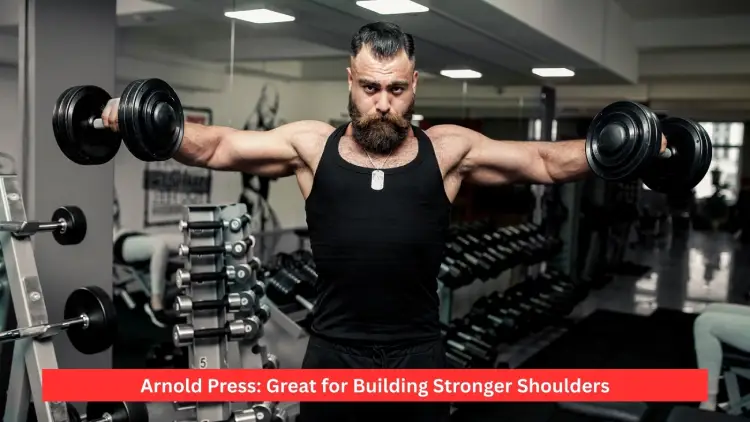

Arnold Press exercise is a shoulder technique, which is a combination of strength, size, and stability. Essentially, contrary to conventional presses, its rotating action is effective for all deltoid heads, also involving supporting muscles, and it can also be made more beginner andadvanced-lifter-friendlyy. The Arnold Press is effective and versatile, making it a foundation of any upper body routine and provides a perfect way of sculpting 3D shoulders.
- What Is the Arnold Press?
- The Arnold Press works the following muscles
- Intro to Arnold Press
- Benefits of the Arnold Press
- Arnold Press vs Shoulder Press: Which one is better?
- The Arnold Press has some common errors.
- Modifications of the Arnold Press
- Arnold Press Shoulder Workout: How to Fit in Arnold Press Workouts
- Precautions to maximize Shoulder growth using the Arnold Press.
- Safety Considerations
- Arnold Press and Total Upper Body Strength
- Exercises to Arnold Press Compared with Other Shoulder Exercises
- Performance Benchmarks
- Conclusion
- Frequently Asked Questions
What Is the Arnold Press?
A variant of a standard dumbbell overhead press is called the Arnold Press. Arnold Schwarzenegger made this exercise popular, although it still requires a turn of the wrists in the press, where the palms face back at the beginning and forward at the top. This special kind of movement works not only the front delts, but also the side and rear deltoids and therefore gives the whole shoulder a workout in a single motion.
The Arnold Press is different in that it involves both pressing and rotation, an added benefit compared to the traditional shoulder presses or military presses, which have restricted movement, shoulder stability and mind-muscle connection. It is not only a strength exercise but also a sculpting tool that allows making the shoulders look round.

The Arnold Press works the following muscles
The Arnold Press is a very efficient shoulder exercise which involves hitting the deltoids with a few other supportive muscles to give stability and strength.
- Anterior Deltoids (Front Shoulders): These are the main movers, which are involved in the pressing and rotation as well as increasing shoulder size, strength and functional pushing of the shoulder.
- Lateral Deltoids (Side Shoulders): triggered when you press over your head, and it expands the shoulders and enhances the body’s upper torso symmetry.
- Posterior Deltoids (Rear Shoulders): The use of the rotational movement is used to encourage balanced development and posture.
- Trapezius (Upper Back): Is used to stabilise the shoulder girdle in the press and assist in supporting the strength of the upper body in general.
- Triceps: Helps in extension of the elbow, giving extra support and stability to heavier presses.
- Rotator Cuff: It stabilises the shoulder joint during movement, lowering the risk of injury.
- Secondary Muscles: These include the chest, core and upper back, which assist in keeping a stable posture and correct form,m especially when the exercise is carried out standing up.
Being aware of the muscles involved, you will be able to better connect the mind and muscle, get the maximum growth, and perform the Arnold Press as an exercise of power and shoulder-shaping.
Intro to Arnold Press
The Arnold Press project is crucial in achieving maximum benefits with minimal harm. To do so, follow these steps:
Starting Position:
- Sit up or stand up, keeping a distance between your feet and your shoulder.
- Grasp dumbbells at the level of your shoulders with palms to your body.
- Utilise your back core and ensure that your chest is not slumped.
The Press:
- At this point, you will move your palms outward and lift the dumbbells on top of your head.
- Warm up your arms, bring them to full extension without locking the elbows.
Lowering Phase:
- Gradually spin your palms back to the body, bringing the weights back to your shoulders.
- Keep the weights under control; do not allow them to fall too fast.
Repetition and Sets:
- Novices can do 3 series of 8-12 repetitions.
- Advanced lifters can add volume or weight at a slow pace.
The ability to save control and a complete spectrum of movement is more significant than to raise heavy weights. Correct shoulder positioning will help increase the shoulder movement as much as possible and minimise the chances of typical harm.

Benefits of the Arnold Press
The Arnold Press has several advantages, not limited to conventional exercises of the shoulders:
- Full Deltoid Activation: Loads all three groups of deltoid muscles, with which there is balanced development of the shoulders.
- Shoulder Stability: Tightens thestabilisingg muscles, e.g. rotator cuff and upper back.
- Flexible to Strength and Hypertrophy: It may be done with moderate weight to put on size or heavy weight to put on strength.
- Better Mind-Muscle Dynamics: The rotational movement emphasises the shoulder involvement during the movement.
- Shoulder Development in 3D: Anterior, lateral and posterior activation combine to improve the aesthetic of the shoulder.
Arnold Press is one of the fundamental exercises that every person who wants to have fit, well-contoured shoulders must have in their arsenal of exercises, as this mode of exercise is both functional and hypertrophic.
Arnold Press vs Shoulder Press: Which one is better?
Both the Arnold Press and the traditional shoulder presses are useful, although they have slightly different uses.
- Arnold Press: Provides more motion and engages more shoulder muscles, such as back delts. It also enjoys the advantage of rotational motion, which makes it the choice of the sculptors who are concerned with making 3D shoulders.
- Traditional Shoulder Press: It is easy to perform and is possible to perform heavier lifting because of its direct direction. Superb as far as pure strength gains only,y and possibly insufficient recruitment of stabilising muscles.
The Arnold Press is usually safer to the shoulder than a butterfly press as far as safety is concerned due to the reduction of impingements in the process of a correctly executed rotation. Nevertheless, the heavier weights should be taken into consideration carefully to ensure that there is no strain on the rotator cuff.
The Arnold Press has some common errors.
Even the professionals with regard to lifting weights may err when it comes to the Arnold Press.
These errors should be avoided to achieve the best results:
- Excessive weights: Pain develop and risks of injury are augmented. Beginning with lighter to master rotation.
- Incomplete Rotation: Even the incomplete rotation of the palms does not allow activation of the deltoid.
- Shrugging Shoulders: Traps to be relaxed and shoulders to be down.
- Arching the Back: Use the lumbar to save the lower back.
- Leap Frog Repetitions: Slowly moving and constant movements enhance strength and hypertrophy.
It is these errors that are corrected to lead to safer execution and more efficient growth of the shoulder.
Modifications of the Arnold Press
Since you need to keep the muscles taxed and avoid plateaus, you should mix it up on your shoulder:
- Seated Arnold Press: It decreases the momentum andcentress on the strictness of forms.
- Single-Arm Arnold Press: It works each shoulder separately and balances the load out with one another.
- Cable Arnold Press: It applies a constant load to the deltoids to hypertrophy.
- Standing vs Seated: Standing is more exciting as core muscles are involved, whereas seated is stable and able to lift heavy.
Through rotation of variations, you are able to keep the muscles constantly challenged, and thus growth of all deltoid heads is promoted.

Arnold Press Shoulder Workout: How to Fit in Arnold Press Workouts
To maximise the development of the shoulders, combine the Arnold Press with other specific exercises:
- Warm-Up: Lots of shoulder mobility exercises and easy cardio within 510 minutes.
- Arnold Press: 3 -4 sets + 8-12 repetitions of primary shoulder activation.
- Lateral Raises: 3 sets of 12 -15 reps will target side delts.
- Front Raises: 3 sets of 12 -15 reps to continue to use the anterior delts.
- Rear Delt Fly or Face Pulls: 3 sets 12 -15 reps to engage the aller goes.
- Elective Shruds: Intensify trape to have an overall aesthetic appearance at the entire upper part of the body.
- Cool Down: Shoulder, Trap and Chest stretching to help the recovery process.
The combination guarantees balanced growth, and the possibility of shoulder imbalance and injury is decreased.
Precautions to maximize Shoulder growth using the Arnold Press.
To create powerful, three-dimensional shoulders:
- Pay attention to the progressive overload: Step by step, it is possible to add weight/volume.
- Basic priority: Have mind-muscle connection: make sure that it is the delts doing the work, not the arms.
- Optimally use with the combined lifts: Bench presses, pull-ups, and rows, which stress muscles.
- Rest body, shoulders get sore. Rest 48-72 hours between intensive sessions.
- Combine with appropriate nutrition: Enough protein and energy promote the development of muscles.
By constantly adhering to these concepts, any individual will build wide-set, T-shaped shoulders that will be significantly outstanding.
Safety Considerations
Although the Arnold Press is not dangerous as a rule, several factors should be taken into consideration:
- One should also not use excessively heavy dumbbells, as it will involve poor form and load on the rotator cuff.
- The newcomers are recommended to be positioned sitting to stabilise and train good rotation of the spine.
- Overhead presses should be avoided by individuals with pre-existing injuries in their shoulders, as they may result in adverse outcomes.
The Arnold Press is potentially safer than a normal shoulder press when being done properly, as its rotation mechanics lower the chances of shoulder impingement.
Arnold Press and Total Upper Body Strength
The Arnold Press does not merely build shoulders but will also help in the strength and stability of the upper body. The muscles involved in the movement include triceps, traps, rotator cuff, and are supported. With practice o, one can gain overall pressing strength, increased results in the bench presses, push-ups, and even sporting manoeuvres

Exercises to Arnold Press Compared with Other Shoulder Exercises
And although there are a lot of shoulder exercises, Athe rnold Press occupies a different status:
- Military Press: Is more targeted to the anterior delts; it is more appropriate for the development of strict strength.
- Lateral Raises: Narrow delts.
- Front Raises: Trains front delts.
Shrugs Strengthens trapezius to increase shoulder size
The Arnold Press is frequently regarded as one of the most appropriate shoulder exercises, in general, and as a compound exercise, in particular, because all the heads of the deltoid muscles are attracted into it.
Developing Big Shoulders and 3D View
Having big and distinct shoulders can be attained through a mix and match of exercises, diet and rest:
- Compound Presses: Arnold press, Military press and Bench Press variations of mass in general.
- Isolation work: Front suffix Rear delt Lateral raises, and rear delt, to shape and define.
- Progressive Overload: Add weights oover timewith ithe issuanceof appropriate form.
- Response: Exercise 2-3 times daily, with an equal amount of volume and rest.
- Recovery: The muscles in the shoulder cease to be developed when overtrained; therefore, rest and sleep are necessary.
A cornerstone exercise, such as Arnold Press, would guarantee balanced development and would help create the desired 3D shoulder.
Performance Benchmarks
To put that in the context of the different levels of strength:
- When one is 70 kg in weight, it is possible to target 40-70kg or so on the overhead press, according to experience.
- Heavy presses show more developed strength, but it must not affect form.
- The Arnold Press with moderate weights in increased reps tends to build size, as opposed to actual strength.
This method will allow avoiding injuries and, at the same time, realise significant benefits.

Conclusion
The Arnold Press is not only a shoulder workout, but a full deltoid development shoulder exercise that will increase size, strength, and stability. Its rotation allows it to stand out in the market compared to normal presses and offers a safer and more efficient way of producing full, 3D shoulders. The Arnold Press may be used to make any upper body workout more effective and allow people of any level to develop strong and well-shaped shoulders by applying the successful combination of proper technique, progressive overload, and complementary exercises.
Frequently Asked Questions
1. What are the biggest muscles that are used in Arthe nold Press?
The Arnold Press primarily targets the deltoids front (anterior), side (lateral), and back (posterior) and therefore is a good exercise to have a well-rounded shoulder.
2. Do other muscles get involved?
Yes. The trapezius, triceps, and rotator cuff are usealso d in order to stabilise shoulders and aid the pushing movement.
3. Do you mauseecondary muscles be Arnold Press?
Absolutely. The chest, core, and upper back assassist maintaining the balance, posture, and correct form par, particularly when undertaking the exercise in an upright position.
4. So why are we concerned with knowing what muscles are engaged in?
Applicable knowledge on the muscles involved enhances mind-muscle connection, maximises growth, enhances strength, thereby increasing injury risk to the shoulder.