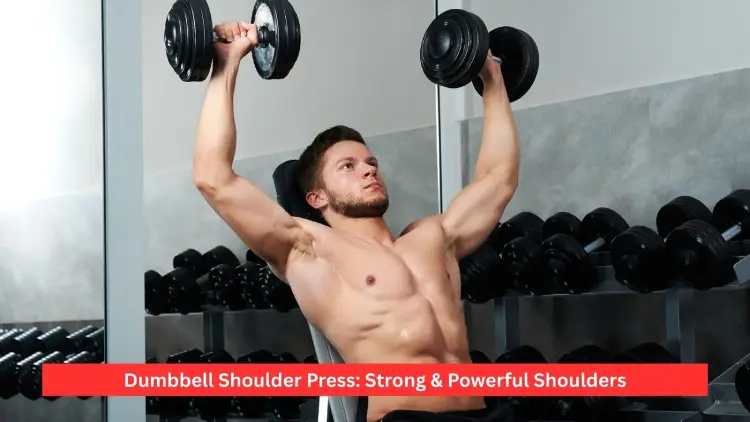

One of the best exercises to build and strengthen all three heads of the deltoid, with involvement of the triceps and upper chest, can be done through the dumbbell shoulder press. It enhances the strength of the press, the shoulder becomes more stable, and the general growth of the upper part of the body is strengthened.
Good form, the right bench angle, progressive overload guidelines, and the intelligent training schedule are the right keys to the most outstanding outcomes. Knowing the optimal weights, making the right mistakes, and knowing how to tell when you are under-training are some of the ways you can develop safely. Combined with good programming, this exercise can build muscle, fatten shoulders, and give arms a good look.
Dumbbell Shoulder Press is very effective due to the following reasons
- This is an incredibly effective exercise, as it can press several muscles that are located in the upper part of the body simultaneously and press the shoulders to move in an extremely difficult way. Most of the load is put on the anterior-medial deltoids; the triceps, traps and upper chest also play a role.
- The other advantage of it is the source of freedom of movement dumbbells provide. Dumbbells also enable you to press in a manner that best fits your shoulder structure, unlike a barbell, where you are locked to one particular direction. This will take away the joint stress, and more natural movement will be promoted. This also explains why dumbbells are mostly used by lifters who have been facing shoulder pain.
- The workout also aids the development of strength. Following guidelines such as the 2-for-2 rule, which states that you need to gain weight only when you can add two more reps to two consecutive workouts, would keep you growing and always safe.

Shoulder Press with Dumbbells (How to do it correctly)
The right form is very important in case you need to get stronger, build any muscle, or prevent any injuries. Begin by choosing a weight with which there is maximum control. Novices would begin with 5kg -10kg dumbbells, whereas more experienced weight lifters would proceed to 20kg -40kg, depending on the level of strength.
Sit up on a bench that has your back supported, or stand straight on your back with the core of your back in the upright position. Towards the front or slightly folds upwardsHave dumbbells at the shoulder level with the palms facing either forward or slightly inwards. Raise the dumbbells vertically such that you straighten your arms without soiling them. Bring them down again under control, with your elbows bent a little in front of your torso, so that they will not stick on the shoulders inside.
Bench angle matters too. It is also a subject of debate among many athletes as to which one is the best between 45, 60, and 90 degrees. A full 90-degree sitting Press is the most difficult on the shoulders, but it may be a source of discomfort to other people. Sixty degrees is a common angle which offers the most combinations between shoulder activities and joint comfort. Low angles, such as 45 degrees, incorporate more upper tors, and hence do not give the optimal shoulder training. In the motion, do not arch up your back or puff your elbows. It will keep the shoulders in good shape and prevent unwarranted neck strain.

Common Mistakes to Avoid
- The second largest error is that of pressing too hard at an early stage. Shoulder press with a 20kg dumbbell should be good with most lifters, so long as they have sufficient control over it. When you lean back or cannot bear the weight on your neck, then you are too heavy.
- An elbow flared at a 90-degree angle is also another error that must not be pressed. 90-degree shoulders might appear right, but such a posture is not wanted to leave the joint with unjustified stress. A small forward inclination is more comfortable and less dangerous.
- A steeper or flatter bench angle may cause the load to be displaced off the shoulders. Wrong postures may also cause the neck or upper traps to be strained.
- Another error is the haste of the movement. The slower and gradual getting of the press is more effective in activating the muscles and avoiding injuries.
- Lastly, there are overtrainers of lifters. Shoulders are sensitive, and they burn out easily. Continuous soreness, weakness, poor performance and acute pain are indicators of overtraining. The smart training frequency is a very important element in long-term outcomes.

Advantages of Dumbbell Shoulder Press.
Dumbbell shoulder press has various advantages:
- Development of Shoulder Size and Strength: It engages all three heads of the deltoid, particularly, front and side delts, and thus, is good in enhancing the upper-body shape and size.
- Supports Arm Growth: Large shoulders appear to enlarge the arms and make them more proportionate. Most people think that the building of the arm is done by the biceps alone, and round and full people are made by strong delt, which gives the arm the shape of a defined shape.
- Helps Burn Calories: The shoulder press will not directly help slim the arms or keep the fat away, but any heavy compound exercise will increase the total amount of calories burned. Diet and total body exercise are more important in fat loss.
- Strengthens Stabilisers: The workout develops muscle in the rotator cuff, traps, and upper back, and aids in the protection of the shoulder joint.
- Additional building to Other Lifts: Bigger shoulders enhance presses on the bench, push-ups, overhead and daily lifting.
Dumbbell Shoulder Press
These are some of the variations of the Dumbbell Shoulder Press.
The dumbbell shoulder press can have a variety of different variations, which have various advantages:
1. Sitting Dumbbell Shoulder Press.
The sitting strengthens are less demanding on the legs and completely centred on the shoulders. This results in it being superior to controlled muscle-building work.
2. Standing Shoulder Press using Dumbbells.
This fluctuation involves the stabilisers and core more. It tests the balance and increases body coordination.
3. Neutral-Grip Press
To decrease the load on the shoulder joint, the palms-in grip is a safer style and prevents potential risk to persons with a prior injury.
4. Arnold Press
Famousized by Arnold Schwarzenegger, this version contains a twist in the movement. Yes, Arnold had used this exercise to develop his famous shoulder size many times. The rotation utilises more fibres of the deltoid and the time under tension.
5. Alternating Shoulder Press
Activation of the core is greater when one arm is pressed at a time, and imbalances are reduced. Regarding what kind of shoulder press is scientifically the best, there are numerous EMG studies indicating that the standing dumbbell shoulder press and the Arnold press activate the largest quantity of overall deltoid fibres. At the same time, the most favourable press in you would depend on comfort, mobility and muscle activity.

Shoulder press with Dumbbells: Who Does It?
Any person who wishes to have stronger shoulders, more strengthening of upper strength, or a better structure is supposed to do the dumbbell shoulder press. Lifters wishing to gain the same amount of muscle through only dumbbells are definitely capable of doing it as long as they employ progressive overload and adhere to organised programming.
The exercise is particularly effective in enhancing the posture, overhead strength, as well as the shoulder size of the person exercising. It can also be used by sportsmen who make use of vigorous pressing actions.
Novices can lift 5kg dumbbells, average lifters can lift 10kg-20kg, and the advanced athletes will have a lift of 25kg-40kg. The press using a dumbbell of 40kg is strong to most lifters.
On the question of what exercises are sufficient for the shoulders, the majority of the programs have approximately 3 specific shoulder moves in a workout, which consist of presses, lateral raises, and rear delt exercises to promote balanced development.
The point of the press that you feel should be in the front and the tangential deltoids, and third in the triceps.
In the case of lower back or neck pain, it is a pointer to poor form or being overweight.

Final Thoughts
Dumbbell shoulder press is among the most effective exercises used in strength training for building shoulders. When it is done without mistakes, correct bench position, and intelligent progress, it enhances strength, stability, and muscle development. Even though the shoulder press will not directly burn the arm fat, it contributes significantly to the form of wider, stronger shoulders that bring an overall enhancement to the arms.
Regularity, the gradual nature of weight gain, and self-monitoring will help you get through. The dumbbell shoulder press is a widely known exercise that should be used in every shoulder workout, regardless of whether the body worker is a beginner or an advanced worker, using 5kg dumbbells or 40kg dumbbells, respectively.
Frequently Asked Questions
1. Is the dumbbell shoulder press a beginner exercise?
Yes, it is easy for the beginner, provided one exercises with light weight and decent form.
2. What are the muscles that the dumbbell shoulder press exercises?
It primarily involves the frontal and oblique delts, assisted by the triceps and high chest.
3. What should be the best bench angle in the shoulder press?
The ideal temperature range is between 60 degrees to the majority, as it reaches the shoulders without making the neck strain too hard.
4. I do not know whether I overtrain my shoulders or not.
Severe restlessness, fatigue, or stiffness of the joints are some signs you should be able to notice.