
The running vest is an efficient piece of training equipment that provides workouts with resistance to enhance endurance, strength, and general training. Typically applied to train for 5K, 10K, and half marathons, when used properly, it increases cardiovascular efficiency and muscular endurance. Although not a necessity for all runners, the running vest would take the cardio sessions and bodyweight exercises to another level when worn with time and in the correct position.
- What Is a Running Vest in Workout Training?
- Benefits of a Running Vest
- Best Running Vest Exercises
- Sample Running Vest Workout Plan
- Running Vest Safety Measures
- Common Mistakes to Avoid
- Who Should Use a Running Vest?
- Race Factors and Exercise Situation
- Distance Training Insights
- Performance Benchmarks
- Running Vest vs Alternatives
- Exercising Regime and Attitude
- How to Progress With a Running Vest
- Why Running Vests Are Popular
- Final Thoughts
- Frequently Asked Questions
What Is a Running Vest in Workout Training?
The running vest is a resistance garment which is worn in order to evenly spread the additional weight on the torso. It does not have the artificial weight of a backpack or handheld weights, but this ensures the preservation of natural biomechanics during movement. A running vest is utilised in exercise training to augment workload in cardio and bodyweight exercises with no changes in movement pattern.
Progressive overload is very crucial in a structured exercise program. A running vest is an overload item that helps a person increase walking, jogging, sprinting, climbing stairs, and strength exercises. It can also be used as a hydration-based system during endurance training, but its fundamental usage is resistance-based conditioning.
In the case of runners who are to run 5K, 10K, or 21km, a training vest can be implemented in the conditioning stages, though not necessarily on the day of running, depending on the training objectives. There is no need to cover smaller distances, but when implemented in a strategic manner, it can enhance stamina.
Benefits of a Running Vest
1. Enhances Cardiovascular Endurance
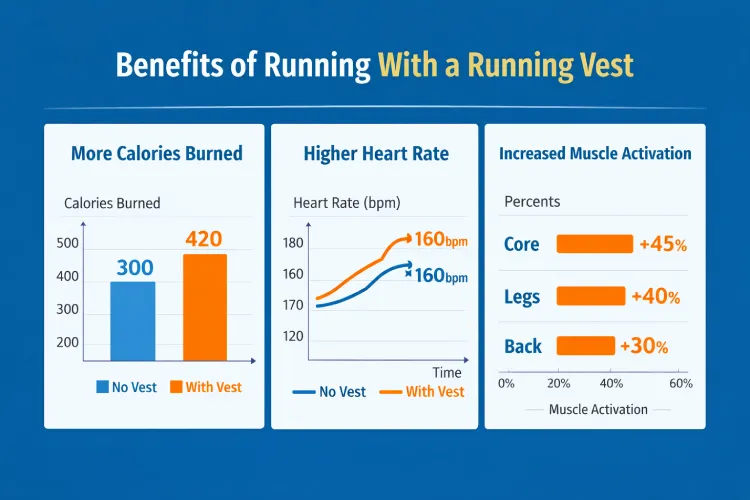
Exercising increases the oxygen demand. When you are doing steady-state cardio and put on a running vest, your heart rate will increase faster, and your cardiovascular system will have to adapt to it.
This adaptation increases aerobic capacity with time. Many athletes have reported faster and perceived easier normal runs when this happens after the vest has been removed. This principle corresponds to models of structured endurance training, such as the 80 per cent rule that has so often been mentioned in running, in which about 80 per cent of the targets are done at low- to moderate-intensity, and 20 per cent at high intensity. A running vest may be introduced in the controlled low-intensity sessions to build up gradually working capacity without escalating to excessively high-stress levels.
2. Builds Functional Strength
A running vest increases the muscle involvement of the whole body. The core is active in the stabilisation process, the glutes and quadriceps are more involved in propulsion of strides, and the upper back is used to maintain posture.
This renders it very effective on:
- Hill training
- Stair climbing workouts
- Plyometric drills
- Bodyweight fitness programs.
The additional weight is used to exercise the muscles without the need for barbells and heavy machines.
3. Increases Calorie Burn
As it is impossible to change the resistance, the caloric output can be enhanced by wearing a running vest during cardio. This would make it a practical part of the conditioning-based exercise interventions, which are aimed at fat loss and metabolic betterment.
Nevertheless, calories burned must not prevail over the correct form and healthy progress.
4. Enhances Bone Density
The stimulation of bone remodelling has been caused by impact-based loading. A running vest, when used in a proper way, can lead to long-term skeletal strength when weighted walking or jogging is carried out. Novices need to be progressive so that they do not experience stress on their joints.
5. Improves Mental Toughness
Although running is a physiological task, so is performance, mental as well. Most coaches guess that endurance performance may seem as high as 90-percent mental when in a fatigued state. Resilience is developed through resistance training. The removal of the running vest subsequently tends to give a mental edge.

Best Running Vest Exercises
The following are systematic exercises that are meant to optimise strength and endurance.
1. Weighted Running
Start with short durations. Focus on posture:
- Upright torso
- Relaxed shoulders
- Midfoot strike
- Controlled breathing
There is no need for a running vest to complete a 5K or even 21km. Nevertheless, conditioning of those distances can be enhanced by the application of one during the training.
For example:
- Beginner: 10–15 minutes
- Intermediate: 20–30 minutes
- Advanced: Tempo intervals
It is not advisable to race with a weighted vest unless this is allowed and you have been trained to do so.
2. Weighted Walking
Among the novices, walking in a running vest is best. A person who is not fit can train to run a 5K by beginning with fast walking sessions and working up to jogging sessions.
A moderate intensity 60-minute walk can occasionally match the amount of calories burned by short-term running, based on the intensity and weight.
3. Vest Push-Ups
The importance of adding load adds demands on upper-body strength. Keep a neutral cephalo-spinal position.
4. Weighted Squats
The weight is evenly distributed so that squats are safer than the barbell loading for beginners.
5. Lunges With Running Vest
Improves strength and balance on one side of the body, helping stabilise muscles during movement and enhancing overall coordination and athletic performance.
6. Step-Ups
Step-ups are suited to the training of highly competitive runners who are going to participate in longer races like 10K and 21km.
7. Weighted Plank
Stride efficiency and minimisation of energy leaks are the benefits achieved through core stabilisation.
8. Hill Sprints- Running Vest
Intensive training can include one hill sprint. Make sprint lengths short so that joints are not overworked.

Sample Running Vest Workout Plan
Beginner
A running vest is not always what you need at the beginning of the exercise. Master movement first.
Intermediate
Advanced
- Interval running
- Hill sprints
- Plyometrics
- Strength circuits
Running Vest Safety Measures
Are running vests safe? Yes, when:
- Load is suitable (initially 5 -10% body weight)
- Form remains controlled
- Volume is built up progressively.
Stop running when you have:
- Sharp joint pain
- Dizziness
- Chest discomfort
- Severe shortness of breath
Common Mistakes to Avoid
- Too much weight
- Ignoring recovery
- Poor footwear
- Skipping warm-ups
Running pace matters. An OK running pace depends on the fitness level. Most novices have a speed of 6-8 minutes per kilometre. High-end runners can run much more quickly.
Who Should Use a Running Vest?
- Endurance training in runners.
- Military-style trainees
- Athletes improving speed
- People who want to be conditioned to metabolism.
Is 80kg a heavy runner? Ability is not just the body weight. Conditioning, strength, and biomechanics are dependent on performance.

Race Factors and Exercise Situation
There are races where such vests are acceptable when the pace of the race is slow; they are not installed in races where the pace is too fast. Some of the high-end championship events limit footwear to advanced technology, such as certain stacked high-carbon plates. Models such as the advanced foam racing shoes have also been discussed, though they are only legal depending on the regulations of governing bodies.
Certain races limit the hydration vests used in a crowd on the basis of safety, whereas the vast majority of non-competitive marathons allow lighter constructions.
It is generally allowed to run naked in most events, but depending on the guidelines set by organisers.
Distance Training Insights
An average human being can also be trained to run 10km progressively. An inexperienced athlete training on 21km can take between 10 and 16 weeks basing on their fitness.
It is highly discouraged to run 30 km without training. Even accumulation of mileage will decrease the risk of injuries.
The age cover depends on the course of action, but there is no upper age limit when it comes to recreational running. A large number of older adults do endurance events successfully.
Performance Benchmarks
Another factor in good 5K performance is age and fitness. Several leisure runners take between 20 and 35 minutes.
Sometimes celebrities and leaders of technology companies and even chefs post race performances; in particular, some technology executives and celebrities have documented competitive 5K times in the amateur category, and some chefs who compete in marathons have recorded decent sub-4-hour times.
The marathon with 3 hours and 30 minutes is regarded as a great achievement of the amateur. Marathon completion is an uncommon event, with only a small percentage of the entire world population doing a marathon.
Running Vest vs Alternatives
Is it better that running belt or a running vest?
- Running belt: minimal carry, lightweight.
- Running vest: balanced loading, storage of hydration.
Other versions of a running vest are the belt of the waist in forms of a bottle, or simple backpacks. In case of resistance training, ankle weights or a weighted backpack can be used instead, but biomechanics will change as compared to a running-specific running vest.
Exercising Regime and Attitude
- Is running 90% mental? Mindset is of great importance during long-distance fatigue periods. Formal conditioning creates a physical and psychological installation.
- Can an unfit person run a 5K? Well, and gradually training along. Start by walking in intervals, then increase.
- Should it be 30 minutes of running or 1 hour of walking? It depends on intensity. Gradual progressive walking may be very effective among beginners.
- Is 2 miles on a treadmill equivalent to running outdoors? Treadmill running offers controlled conditions, whereas running in open terrain offers variations and resistance to wind.
How to Progress With a Running Vest
The process of walking around with a running vest must be gradual and systematically arranged, without adding any unwarranted stress and ensuring fewer injuries.
Increase Duration First
To begin with, you can increase the length or miles per time you train with the vest on. As an illustration, increase the time period (i.e., 15 minutes) to 25 – 30 minutes within several weeks. Endurance is one where you build up at the same weight, and this is safe.
Add Weight Gradually
After the time has become comfortable, add a little load to the time in small, 1–2 kg increments. Minor alterations will keep you in good running position and prevent injury to your joints.
Monitor Recovery
Since work with excessive weight is higher, be aware of soreness and tiredness. Add some rest days and lighter days in order to allow your muscles and joints to rest well.
Intensity Cycle with the 80/20 Approach
Maintain the majority of the sessions in moderation and control (approximately 80%), and blast such efforts as hill-sprints or speedy segments to a relative amount (some 20 per cent) a week. This balance contributes to consistent advancement without training too hard.
Why Running Vests Are Popular
Running vest continues to get popular in exercise and endurance training due to their practical benefits that might not interrupt exercise and training. With more individuals joining 5K races, 10K events, half-marathons, and more vigorous training runs, athletes seek out clothing that makes it more comfortable and effective. A running vest is worn by many athletes because it is worn because of many things.
Hydration Storage
It is necessary to be hydrated during longer workouts. A running vest enables the runners to comfortably carry water or soft flasks without interruption. This is particularly useful when training at 10K or 21km training, when endurance and periods of fatigue can be countered by routine fluid intake.
Hands-Free Movement
A running vest is free of the arms as opposed to handheld bottles. This gives the ability to swing the arm over with ease, improved posture and less complex running mechanics. Freedom of movement is useful,l especially in periods, in hill running or in tempo running.
Even Weight Distribution
The weight of a running vest is distributed through the torso, which causes less strain to the shoulders or lower back. Carrying a balanced load is safer and less difficult than carrying a backpack or an unequal load because it is more comfortable to carry a balanced load.
Functional Conditioning
A running vest is a resistance device used by some of the athletes when they are performing strength-based exercises. Other forms of exercises such as squats, lunges, push-ups and stair climbs, are also performed with extra weight, thus aiding in muscle endurance.
This has also enhanced the visibility of the runners with vests due to the increased growth in the endurance events and outdoor fitness trends. What began as a niche tool among long-distance runners today is an effective training tool for a variety of fitness levels.

Final Thoughts
A running vest is not obligatory among the beginners, nor when participating in a 5K or 21km race. But when it is applied strategically in exercise programming, it can increase strength, endurance, posture and calorie output.
Execution practice is a bigger concern than machinery. A running vest can be an effective addition to the training equipment, whether in preparation for a first 5K, a 5K time improvement, or training for a race of any length, such as a marathon.
Progress gradually. Respect recovery. Build mileage carefully. Emphasise healthy practices of exercise. Rapidly applied, a running vest can be more than portable struggle — a format of crafting entire-man endurance and overall performance.
Frequently Asked Questions
1. Should I wear a running vest in a 5K or 10K?
In a short racing distance, there would be no need to have a running pest. It is mostly used in training to enhance resistance and endurance and create strength. Amateurs are capable of making such distances without one.
2. What is the best way to begin using a running vest?
The initial duration and load should start light (approximately 5 -10 per cent of your body weight) and not be lengthy. Start by adding weight or time and continue to add gradually until there is no more soreness, and ensure rest days.
3. Will a running vest be useful with long-distance racing, such as a half-marathon?
Yes, it can increase stamina, muscular endurance and complete conditioning. Most of the runners do not use the weighted vest during a race, though it can help them to train.
4. Which are the best exercises to be used in a running vest?
Running with weight, vigorous strolls, squats, lunges, push-ups, planks, and hill sprints. The vest adds resistance to the natural movement patterns.