

The process of learning how to run a marathon is not about talent, speed; it is a steady exercise, a planned running process, training exercises, intelligent rest and patience. Novices are able to participate in a marathon by training their cardiovascular system, muscles and joints in a manner that is slowly strenuous by running in most cases, which is of an easy nature, with the occasional intensity running, strength running, mobility running and methodical walking. This guide talks about running a marathon through exercise alone, including time-tested running principles, rules of training, preventing injuries, and helps the first-time runner to know realistically what to expect from the exercise.
- Understanding Marathon Running From an Exercise Perspective
- Marathon Preparation: Base Running
- Marathon Runners Strength Training Exercises
- Stability Exercises During a Marathon
- Mobility and Flexibility Exercises
- Marathon Conditioning Cross-Training Exercises
- Active Rest and Recovery Exercises
- Weekly Training Plan for a Marathon
- Injury Awareness Runner Knee and Overuse Prevention
- Walking, Stepwise Progressive, and Novice Accessibility
- Final Thoughts
- Frequently Asked Questions
Understanding Marathon Running From an Exercise Perspective
In order to know how to run a marathon, it is essential to consider the marathon as a whole-body endurance activity and not just a running test. The body continuously absorbs impact, generates forward movement, and maintains posture efficiently for several hours. This puts muscle, tendons, ligaments, joints and the cardiovascular system under demand.
Exercise-wise, marathon running shapes:
- Aerobic stamina is developed by moving over a long period of time.
- Leg and Hip Muscular endurance.
- Ligamentous strength, more so in the knees and ankles.
- Core stability provides stability and efficiency.
- Young runners: Long-distance neuromuscular coordination.
Many amateurs think that the process of marathon training is only associated with running fast or weekly running. In an actual sense, the majority of marathon fitness is acquired through low-intensity exercise that is done regularly. This will enable the novices and the seasoned runners to learn at their own pace, safely, on how to run a marathon without collapsing physically.
Completing a marathon is a rare achievement, not because it is beyond human ability, but because it requires dedication, consistent training, and time for the body to adapt physically. Physiologically, it has been seen that a human body can run a marathon when it is trained gradually.

Marathon Preparation: Base Running
Easy Runs
How to run a marathon depends on easy runs, particularly in the case of beginners. These are slow runs that are conducted at a steady pace that does not make breathing hectic.
Training-wise, easy running is more efficient in terms of aerobic efficiency and less risk of injury. Easy running should supply between 80 and 90 per cent of the total marathon training mileage since it agrees with the long-established endurance exercise principle that the bulk of exercise is performed at low intensity. The positive effects of easy running.
Strengthen heart and lungs
- Increase the density in capillaries in muscles.
- Increase the use of fats as a source of energy.
- Condition of joints and connective tissue.
It is also during easy runs that most runners use structured walking. Easy training does not entail any weakness, but rather a means of training. Novices in training how to run a marathon usually do the running and walking in turn so that the muscles and tendons can adjust to the expected environmental standards.
Long Distance Runs
Long runs are most characteristic of marathon exercise in any training program. These exercises help the body to learn how to remain effective during long durations of the movements.
On physical grounds, long runs become better:
- Bone strength of the legs.
- Mental tolerance against the long-lasting exercise.
- Repetitive-stress joint durability.
Long runs are performed at a relaxed, comfortable pace, allowing the body to build endurance efficiently and safely. This holds to the thought that marathon fitness should be accomplished by length, but not by speed. It is quite normal that beginners can only undertake long runs comfortably after several months when they learn how to run a marathon.
Another issue that first-time marathoners are concerned about is running the entire distance during training. There is no need for physiologically. This is aimed at building up time on foot slowly to come up with a non-race distance every week.
Tempo Runs
Marathon has tempo trains that provide moderate intensity training. These exercises are between the simple running and the intervals, which train the body to run long distances with effort.
Concerning exercise, tempo runs:
- Increase lactate threshold
- Improve muscular stamina
- Enhance running economy
The tempo sessions take up a normal range of 10 -15 per cent of the overall training volume. This moderated attitude helps sustain without burnout, as this is of utmost importance in the process of learning how to run a marathon as a novice.
Interval Training
Interval training concentrates on brief periods of intensive running, which are interspersed with rest. Although intervals are not the marathon training, they help in cardiovascular conditioning and the strengthening of legs.
Exercise benefits include:
- Improved oxygen uptake
- Increased quick-starting muscle fibres.
- Enhanced stride efficiency
Breaks should be gradually implemented and in minimal amounts. Balanced training supports long-term marathon progress and helps the body adapt safely.
Marathon Runners Strength Training Exercises
Runners who learn to run their first marathon should include strength training in their training regimen, especially to avoid injuries.
The common overuse injuries are caused by overloading the joints with the help of weak muscles.
Squats
The main muscles of running (quadriceps, glutes, and hamstrings) are strengthened with the help of squats.
Exercise benefits:
- Improve knee stability
- Enhance force production
- Assist with upwards and end-of-the-race running.
Squatting under control develops the strength of thousands of repetitive steps.
Lunges
Lunges also simulate the actions of running, given that one leg at a time is overloaded.
Exercise benefits:
- Enhance Faltering and coordination.
- Strengthen hips and glutes.
- Reduce asymmetries
The lunges are used to prepare the body to incur unilateral loading during marathon racing in case the runner is new.
Deadlifts
Deadlifts improve the posterior chain responsible for maintaining posture and stride strength.
Exercise benefits:
- Protect the lower back
- Improve hip extension
- Enhance running efficiency
Powerful hips decrease energy wastage during long-distance running.
Calf Raises
The calves gain much force in each stride.
Exercise benefits:
- Improve ankle stability
- Strengthen the Achilles tendon
- Enhance push-off efficiency
The strength of the calf is essential in the education of running a marathon, especially for those runners who move with walking.

Stability Exercises During a Marathon
The basic training also aids in the efficiency of posture and movement during long-distance runs.
Planks
Planks enhance stability in the trunk and inhibit any excessive movement of the torso.
Exercise benefits:
- Reduce energy waste
- Support the breathing mechanism.
- Improve endurance posture
Russian Twists
- Rotational strength prevents loss of balance and control in fatigue.
Leg Raises
- Leg lifts enhance hip stability, which helps to maintain the stability of the stride and minimises overuse traumas.
Mobility and Flexibility Exercises
Mobility is a type of exercise that involves the freedom of movement of joints in effective ranges of movement.
Dynamic Warm-Up Exercises
Stretching before going to run, muscles and joints are equipped with dynamic exercises:
- Leg swings
- Hip circles
- High knees
- Butt kicks
These movements strengthen neuromuscular activity and make it less stiff.
Static stretching exercises
Stretching together with running promotes recovery as it ensures that the muscles remain long and that tightness decreases in:
- Hamstrings
- Hip flexors
- Calves
- Quadriceps

Marathon Conditioning Cross-Training Exercises
Cross-training is important for the knowledge of a safe and sustainable running of a marathon, especially among beginners and those who have to cover a lot of miles. Although running is the main activity of the marathon preparation, the same movement pattern taken up daily exerts recurring stress on the joints, muscles and connective tissues. Cross-training also involves different aerobic activities to continue with cardiovascular fitness and slow down the repetitive impact forces.
Exercise-wise, cross-training has enhanced endurance, muscle balance and recovery rate. It enables the runners to keep on developing aerobic conditioning despite the fatigue, soreness and low level of discomfort restricting the running volume. This renders cross-training as a tool that is necessary in marathon training to be considered as being consistent in the long term.
Cycling
As it happens, cycling remains among the most useful cross-training exercises that can be used to prepare the marathon conditioning since it works very close to the muscle group utilised during a running activity without exposing the body to impact stress.
Physiologically speaking, cycling:
- Trains hamstrings, glutes and quadriceps.
- Enhances cardiovascular capacity.
- Improves muscle strength in the legs.
- Load-bearing Offload the knee, ankle, and hips.
Bike rides may be done at different degrees, from easy spins to longer and steadier rides. Cycling also aids in the endurance of legs in beginners who want to know how to run a marathon, and gives time to the knees and tendons to rest after running activities. It also strengthens good rhythmic movement patterns that are transferred to running efficiency.
Swimming
Swimming is an aerobic activity of good exercise and offers superior benefits to the heart without affecting it in weight. Since the body is suspended in water, swimming enables the runners to train the heart and lungs, and it gives muscles and joints a total break not to beating.
Swimming has the following benefits of exercise:
- Improved aerobic capacity
- Increased lung functionality and breathing capacity.
- Heightened shoulder, core and hip involvement.
- Proactive rest to achy or weary legs.
Swimming should be used particularly during high-volume marathon training or recovery weeks. Among individuals who are undergoing the process of training how to run a marathon, swimming also helps in building stamina as well as the development of muscular equilibrium and general fitness.
Elliptical Training
The running motion is in close resemblance to the elliptical training that greatly decreases the impact forces. The running style engages nonstop pounding of the leg, synchronised movement of the arms and standing erect, which are all necessary components of running a marathon.
Exercise-wise, the follow-up exercises:
- Maintain aerobic fitness
- Training running particular patterns.
- Lessen the pressure on the joints and connective tissues.
- Training consistency of support in the case of recovery.
Elliptical sessions tend to be used especially for beginners or runners who are experiencing mild symptoms of overuse. They enable one to engage in endurance training continuously, without stopping the learning process of how to run a marathon.
Active Rest and Recovery Exercises
The process of recovery is dynamic. The body does not get better in the process of running a marathon; rather, it gets better when it is in the recovery period. The time and the mild movement are needed to fix micro-damage that has been caused by repeated running of muscles, tendons, ligaments, nervous system. Exercises of active recovery speed up this process by improving the blood circulation, eliminating stiffness, and restoring the quality of movement without another stress factor.
In the context of marathon runners being taught how to run a marathon, recovery is the most important to ensure that they will remain consistent, avoid overuse injuries and keep the momentum going. The full rest may even make a person stiff, whereas active recovery stimulates the acceleration of adaptation and performance.
Foam Rolling
Foam rolling is a self-myofascial release treatment method which is useful in alleviating the tightness of the muscle due to repetitive running efforts. In the process of marathon training, calves, quadriceps, hamstrings, butt, and hip flexors work continuously. Foam rolling will use mild pressure on such tissues, which stimulates relaxation and better circulation.
Regarding exercise:
- Enhances blood circulation to muscles that are tired muscles.
- Helps alleviate muscle pain after running.
- Improves tissue elasticity
- Improves the range of motions of the joints.
Frequent foam rolling not only serves as a method to keep the body efficient in its movements, but also might help decrease the stiffness of muscles that is frequently created due to the volume of marathon training. It is particularly useful following long-distance running and tempo training when the body muscles are at their most tired. Foam rolling is also a relatively easy option for novices who intend to learn how to run a marathon; this will help in ensuring their training is more sustainable, as the discomforts that come after training will be minimised.
Foam rolling is to be done with slow and careful breathing motions, permitting the muscles to be relaxed but not resistant to the pressure.
Light Jogging and Walking
Jogging and walking are some of the best recovery activities that a marathon runner should perform. These are the least intensive exercises that encourage blood flow without subjecting the joints or muscles to too much strain. Alternating to a slow muscle movement does not cause total cessation of movement, but rather flushes the muscles and other body parts of the metabolic waste and promotes faster healing.
The use of walking, specifically in the training for marathons, is significant. Structured walk sessions are also very common in controlling fatigue, especially when on a long run. Walking also enables the cardiovascular system to continue working as it gives the muscles and connective tissues some rest, not to be in constant impact.
Regarding exercise Walking:
- Reduces muscular fatigue
- Lowers joint stress
- Enhances the duration of stamina.
- Encourages the use of standard training intensity.
Marathon walks are no less legitimate. Actually, they make long-distance running open to both novices and experienced runners since it is more sustainable. Millions of marathon runners finish using strategised walk breaks and prove that walking is not a handicap, but a valuable application of exercise.
The same purpose is served by light jogging on recovery days. It ensures the body is kept in motion, keeps the neuromuscular coordination and helps in adapting without disrupting the harder training sessions. In case runners who are taught to run a marathon include walking and light movements during recovery days, this would enhance longevity and also minimise the risk of injuries.
Weekly Training Plan for a Marathon
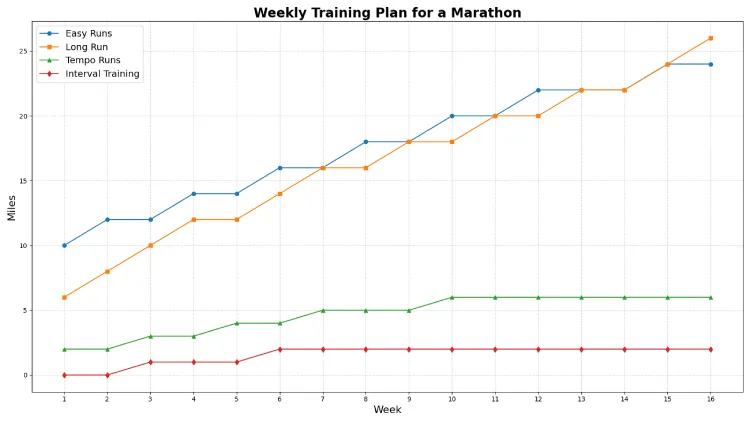
The average training week of a marathon training program will consist of:
- Multiple easy runs
- One long run
- One quality session (tempo or intervals).
- Strength training sessions
- Daily mobility work
The majority of them are simple mileage, which is consistent with the principles of endurance training that focus on low-intensity volume.
First-time marathoners can train in a few months to be prepared to run the marathon. Within the context of exercise adaptation, it may take between four and six months or more to build up enough endurance to be able to safely execute a marathon as a complete beginner.
Injury Awareness Runner Knee and Overuse Prevention
Knee joint Stress repetitions on the knee joint commonly result in Runner’s knee, which is a type of overuse injury. It may be because of weak hips, inappropriate mechanics or a rapid growth of training volume.
The use of exercise involved in prevention entails:
- Enhancing butt and thigh muscles.
- Improving hip mobility
- Minimisation of over-intensity.
Learning the injury mechanics is also a necessary component of learning to run a marathon safely.
Walking, Stepwise Progressive, and Novice Accessibility
A significant number of people who are first-time marathon runners use walking as a strategic move. The plan enables muscles to rest briefly, and forward progression is achieved.
Exercise science: Alternating running with walking:
- Reduces muscular fatigue
- Lowers joint stress
- Extends endurance capacity
This renders the marathon running slightly approachable even to absolute beginners due to the progressive training.

Final Thoughts
Knowing how to run a marathon is a physical adjustment program that is made through continuous practice, patience, and a smart choice of exercises. The majority of training experience should not be overwhelming. The strength exercises save the body, the mobility exercises preserve the quality of movement, and the recovery exercises help the adaptation to take place.
Marathon cannot be won by intensity alone; months of low-stress movement will prepare the body to withstand, and that will teach the body to work. Through advancement in exercise, even the novices can safely build the physical ability needed to go the marathon distance.
After all, it all depends on training the body over time, recovery, and time to adapt to it one step at a time, which makes it possible to run a marathon.
Frequently Asked Questions
1. Is it possible to teach a total amateur how to run a marathon?
Yes. Providing a slow progress in exercises, running without challenges, planning the walk, and the correct recovery, a full beginner may learn how to become a safe investor in a marathon. Countlessness is important instead of speed or experience.
2. Is it okay to walk when training for marathons?
Absolutely. Another training practice that is beneficial for training how to run a marathon is walking. Walk breaks, which are scheduled, decrease exhaustion, conserve the joints and enable the runners to run long distances.
3. What is the average duration of the marathon preparation?
It takes most novices roughly four or six months of training to run a marathon. This enables the body to adjust to high levels of running and physical exercise.
4. What are the most important injuries they need to watch out for in beginners?
One of the most prevalent injuries that result from marathons is runner’s knee. It is prevented by training, doing mobility exercises, and running specific seconds to avoid it, and additional exercises enhance understanding of how to run a marathon.