
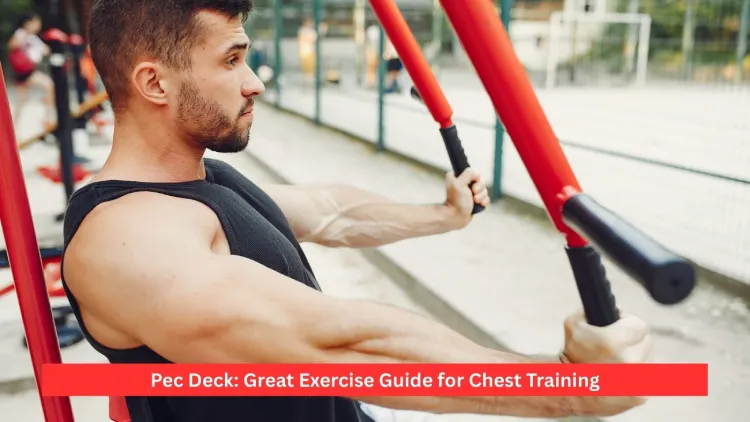

Pec deck is a good exercise that contributes to muscle size, improvement of contraction power, and the appearance of muscles in the chest. It directly compensates the pectoral muscles by pushing against the arms inward, which decreases the momentum. In the case of safe technique and balanced training, it contributes to muscle development and contributes to reducing the risk of injuries.
- What Is the Pec Deck Exercise?
- Worked Muscles in Pec Deck Exercises
- The Pec Deck Exercise and How To Do It Properly
- Pec Deck Exercises Advantages
- Pec Deck Exercise Variations
- Pec Deck Workout Sets and Reps
- Best Placement in a Workout
- Pec Deck Exercise Tips for Better Results
- Common Pec Deck Mistakes
- Pec Deck vs Chest Fly (Dumbbells)
- Sample Pec Deck Chest Workout
- Who Should Use Pec Deck Exercises?
- Safety Guidelines
- Final Thoughts
- Frequently Asked Questions
What Is the Pec Deck Exercise?
Pec deck exercise refers to a type of chest movement done in a machine motion to target the pectoral muscles by a facilitated arc movement. This movement involves mainly squeezing the chest muscles together as opposed to using several muscles at a given time, as is the case with compound pressing exercises.
The movement is very similar to that of a chest fly that involves the arms going inward after being in a fully extended posture towards the middle of the body. Since the machine determines the movement path, lifters are able to keep constant tension during the repetition that is very necessary with regard to muscle hypertrophy.
The fact that the pec deck exercise eliminates the demands of balancing is one of the reasons why it is still popular in structured training programs. Free-weight exercises also demand stabilisers to manage the movement; however, in this case, the resistance remains constant and thus the lifter is in a position to concentrate on the quality of contraction.
In its proper execution, the movement produces great stimulation within the chest muscles that shape and define the upper body. The training programs incorporate it either following heavy presses or as a concluding exercise to exhaust the chest muscles totally.
Worked Muscles in Pec Deck Exercises
Pec deck majorly activates the muscles that help to draw the arms to the mid-point of the body. This movement is referred to as horizontal adduction, and it contributes significantly towards the development of the chest.
Primary Muscles
The primary muscle is the pectoralis major that constitutes a major part of the chest. The sternal fibres and the clavicular fibres all play a role in the movement, as they assist in the provision of the thickness and definition of the chest.
The activation can be felt powerfully in the inner chest part of the body since maximum contraction is realized in the time that the handles come into contact during exercise.
Secondary Muscles
Isolation-oriented, nevertheless, supporting muscles aid:
- Arm positioning is stabilised on the front shoulders.
- Biceps assist in ensuring the angle of the elbow.
- Serratus anterior helps in controlling the shoulders.
- Core muscles stabilize position on the seat.
Since stabilisation requirements are lower than dumbbell flies, the pec deck enables the lifters to gain a better comprehension of the muscles of the chest contracting as they should. This renders it so handy to those who have not learned muscle engagement yet.

The Pec Deck Exercise and How To Do It Properly
The correct form will make the exercise either an efficient muscle-building process or a load towards the shoulders.
Step-by-Step Instructions
- Raise the seat height to position handles at the mid-chest position.
- Sit in the neutral position on the spine, with the shoulders against the pad.
- Open machine design is one where grip handles or place forearms on pads.
- Keep a low bend in the elbows.
- Bend the arms towards the centre until the hands come into contact with each other.
- Wait a moment, and press the muscle of the chest.
- Control Return slowly to the starting position.
Movement control is the most significant one. Rapid repetitions cause a decrease in muscle tension and inhibit growth.
Breathing Technique
- Breathing enhances performance and stability:
- Breathe out in the squeezing stage.
- Breathe in and resume the stretch position.
Systematic breathing allows keeping to the same rhythm and avoids unwarranted fatigue.

Pec Deck Exercises Advantages
1. Strong Chest Isolation
The assisted motion makes sure that it was the chest muscles that did most of the work. This is applied to those lifters who find it hard to feel their chest when executing their pressing exercises.
2. Better Mind-Muscle Connection
Since the balance requires are low, the trainees are taught how to contract their chest consciously. When this bond is developed, it is usually more likely to accelerate muscle growth with time.
3. Reduced Injury Risk
The smooth movement reduces the possibility of abnormal angles of the joints. When properly set up, the risk of strain in the shoulders of the flyers is usually less than when flying free.
4. Perfect for Muscle Hypertrophy
The resistance is maintained on the chest during the repetition. The muscle fibres are also kept active, and this advances growth.
5. Beginner-Friendly Exercise
Pressing movements may be challenging to learn and use among beginners. Pec deck offers a conducive environment to train the chest activation without a heavy load of coordination,n and that is why it can be used in the initial training stages.
Pec Deck Exercise Variations
Intensity and muscle recruitment can be changed depending on the change in the execution style.
1. Standard Pec Deck Fly
This traditional version is dedicated to harmonious movements and the complete scope of movement. It is usually utilised when doing hypertrophic exercises.
2. Single-Arm Pec Deck
One-sided training better enhances symmetry and corrects left vs right chest imbalances of strength.
Unilateral training also intensifies the involvement of the core to a small degree since the body is resistant to rotation.
3. Slow Tempo Pec Deck
Reducing the osseous phase to three or four seconds is a tremendous rate of time under tension. This is a great technique for expanding muscles and stamina.
4. Partial Range Pec Deck
The toughest range to work with is the greatest contraction range that results in severe muscle burn. This variant is a finishing method that is common among advanced lifters, done after heavier activities.

Pec Deck Workout Sets and Reps
Training variables influence muscle adaptation.
| Goal | Sets | Reps | Rest Time |
| Muscle Growth | 3–4 | 10–15 | 60 sec |
| Strength Endurance | 3 | 15–20 | 45 sec |
| Beginner Training | 2–3 | 12–15 | 60 sec |
| Finisher Exercise | 3 | 15–20 | 30 sec |
The moderate weight under control is better. Overloading usually decreases the use of the chest and excessively increases the use of the shoulder.
Most bench pressers also ponder whether they need heavier weights to make fly movements. Controlled moderate resistance is more effective in most cases as compared to maximal weight, to the extent that the focus is on contraction and not the pressing strength.
Best Placement in a Workout
The pec deck will be inserted in various stages of a training routine based on the objectives of training, fitness and the program plan. Since it is an isolation exercise, it can be applied strategically to warm up muscles, build volume of training, or exhaust muscles of the chest entirely at the conclusion of an exercise. Nicely placed exercises prevent undue fatigue sooner in the exercise, yet maximise the likelihood of muscle activity.
As a Warm-Up
Light pec deck sets, as a warm-up exercise to a heavy workout, induce the chest muscles to work first before the heavy exercises. This will enhance blood circulation, enhance the range of motion in the joints, and enhance the mind-muscle correlation. With the chest being correctly stimulated, the exercises such as presses and push-ups are more precise and successful.
Warm-up sets should be gentle and must be technique-oriented as opposed to fatigue. Doing 1 2 sets with more repetitions warms up muscle fibres without consuming the energy required to perform heavy lifts.
Mid-Workout Isolation
The pec deck is incredibly effective following challenges like bench presses or push-ups, which are considered compound exercises. At this point, the muscles of the chest are already partially tired, and it is the presence of isolation work that can be used to engage other muscles that might not have been fully engaged previously.
The use of pec deck sets during training is useful to aid in magnifying the training volume and to accentuate the chest contraction. This position is the best when targeting hypertrophy since it is a combination of strength exercises and controlled isolation of muscles.
Workout Finisher
Owners of pec deck refer to it as a final workout to work the muscles of the chest to the end. The metabolic stress and muscle burn are caused by high-repetition sets and controlled tempo, which are factors resulting in muscle growth.
Finisher sets are usually of low weight and have less time to rest. It does not mean lifting heavy, but a continuous tension till the muscles are at maximum fatigue, which assists in encouraging further muscle adaptation at the workout completion.

Pec Deck Exercise Tips for Better Results
- Even minor changes have enormous benefits on efficacy.
- Shoulders are to be kept down and loose.
- Avoid locking elbows.
- Attention should be on chest squeezing rather than pushing of the arms.
- Use slow controlled motion.
- Prevent the collision of plates at the point of touching to maintain tension.
Stability is more significant than the seriousness of weight. Graduate overload must be undertaken in bits via better management, repetitions or an increase in arrhythmia.
To gain a bigger chest in a short time, it is important to do a combination of proper nutrition, sufficient recovery, and a gradual increase in the amount of training. Bad recovery habits can never be substituted for exercises.
Common Pec Deck Mistakes
Most lifters decrease the results because they execute the movement in the wrong manner.
- Using Too Much Weight: Excess weight creates momentum and shoulder compensation. The isolation exercises must focus on muscle tension and not on ego lifting.
- Bringing Arms Too Far Back: Overstretching causes strain on the shoulder joints and can result in discomfort.
- Leaning Forward: This decreases the chest involvement and reroutes the work to the shoulders.
- Fast Repeats: Velocity kills any moderate strains that are required in muscular development.
- Neglecting Recovery: It is of no benefit to train so hard each day that your training growth does not increase. Not during fatigue in weakening, the muscles are developed in the recovery period. The hypertraining may decrease the performance, stall the development and put the person at greater risk of injury.
Pec Deck vs Chest Fly (Dumbbells)
| Feature | Pec Deck | Dumbbell Fly |
| Stability | High | Moderate |
| Injury Risk | Lower | Higher |
| Muscle Isolation | Excellent | Good |
| Range Control | Fixed | Variable |
| Beginner Friendly | Yes | Moderate |
The two exercises involve similar patterns of movement, i.e. they are biomechanically similar to each other. Nevertheless, they do not coincide. The flies require more stabilization with the Dumbbell version, whereas machines do not change their resistance.
Dumbbell flies can be more difficult for some lifters since they have to manage the weight in two or three directions. The pec deck makes the control less complex, giving it the capability to focus more on contraction.
Sample Pec Deck Chest Workout
Workout Plan
- Push-Ups – 3 × 12 reps
- Bench Press – 4 × 8–10 reps
- Incline Press – 3 × 10 reps
- Pec Deck Fly – 3 × 12–15 reps
- Slow Tempo Pec Deck – 2 × 15 reps
Push-ups, bench presses, and fly variations are some of the most common exercises in the chest that are usually regarded as the foundational exercises owing to their mutual ability to strengthen, enhance endurance and remuscularization.
The extremely high volumes of push-ups each day are likely to enhance endurance but not give the utmost growth to the chest unless the progressive overload and recovery are handled correctly.
Who Should Use Pec Deck Exercises?
The exercise is almost an appropriate exercise for any fitness standard.
- Beginners’ training chest activation.
- Average lifters are enhancing their body size.
- advanced bodybuilders who wish to get isolated.
- Those who have been back to work after a training vacation.
Chest training is particularly beneficial to women as strengthened chest muscles enhance posture, stable shoulders and upper-body strength. Exercises based on the chest do not adversely influence body shape, but rather help in the development of the muscles in a balanced way.
Safety Guidelines
- Pre-setting machine before use.
- Shake off the coldness in the shoulders.
- There should be no sudden jerking moves.
- Stop if sharp pain occurs.
- Sit in a restrained position.
The symptoms of overtraining are constant soreness, decreased strength, insomnia and loss of motivation. Hearing recovery clues avert untimely advances.

Final Thoughts
Pec deck is one of the most useful exercises for chest isolation. The directed movement enables concentrated muscle functioning, a more secure training mechanism, and predictable resistance with quantifiable force during repetition. It can be applied successfully with intelligent use, whether by the novice in mastery of technique or by the advanced lifter in detailing the muscles.
A well-built chest is achieved not through excessive volumes of chest programming but through a balanced one. Having muscles overworked, being too heavy to be able to lift them, or even failure to rest after hard work can restrict progress more than lack of effort. A combination of presses and isolation exercises, proper nutrition, and rest will result in consistent improvement.
The pec deck will be an effective piece of equipment in developing the chest when it is used together with complex lifts and program concepts like progressive overload and recovery management. Regular exercise and proper use will ensure muscle development, strength balance, and overall upper-body training performance.
Frequently Asked Questions
1. Is the pec deck appropriate for a beginner?
The pec deck is easy to use as a beginner, yes, as the machine points out the movement path and less balance and coordination are required. This enables new lifters to learn how to activate the chest correctly and establish a great mind-muscle association, before advancing to more complicated exercises.
2. Is the pec deck equivalent to the chest fly?
Pec deck exercises have the same movement pattern as the chest fly, although, of course, they are not identical. The dumbbell chest fly uses a greater amount of stabilisation and control, whereas the pec deck offers a given degree of motion with a fixed amount of resistance to allow the same degree of control, thus resulting in the ability to maintain the form.
3. Should you work heavily on pec deck exercises?
Markedly, moderate weight tends to work better compared to heavy weights on the pec deck. The objective is regulated muscular contraction as opposed to peak strength output. Excessive weight usually further displaces the load off the chest and affects the shoulders more.
4. Do you overwork your chest muscles?
Yes, overtraining of the chest muscles may occur as a result of training them too often with insufficient rest. Symptoms involve persistent pain, loss of strength, weakness and retarded development. Rest between training sessions assists the muscles in recovering and developing better.