
Yoga Nidra is a form of yoga which is done lying on the ground and is without movement. It systematically soothes the muscles, controls the breathing, and relaxes the nervous system, which provides sufficient time to rest without physical activity. The 30-minute session may come as several hours of rest, which would help to decrease fatigue, enhance sleep, eliminate tension, and aid in recovery among beginners, athletes, and people who want to relax their whole body.
- What Is Yoga Nidra as an Exercise?
- Key Physical Goals of Yoga Nidra
- Yoga Nidra Starting Pose (Exercise Position)
- Basic Components of Yoga Nidra Exercise
- Yoga Nidra Recovery Exercise
- Advantages of Yoga Nidra Exercises
- Yoga Nidra for different degrees of fitness
- Common Mistakes to Avoid
- Safety Guidelines
- How Frequently do You Practice Yoga Nidra?
- Yoga Nidra vs Other Recovery Workouts
- Final Thoughts
- Frequently Asked Questions
What Is Yoga Nidra as an Exercise?
Yoga Nidra is a form of exercise that does not imply movement; it is aimed at inducing the natural healing process of the body. Unlike classical practices that are based on contraction and straining, Yoga Nidra implementation is based on purposeful stillness to mobilise unwarranted muscle activities and soothe the stress response.
When engaged in Yoga Nidra, the brain activity changes to lower cortical levels. This movement enables complete softening of muscles, connective tissues, and the joints. Due to the lack of stress on the body, it is also a common practice to practice Yoga Nidra when regular exercise cannot be performed, e.g. during recovery from an injury or in case of extreme exhaustion.
Yoga Nidra is a practice which can be performed on its own; as a result, it is open to beginners who may not be ready to embrace the rigorous physical exercises.

Key Physical Goals of Yoga Nidra
Deep physical restoration is the major purpose of Yoga Nidra activities. Yoga Nidra improves recovery of the body after exertion as opposed to developing strength or endurance.
The major measurable goals are:
- Taking highly-tensed muscles and guarding.
- Maintaining the balance of the nervous system.
- Enhancing muscle repair with regard to sleep.
- Reducing the physical stress levels because of cortisol.
- Getting rid of tension patterns held in the body.
Yoga Nidra is also used to manage involuntary stress reactions that cause muscles to be contracted subtly all over the day, particularly the hips, shoulders, jaw and lower back.
Yoga Nidra Starting Pose (Exercise Position)
Yoga Nidra would require a proper arrangement.
Required Posture
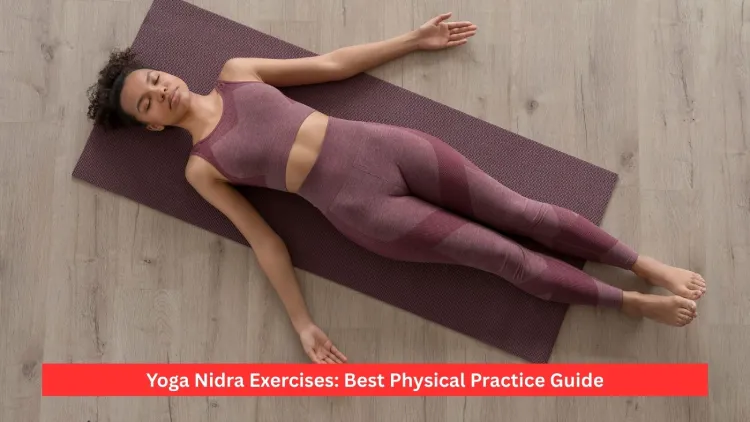
- Rest on your back upon a hard surface.
- Let the feet fall out of their natural hour.
- Hold the arms in the slightly bent but facing-up position.
- Money pose: Keep the spine and head straight.
- Close your eyes gently.
Supportive Adjustments
Proposals may be more comfortable and strain-relieving:
- When putting the lower-back strain, a bolster, or pillow under the knees.
- A thin blanket does not allow body temperatures to decrease.
- Under the neck, a small towel can be used to aid in its alignment.
Comfort also diminishes underlying muscle action, actually permitting Yoga Nidra to be more proficient.

Basic Components of Yoga Nidra Exercise
Yoga Nidra is a guided exercise that can take the body into profound rest, but not sleeping, although alertness is still recommended.
1. Progressive Muscle Release
This step is aimed at the deliberate loosening of muscle groups as opposed to stretching them. The awareness moves slowly all over the body, and with the body, the muscles get soft without any strain.
This often falls as part of the feet, calves, thighs, hips, spine, shoulders, arms, neck, and face. This will aid in the inhibition of protective muscle tension usually associated with stress and trauma.
When muscles are releasing, they can experience body signs of warmth or heaviness or spontaneous twitching or some shaking- some indication that tension is no longer in the body.
2. Full Body Scan Exercise
The body scan is a neuromuscular body awareness exercise. Being conscious flow in the body without any judgment of each part of the body.
This form of scan enhances communication between the muscles and the brain. With time, it assists in locating where tension is always stored, like in the hips or jaw.
Hips and especially are the parts of the body that are believed to hold emotive tension which could be released over time with a series of repeated Yoga Nidra.
3. Breath Regulation Exercise
Yoga Nidra involves slow and natural breathing. Expiration is not spoken but followed softly.
The stronger the breath, the better the oxygen supply becomes, the lower the heart rate, and the energy consumed by muscles decreases. This condition promotes the discharge of exaggerated tension and increases the quality of sleep.
Presence awareness also aids in reducing anxiety, as does the 3-3-3 technique of grounding, which reminds an individual to take their time and focus on the present by breathing slowly and consciously.
4. Physical Recovery Sensory Withdrawal
Withdrawal can help the body to become less responsive to external stimuli. News, feelings, and thoughts become less important, and one can have deeper physical rest.
This is the level at which Yoga Nidra and relaxation differ greatly. The nervous system goes into a similar state as the initial sleep cycles, which aid in repairing tissues and hormonal processes.
5. Stillness Endurance Exercise
The deep rest tolerability is created by staying still during Yoga Nidra. Most individuals subconsciously oppose stillness, and this makes muscles active without the need to be.
Practice makes it a less difficult endeavour, and the body reaches deeper levels of rest. This is especially a good idea among people working on patterns of chronic stress or tension related to trauma.
Yoga Nidra Recovery Exercise
Yoga Nidra serves as a complicated recreational exercise. One in Yoga Nidra can be functional in the habitat of sleep for about 30 minutes, being equal to many hours of quality sleep, since the body bypasses the lighter sleep phases and immediately enters the deep restorative ones.
The activity of the brainwaves during Yoga Nidra is reduced, and the nervous system is no longer engaged in the fight-or-flight mode. This condition improves the restoration of muscles, immunity, and the mind.
It is also normal to sleep in the process of Yoga Nidra, particularly among beginners. Although staying awake offers the greatest advantage, short sleep is not detrimental to the physical rejuvenation variables.
Advantages of Yoga Nidra Exercises
Muscular Benefits
It is the practice of Yoga Nidra that will decrease muscle stiffness, promote circulation, and flexibilities as it decreases the resting tone in muscles. It is especially of benefit on relieving tension in the hips, shoulders and lower back.
Nervous System Benefits
The routine paves the way to a balance between activation and rest. This works better to coordinate, calm body tension that is like anxiety and overall physical strength.
Trauma‑Related Physical Release
The trauma is commonly trapped in the body in the form of chronic muscular tension. Yoga Nidra aids in the safe discharge in terms of stillness, attention, and breath. The physical indications of release can be trembling, emotional-waves, yawning, or deep sighing.

Yoga Nidra for different degrees of fitness
Beginners
Beginners are advised to begin with brief sessions of Yoga Nidra, ranging between 10-15 minutes, where the body and nervous system would slowly become comfortable with deep stillness. The beginner’s guide to Yoga Nidra requires making a certain point that involves focusing on physical comfort, proper body positioning, and mere awareness instead of time. In the first sessions, it is necessary to concentrate on soft body scan and natural breath awareness, which eases muscle tension on the surface and makes them less fidgety. Restoration of relaxation, quality of sleep, and alleviation of physical fatigue, experienced by those who are just starting, are typically noticed over time.
Active Individuals
Yoga Nidra sessions of 20 minutes to 30 minutes are best practised by physically active persons after an exercise or on rest days. On this plane, Yoga Nidra can be used as an effective recovery practice by restoring the nervous system and speeding up muscle recovery after an exercise. It goes hand in hand with walking, stretching, and other activities that are less strenuous by enhancing circulation and the overall experience of tightness in the residual muscle tissues. The work helps eliminate overtraining since one gets to balance between physical work and proper recovery, thus able to get down to business easily.
Athletes
Athletes tend to use Yoga Nidra at deloads, high-stress training periods or the time of an injury. In the case of athletes, Yoga Nidra enhances the efficiency of the nervous system that is of vital importance to coordination, reaction time, and performance. Yoga Nidra is possible as it does not exert any mechanical strain on the body, enabling a person to rest and improve without influencing gains of strength and conditioning. This is particularly useful where a lower amount of physical training is required, and the mind and body have to be prepared.
Common Mistakes to Avoid
- Training on too soft a surface.
- Achieving coldness of the body.
- Forcing breathing patterns
- It wants quick results.
- Neglect of warning symptoms.
- Stability is even more important than time.
Safety Guidelines
Yoga Nidra can typically be regarded as a low-load, safe, and low-risk form of recovery practice among the majority of the population since it has no physical burden on the joints, muscles, or the cardiovascular system. Nonetheless, physically or emotionally, those individuals who have a background of traumatic experiences that cannot be overcome might have more intense sensations during practice. With the body turning into a state of deep relaxation, old tension patterns may emerge, and they can manifest themselves in various ways, which include: tremors in muscles, quick breathing, emotional swings or an extreme alertness of the body. These are all normal reactions of the body in releasing itself, but they must never be overwhelming.
In case the discomfort gets worse, it is better to end the session sooner, come back to practising breathing slowly and steadily, or ease out of the practice. Novices and trauma victims might use shorter sessions guided and increased with time. A consultation with a skilled professional could help you be even more secure.
There are mild side effects that may be experienced as the body gets accustomed to the routine of the Yoga Nidra. These may consist of heightened tension in the moment, intense dreams, fatigue, or that one feels heavy in the post-session. These effects usually fade during the process of getting used to it, and now recovery patterns are normal. Being well hearkened to the body and keeping Yoga Nidra to a regular, moderate practice will keep this exercise both sustaining and restive.

How Frequently do You Practice Yoga Nidra?
Yoga Nidra may be used on a daily basis since it imposes no physical strain on the body and does not exhaust the muscles and joints. Contrary to the old types of exercises, where days are taken to rest and recover, yoga nidra promotes recovery, which results in the safe and beneficial practice of the chosen activity. It is more important to focus on consistency than the length of a session, and even brief sessions may provide significant positive changes in physical relaxation and sleep quality.
The most appropriate time of the day to practice yoga nidra will be based on what you need to recover. Morning classes reboot the nervous system following awakening, minimise remaining muscle contractility and set a peaceful physical equilibrium for the day. Contrary to morning practice that is appropriate to counter physical and mental drowsiness before or after an exhausting sitting period or hard workouts or taxing physical activities, afternoon practice is better. It will enable the body to eradicate accumulated tension before it becomes sore or stiff.
The practice during the night and evening is especially helpful in supporting sleep. Yoga nidra is best practised at night so it can slow down the brain and lower heart rate, as well as cause the involuntary muscle tension to relax, allowing natural sleep to fall asleep. This is akin to organised sleep patterns, including the 10-5-3-2-1 technique, where the body is in a prepared state to go to bed by a gradual progression of lessening stimulation. Yoga nidra can also be used regularly to reduce the time of falling asleep as well as enhance the intensity of restorative sleep.
Yoga Nidra vs Other Recovery Workouts
The reason Yoga Nidra is different from walking and pain relief or mobility practices is that the practice does not concentrate on the length of the muscles or movement, but it works directly on the nervous system. Light mobility and walking exercises enhance circulation, lubrication in the joints and physical activity in individuals, hence being effective when one is to remain physically ready. Stretching and mobility exercises aid in the enhancement of range of movement and stiffness by means of controlled movement. Nevertheless, none of these procedures demands some sort of physical activity and energy consumption.
By comparison, yoga Nidra enhances more effective rest. It slows down the excessive body neural stimulation that maintains the muscles in a slight state of involuntary contraction even when the body is at rest. This enables the muscles to relax, reduces stress tension, and helps the body to heal in a more rapid physical healing mechanism without exerting any burden on both joints and tissues. Yoga Nidra is particularly helpful on a rest day or when one has an injury or a body that is too tired to move actively.
Yoga Nidra is a complementary practice to walking or stretching, as opposed to competition. Active recovery exercises are useful in facilitating circulation and mobility when Yoga Nidra is associated with active recovery exercises in a balanced regime. They taken together bring out a more comprehensive recovery strategy that improves long-term physical performance and resilience.

Final Thoughts
Yoga Nidra is a strong and accessible form of recovery practice in which the body gets to release the muscular tension, restore the balance, and recover deeply with ease and not strain. Through the applied stillness instead of motion, yoga nidra helps the nervous system to move into a low-suicide state where the muscles relax, circulation increases, and actual physical healing can then commence.
Yoga nidra improves the quality of sleep with frequent practice and helps release tension related to trauma, especially in such parts of the body as the hips, shoulders, and lower back. Being a non-movement exercise, it further enhances traditional fitness programs in increasing the effectiveness of the recovery process and physical resistance without creating fatigue.
Frequently Asked Questions
1: Can Yoga Nidra replace sleep?
Yoga Nidra is not a substitute for normal sleep, but can enhance the recovery process when one has restricted sleep. A low-intensity session is known to lower fatigue and nervous system tension, as well as aid muscle recovery, thus a useful daily use in addition to healthy sleep patterns.
2: Should I be able to fall asleep through Yoga Nidra?
Well, sleep is usual, more so for beginners. Although being awake is the most advantageous, short sleep does not diminish the effect of physical recovery and relaxation.
3: Does Yoga Nidra relieve physical stress/trauma tension?
Yoga Nidra assists in relaxation of stress-related physical pressure, which is accumulated in the regional parts such as the hips and shoulders. Stress patterns may be eased with time through intense relaxation and bodily awareness.
4: What is the time of seeing the results of Yoga Nidra?
Most of them get relaxed after a single session; however, with regular practice in a few weeks, they would get to sleep better, recover better and reduce muscle tension.