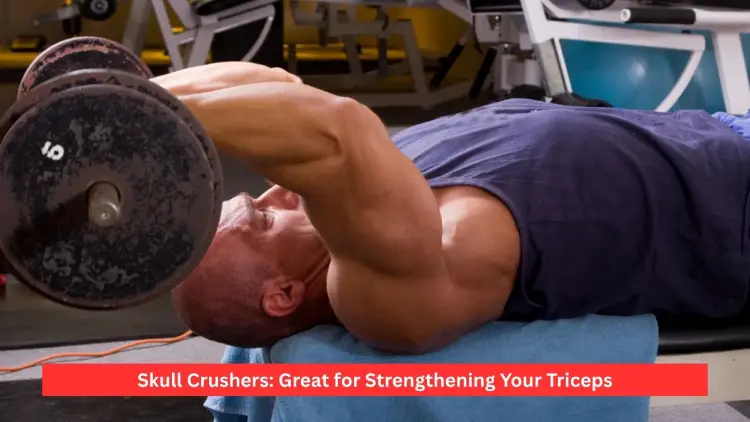

The isolation exercise is referred to as skull crushers, which help strengthen and grow all three heads of the triceps, and also improve performance in pressing and overall arm development. They are used to enhance the strength of lockouts and hypertrophy, and can be performed with the assistance of dumbbells, an EZ-bar, cables, or even on a decline bench. When done properly, they provide one of the most direct stimulations of the triceps during training.
- What Are Skull Crushers?
- Muscles Worked
- Technique for doing Skull Crushers
- 2. Dumbbell Skull Crushers
- 3. Cable Skull Crushers
- Benefits of Skull Crushers
- Common Mistakes to Avoid
- How to Build Skull Crushers into Your Workout
- Decline Skull Crushers
- Secret of the Skull Crushers
- Are Skull Crushers Hard?
- Common reasons include:
- Rushing the eccentric phase
- Variations and Difficulty of Push-Up
- Additional Knowledge (Triceps)
- Final Thoughts
- Frequently Asked Questions
What Are Skull Crushers?
Skull crushers are an isolation movement being done on a bench, and involve bringing a weight and dropping it over the forehead or slightly behind the head. Almost all the work is carried out by the triceps through the main movement of skull crushers, which is an extension of the elbows. In comparison to the compound lifts, skull crushers eliminate the use of the chest or shoulders, and, therefore, they are one of the purest methods of triggering the development of triceps.
The exercise may be executed by use of an EZ-bar, dumbbells, a cable attachment, or machines. In every variation, the movement maintains tension on the triceps during the exercise. The skull crushers are particularly popular with the athletes and bodybuilders who are interested in enhancing the pushing power of their upper bodies or in developing the shape and thickness of triceps.

Muscles Worked
Skull crushers mainly attack the triceps brachii, which consists of:
- Long head – helps to increase the size of arms and the stability of shoulders.
- Lateral head- imparts visible form and definition of horseshoes.
- Medial head –helps to give pressing support and endurance.
The major benefits of skull crushers include the fact that they are able to strike all three heads of the triceps, which most push exercises cannot easily accomplish. Since in this exercise, the elbows remain stationary and the forearms move back and forth, they execute the forearm extensors, which also help in weight stabilisation.
Technique for doing Skull Crushers
1. EZ-Bar Skull Crushers
Lie flat on a bench
- Gasping an EZ-bar bunt a slit or medium grip in the region over the breast.
- Make your elbows face upwards.
- Reduce the bar against the forehead or a little very the back.
Arnoldian: Strauss, Teillebotte, and Raguse (2012) do not specify the direction in which the bar is to be lifted to the starting position with the elbows.
Such a difference minimises the strain on the wrist and enables the majority of lifters to work with moderate and heavy weights.
2. Dumbbell Skull Crushers
- Stand with dumbbells above the chest, held with arms straight.
- Prepare dumbbells downward and sideways of your head.
- Retain the elbows and do not flare.
- Extend and squeeze at the top.
Dumbbells are better in providing a wider scope of movement and are good in correcting any strength imbalance. Yes, bonesmashers with the dumbbells are a good hypertrophic as well as stabilising aid.
3. Cable Skull Crushers
- Attach by use of a rope or straight bar.
- Rest again on a bench or kneel with your back in the direction of the stack of cables.
- Reduce the bondage at the back of the head.
- Keep stretching until the arms stretch.
Cables ensure the cable is constantly under tension, so the movement becomes easier and more difficult at every point.

Benefits of Skull Crushers
Maximum Triceps Isolation
- Skull crushers give maximum triceps action, and hence they can be used when the aim is directed at muscle development.
- Improved Pressing Strength
- Powerful triceps play a greater role in bench press, military press, dips and push-ups. Power is especially the lockout power, and it improves.
- Stimulates All Three Heads
- A balanced growth and shape will be acquired by proper execution; hence, all three tricep heads will be engaged.
Stabilisation of the forearm
The triceps do not necessarily need the stabilising muscles of the forearms to be strengthened; however, skull crushers assist in this effort. Instructional in Every Fitness.
Since one can use skull crushers with an assortment of equipment, novices and professional athletes can easily customise the difficulty.

Common Mistakes to Avoid
Elbow Flaring
Flaring causes straining of the shoulders and lessening of the triceps involvement.
Lowering to the Wrong Angle
The amount of weight can be brought too far forward or too close to the chest; this eliminates tension on the triceps.
Using Too Much Weight
This does not allow a complete range of movement and exposes one to risk.
Moving the Upper Arms
In case the arms raised move to the back or forward, then this exercise may be less efficient. Errors such as these usually make individuals fail to experience the pulling of the triceps. You will experience an overwhelming activation when you do it correctly, that is, slowly and in control lowering and very stable elbows.
How to Build Skull Crushers into Your Workout
Inclusions to skull crushers could be:
- Push day routines
- The arm exercises concentrate on the triceps.
- Upper-body training days
Accessory sessions that are strength-building.
Ideal volume:
- Muscle growth– 3-4 sets of 10-15 reps.
- 2–3 sets of 8–12 reps for strength
- An amateur must start with lighter weights until the form is acquired. Control should be made first, and heavy lifting can be left to later.
Decline Skull Crushers
Decline skull crushers position the arms in an overstretched orientation, thus self-activating long-heads. They are carried out through establishing a bench at a decline, by lying back and undertaking the same movement pattern. The smaller the angle of decline, the harder the lift is; hence, the reason why most lifters prefer skull crushers on a decline.

Secret of the Skull Crushers
Skull crushers use the triceps as they extend them to their full length without any part of them giving way. This is a significant contributor to muscle growth, and this is one of the reasons that skull crushers are regarded as one of the best movements to isolate the triceps.
Other lifters would inquire, Is the best exercise for triceps skull crushers? Although dips, close-grip bench press, and overhead extensions are remarkable, it is because he considers skull crushers as the best source of direct elbow-extension isolation; they are considered one of the best exercises in pure hypertrophy.
Are Skull Crushers Hard?
Skull crushers may be difficult as they can make a person feel like:
- They work on a single group of muscles without propulsion.
- They depend much on the stability of the joints.
- They focus on the unconventional, which is a physically demanding element.
A failure on a skull crusher normally occurs when you are unable to come all the way forward with the elbows under control. Without involving other muscles, the weight will not even lift.
The Wonders of Your Arm and Why You Couldn’t Swear Your Triceps are At Work.
Common reasons include:
- Elbows drifting outward
- Reducing the weight to an extent too near the face.
- Taking on a load to request the help of shoulders.
Rushing the eccentric phase
- The eccentric phase of interest will be slow lowering and strict elbow positioning; this will be resolved in a matter of time.
- Other Training Concepts related to Triceps and Push Movements.
Although skull crushers are one of the main exercises, there is an array of training questions that are likely to be associated with pushing power, tricep building, and body weight exercises.
Variations and Difficulty of Push-Up
- Diamond push-ups involve the use of triceps intensively, whereby the hands are held together.
- The push-ups are of military style, and the elbows are brought closer; the emphasis is placed on form.
- Russian push-ups are mixed up with a plank-to-dive motion, therefore, difficult.
- The most difficult kind of push-up is usually dependent on the athlete, but one-arm push-ups, as well as elevated ring push-ups, are at the top of the list of the most challenging ones.
Doing lots of push-ups, such as 1000 push-ups in a day, would develop endurance but would cause problems of overuse. A more realistic amount, like 100 per day, can aid in losing moobs around the chest, but will not work out moobs individually from overall fat loss.
High-volume training is associated with elite military personnel. The number of push-ups that Navy Seals can do can often be hundreds, with the variation depending on a person.
Additional Knowledge (Triceps)
- C7, with a certain level of C6, controls the triceps.
- Skull crushers assist in enhancing forearm stabilisers, but this is not one of the major forearm exercises.
- Skull crushers are still terrific partners of overhead extensions, dips and close-grip bench press.
When it comes to an ab exercise that is the best, the question many trainers will ask is exercises such as hanging leg raises or ab-wheel rollouts because these exercises involve a complete core contraction. These go hand in hand with skull crushers during full-body workouts.

Final Thoughts
Skull crushers are still among the best exercises for developing mass, shape and strength in triceps. Isolating the triceps and focusing on the stretch and contraction they provide gives them some perspective of concentration not available to other movements. When done correctly, including maintaining even and stable elbows, lowering, as well as a complete range of motion, skull crushers can significantly enhance the development of the arm, the strength of pressing, as well as the overall performance of the upper body. Either with a dumbbell, cable or an EZ-bar, they should always have a space in any well-timed and scheduled exercise program.
Frequently Asked Questions
1. Are triceps well done with skull crushers?
Yes, they are one of the most effective isolation exercises to have bigger and stronger triceps.
2. Between dumbbells or EZ-bar, which one is better?
Both work well. Dumbbells increase the range of motion, and the EZ-bar does not put a lot of strain on the wrists.
3. Why do I feel pain in my elbows in the case of skull crushers?
Commonly, as a result of excessive amounts of weight being used or bending of the elbows. Consider the lighter loads and have tight-fitting elbows.
4. What is the frequency of skull crushers?
The best dose for most lifters is 3-4 sets of 10-15 reps 1-2 times/week.